zugzwang

every game is a duet

20 HP

It plays chess against itself and you hear the game. A chess board's columns are lettered a to h, and those are note names, so every move is a note. White moves, black answers, the middle gets busy, the ending thins out, and checkmate is the last chord.

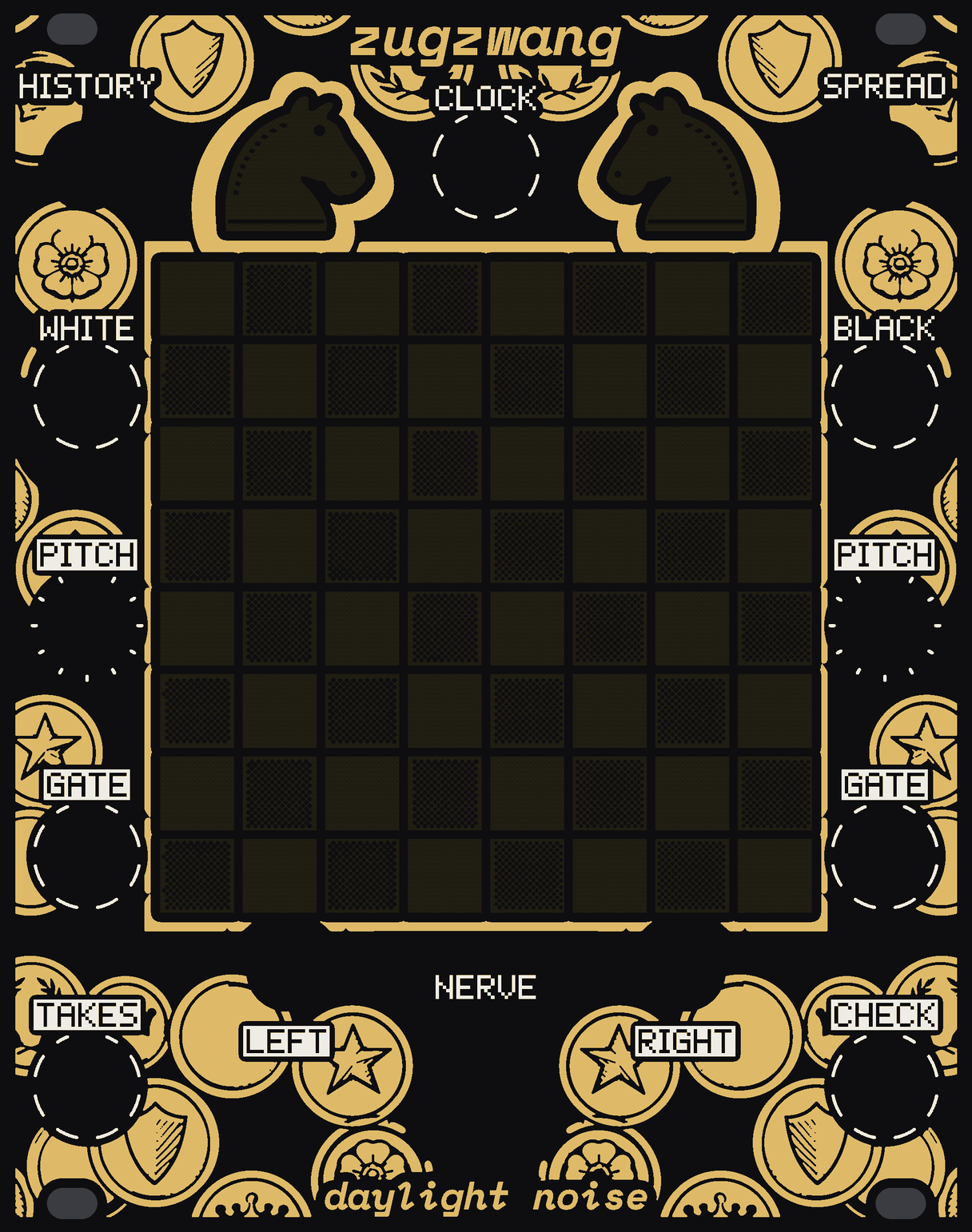
The ZUGZWANG panel, black and gold, seen from straight above: a chess board on a dark table with old gold coins spilled round it. The board fills the middle: eight by eight squares of bare glass for light in a thin border, the light squares bare and the dark squares speckled with black dots, so the board is a checker even unlit. Big round coins inked on solid gold, each with its rim and a crown, star, shield, rose or wreath, run down both edges behind the jacks and pool across the foot. At the board's head two chess knights' heads in gold rims face each other across the CLOCK jack, their glass lit from behind with a black eye and a mane (the knight of the side to move lit), the HISTORY and SPREAD knobs in the corners beside them. Under the board are NERVE, the big knob, and the LEFT and RIGHT jacks either side of it. Down the left edge are white's jacks and down the right edge black's: a gate in, a PITCH out and a GATE out each, then TAKES and CHECK in the bottom corners.

Turn a knob: drag it or tap either side of it, roll the wheel over it or use the arrow keys; a double click puts it back. The patches step on by themselves until you touch anything.

Synthesised here, as the module would make it: the game and its two voices, with a stand-in rack round them.

example patches

Everything ZUGZWANG does here is the module's own engine, to the bit. The clock, the bass, the drums and the synths round it are a stand-in rack.
One cable, a game

Patch a clock into CLOCK and LEFT and RIGHT to your mixer, and leave every knob where it is. White moves and you hear a note; black answers. A game goes somewhere: an orderly opening, a busy middle, a slow ending and a last chord. Then a new one starts, never the same twice.

A square is a note

How they play

The chess clock

Seven famous games

In a rack

Inside

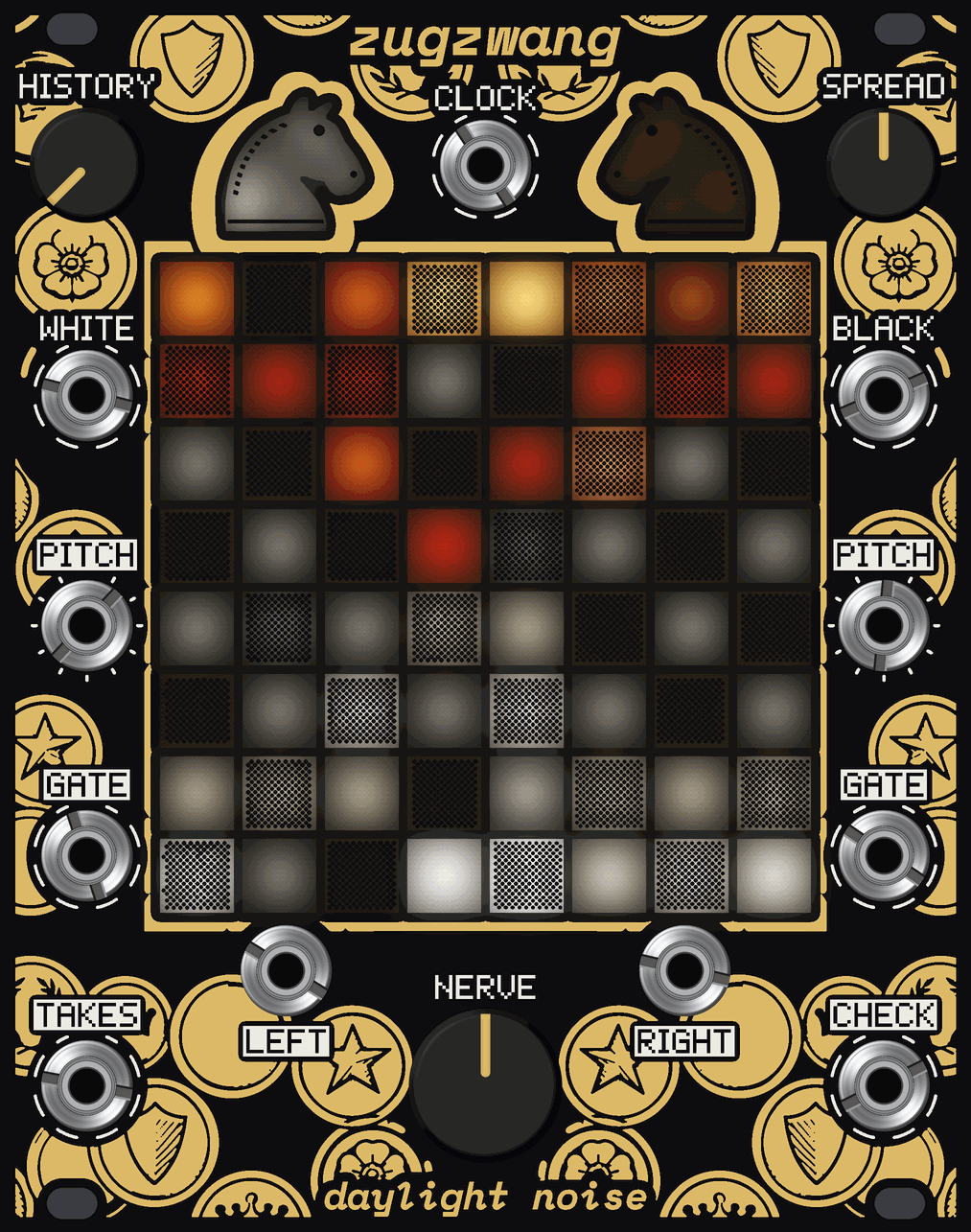
The ZUGZWANG panel lit in the middle of a game: the chess board's squares glowing warm white for white's pieces and ember for black's, the knight of the side to move lit, the gold coins round the board in gold.

Drag it or use the arrow keys to turn it; click it to take it apart.

Specs

Format

Width
20 HP
Depth
20.6 mm behind the panel
+12 V
about 74 mA dark, 164 mA playing, 204 mA at its busiest (estimated)
−12 V
about 6 mA (estimated)
+5 V
not used
Controls
three knobs: NERVE (the big one), HISTORY and SPREAD
Light
76 RGB LEDs: one under each square, six under each knight
Replaces
two sequencers, two simple voices and a trigger source for drums

Inputs

CLOCK
clock: a move every one to six pulses
WHITE
gate: white moves, on its turn
BLACK
gate: black moves, on its turn

Outputs

PITCH (white)
1 V an octave, white's note (0 V is C3)
GATE (white)
gate, 5 V while white's note sounds, 8 V for a capture
PITCH (black)
1 V an octave, black's note (0 V is C3)
GATE (black)
gate, 5 V while black's note sounds, 8 V for a capture
TAKES
trigger, 5 ms, for every capture
CHECK
trigger, 5 ms, for every check
LEFT
audio, white's voice (alone, both)
RIGHT
audio, black's voice

Engine

Brain
RP2350 at 192 MHz, both cores, 46.875 kHz: this page's engine, to the bit