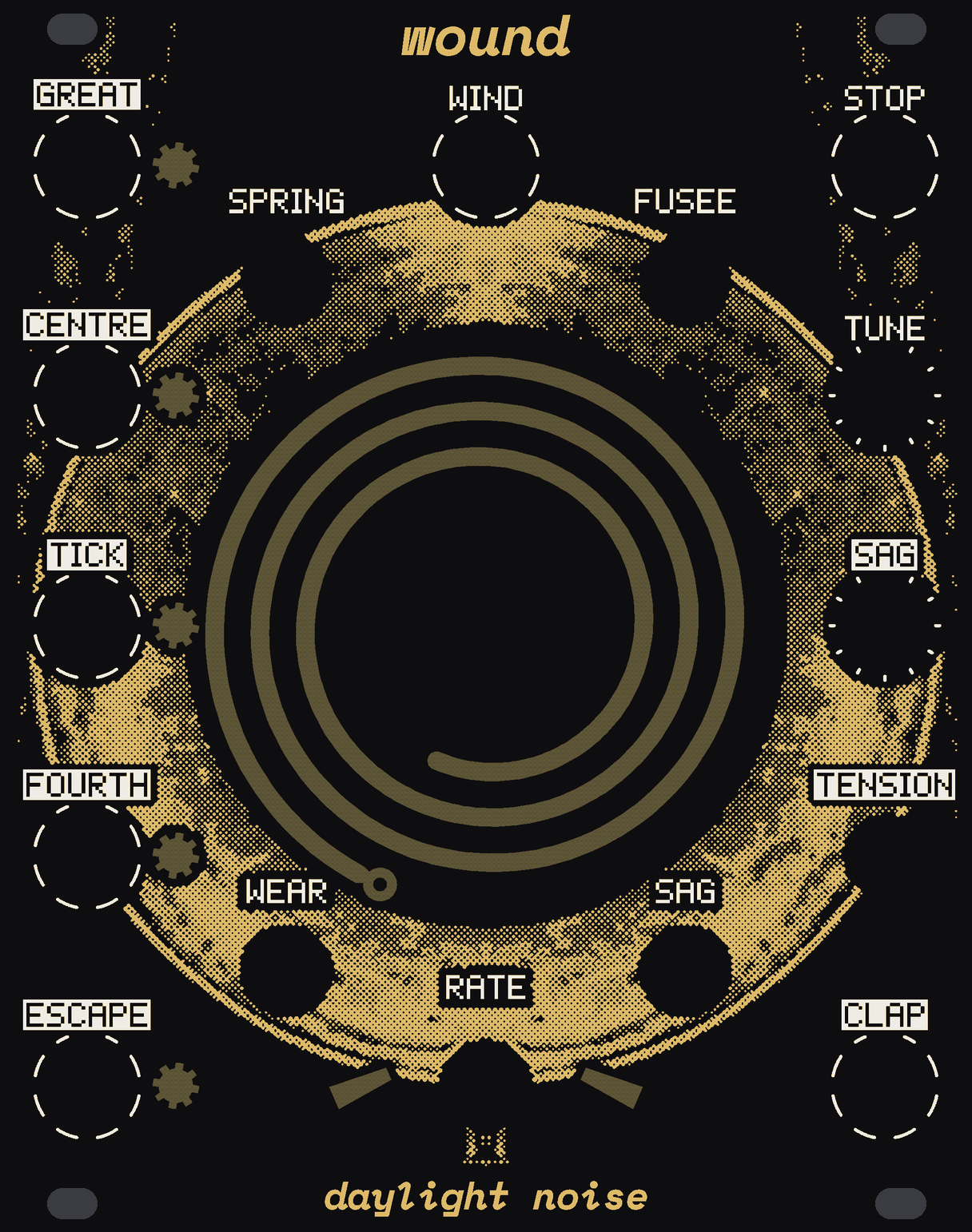
it's running down
20 HP
A crank on the panel winds a spring, and the spring runs your clock. Wound, it's a steady master clock. Let go and it starts to run down: the tempo drags and every pitch patched to it falls too, until the whole rack ends on one dragged note. Then you wind it back up.
Turn a knob: drag it or tap either side of it, roll the wheel over it or use the arrow keys; a double click puts it back. Wind it: take the crank anywhere on the spring and go round clockwise. Back the other way lets it down. Or tab to it and use the arrow keys, Page Up for a whole turn. The patches step on by themselves until you touch something.
example patches
Everything WOUND does here is its firmware's engine, running in your browser; the crank's shaft and its click are the page's. The band is a stand-in rack.
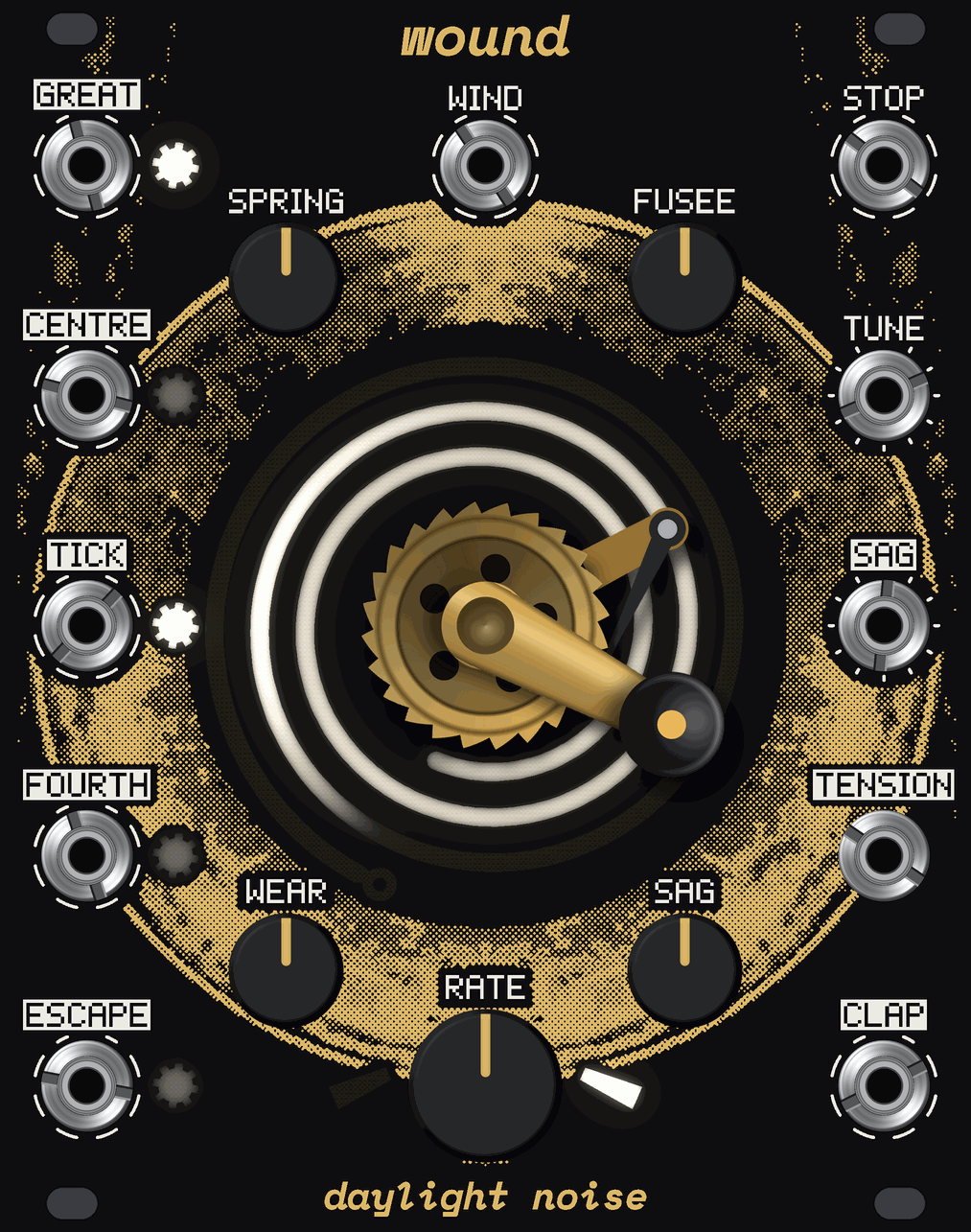
Eight turns of the crank wind it from nothing to full, at any setting. Each tick the clock runs takes a little of that back. The lit coil round the crank is what's left, running out from the hub to its hook, and a faint mark on it shows where it starts to fall.
Under the mark the tempo falls in a straight line, the way a record does. SAG is that speed as pitch. Run every oscillator from it and they all go down together with the clock.
Five wheels on one train, named for the wheels of a real clock. Each stays high for the first half of its own turn, so when the train drags, the gates drag too.
The crank is printed: a click wheel and its arm on a brass shaft, the shaft in two ball bearings held in two cups clamped through the panel, and on its back end a magnet over a sensor on the board, 1.3 mm away. One board sits 10 mm behind the panel, everything on its front. The coil's 45 LEDs light a white printed channel, so the spring reads as one line. Turned round, the panel lights from a second set, through a second baffle.
Drag it or use the arrow keys to turn it; click it to take it apart.