wormsign

keep time and it comes

20 HP

Something under the sand that listens for rhythm. Keep a steady beat and it comes, a rumble rising and the mix sinking, until it erupts at HOOK and swallows the bar. Play loose and it loses you.

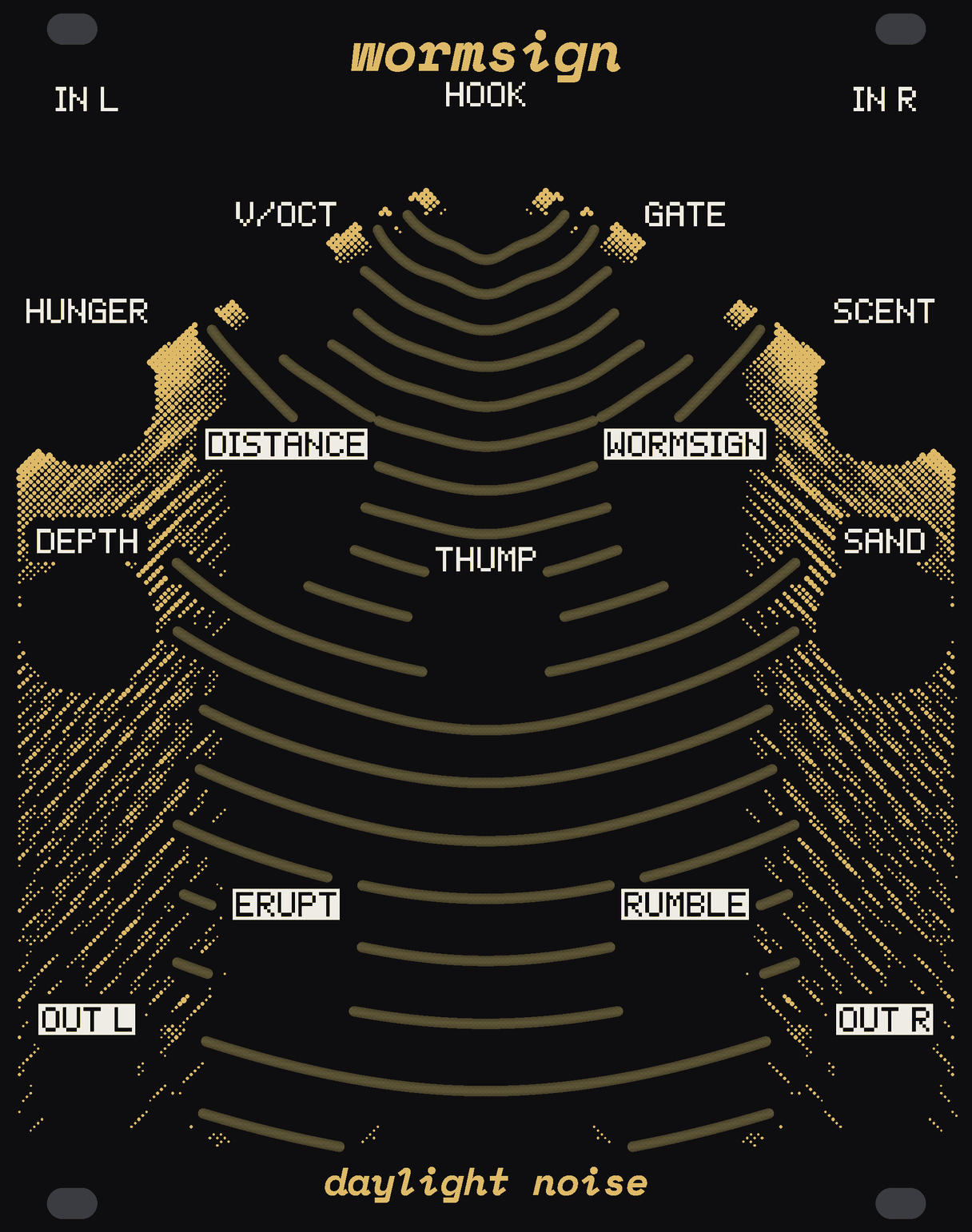
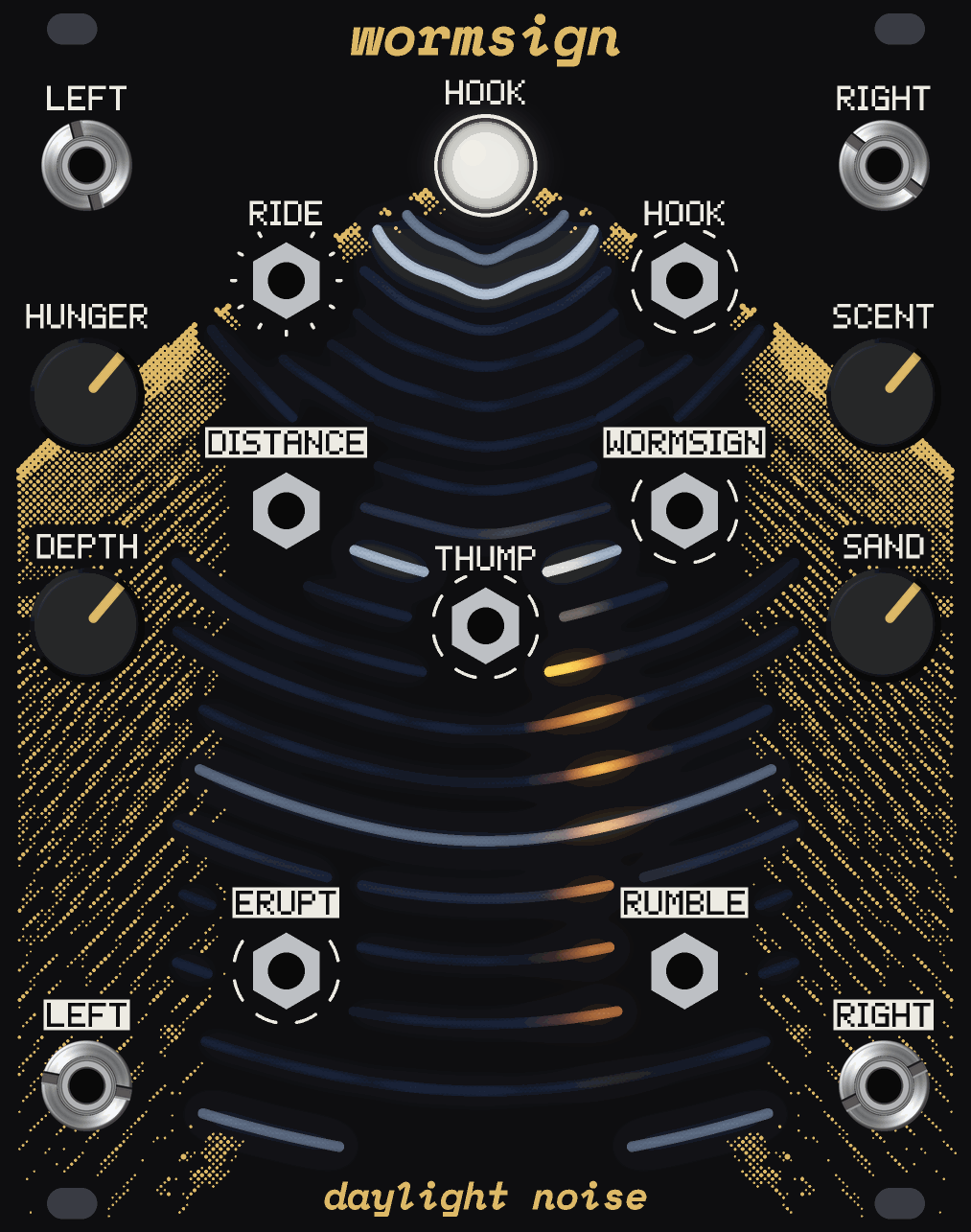
The WORMSIGN panel: black, with a dune at night in gold dots, its crest falling away either side of a round button at the top and its rippled face running down both sides. Down the middle, twenty ripples of bare circuit board spread out from the button, small near it and wider towards the foot, broken round seven jacks. White labels: HOOK on the button; RIDE and HOOK (a jack) either side of it; DISTANCE and WORMSIGN below them; THUMP in the middle; ERUPT and RUMBLE near the foot; a ring of white dashes round the HOOK jack, THUMP, WORMSIGN and ERUPT, twelve white ticks round RIDE. LEFT and RIGHT, the ins, at the top corners, HUNGER and DEPTH down the left, SCENT and SAND down the right, LEFT and RIGHT, the outs, at the bottom corners. wormsign at the top, daylight noise at the bottom.

Turn a knob: drag it or tap either side of it, roll the wheel over it or use the arrow keys; a double click puts it back. Make rock: click a jack in the sand to plug a cable into it, and click it again to pull the cable out. HOOK is a button to press and hold: press it as it erupts to ride.

The rumble, the eruption and the ride are WORMSIGN's own. The band it listens to, a goblet drum and frame drums, a plucked bass, a reed drone and an oud, playing in F with the desert's minor second, is made in the page as you listen.

example patches

The hearing, the way through the sand, the sound and the light here are WORMSIGN's own engine, the module's firmware, running in your browser: what it hears, how steady it judges you, where it goes, when it erupts and what every LED shows. The drums, the bass, the drone and the oud are a stand-in for the rest of a rack.
What calls it

Every hit it hears runs out from HOOK through the sand as a ring. It listens for how machine-like the beat is: how close each hit sits to an even grid, and whether the pattern keeps coming. The steadier the beat, the faster it comes. Swing, rush or drop a hit and it hesitates; stay loose and it loses the scent and drifts back under.

Rock

A jack in the sand with a cable in it is rock. The sand round it goes dark and the wake goes round it, so where you patch changes its way and how long you've got. Patch THUMP, DISTANCE and WORMSIGN and there's a wall right across: it prowls along it, the rumble at its loudest, and can't erupt until a cable comes out.

What it does to the mix

As it comes, a sub rumble rises under the mix and the mix starts to sink. At HOOK it erupts and swallows the mix: a huge sub drop, the mix pulled down into it, its pitch diving and its top gone. Then it goes back under and starts again.

The ride

Hit HOOK as it erupts, within a sixteenth either side, and you're on: instead of swallowing the mix, the rumble becomes a bass you play from RIDE for as long as you hold HOOK. Let go and it goes back under. Miss, and it swallows the mix as before.

What comes out

Inside

The WORMSIGN panel lit by a steady beat: pale rings running out through the sand from HOOK, and the wake, orange and white, coming up the sand towards it, with its knobs on.

Drag it or use the arrow keys to turn it; click it to take it apart.

Specs

Format

Width
20 HP
Depth
about 21 mm behind the panel, to the top of the power header (estimated)
+12 V
about 155 mA with the sand dark, about 215 mA in a tight beat, about 320 mA at the LEDs' cap (estimated)
−12 V
about 9 mA (estimated)
+5 V
not used; 10-pin header
Controls
4 knobs, a lit button

I/O

LEFT, RIGHT (ins)
audio, ±9 V full scale; RIGHT normalled to LEFT
LEFT, RIGHT (outs)
audio, held under 6 V peak
THUMP, HOOK
gate or trigger, rising over about 1.15 V
RIDE
V/OCT in: the ride's pitch, 1 V an octave, C1 at 0 V, −2 to +8 V
RUMBLE
±8 V, DC-coupled
DISTANCE
0 to 8 V, 16 bits
WORMSIGN
5 V gate
ERUPT
5 V, 10 ms
The sand
seven jacks; a cable in any of them is rock

Engine

Brain
RP2350, 46.875 kHz, 32-bit float
Hearing
each hit timed to the sample it fell on; the steadiness of the last 8 s of hits
The way
searched through the sand on a 0.5 mm grid, round every rock
Light
191 RGB LEDs under the sand, about 90 frames a second, their current capped; HOOK's own white LED
Firmware
over USB-C at the board's top edge, or the debug header on its back