wide open

stop it down

20 HP

A stereo low-pass you can watch. Its opening is a lens's iris, lit: turn APERTURE and the light shrinks to the middle as the sound darkens. SHUTTER clicks it open on every note; BLINK shuts it on the kick.

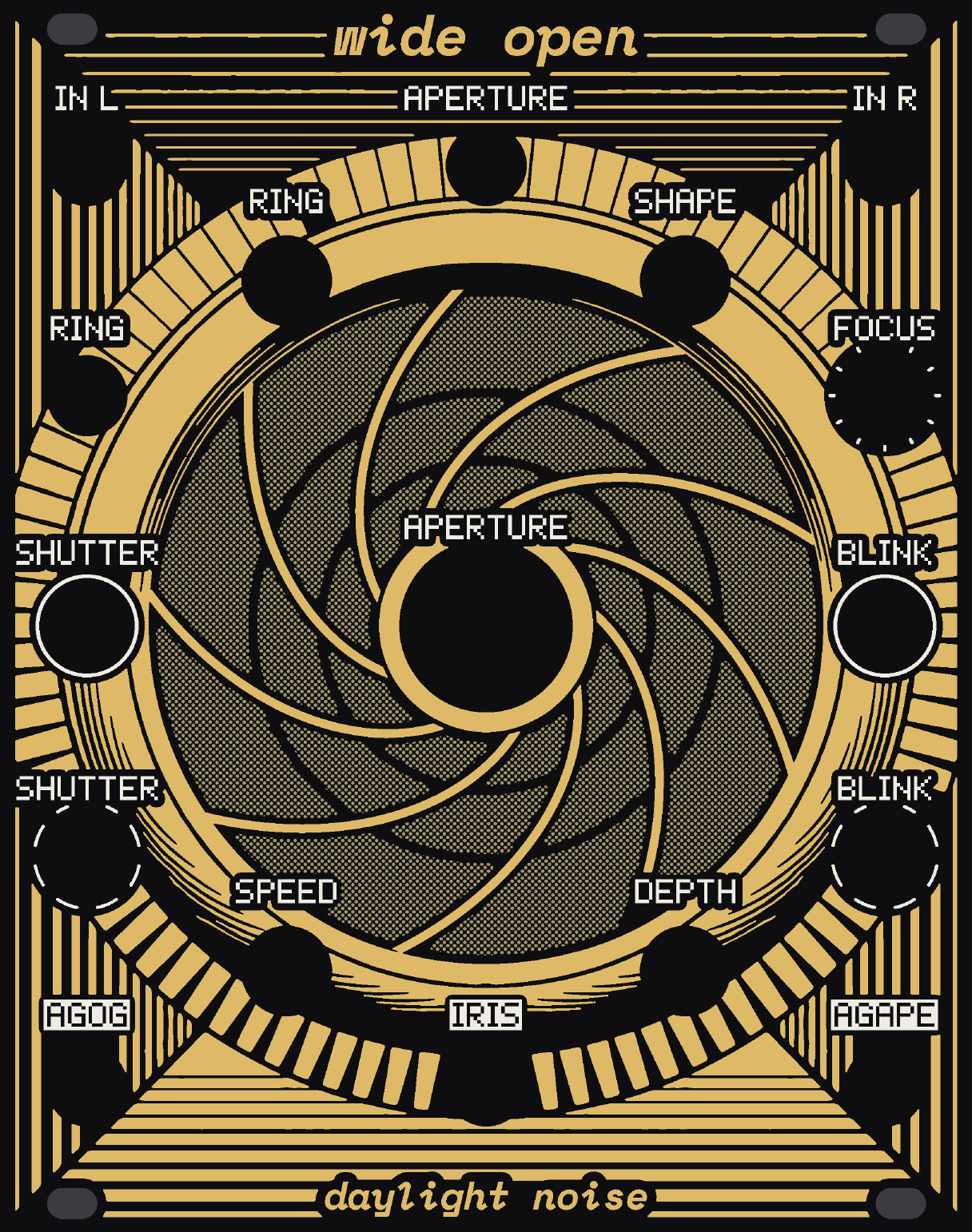
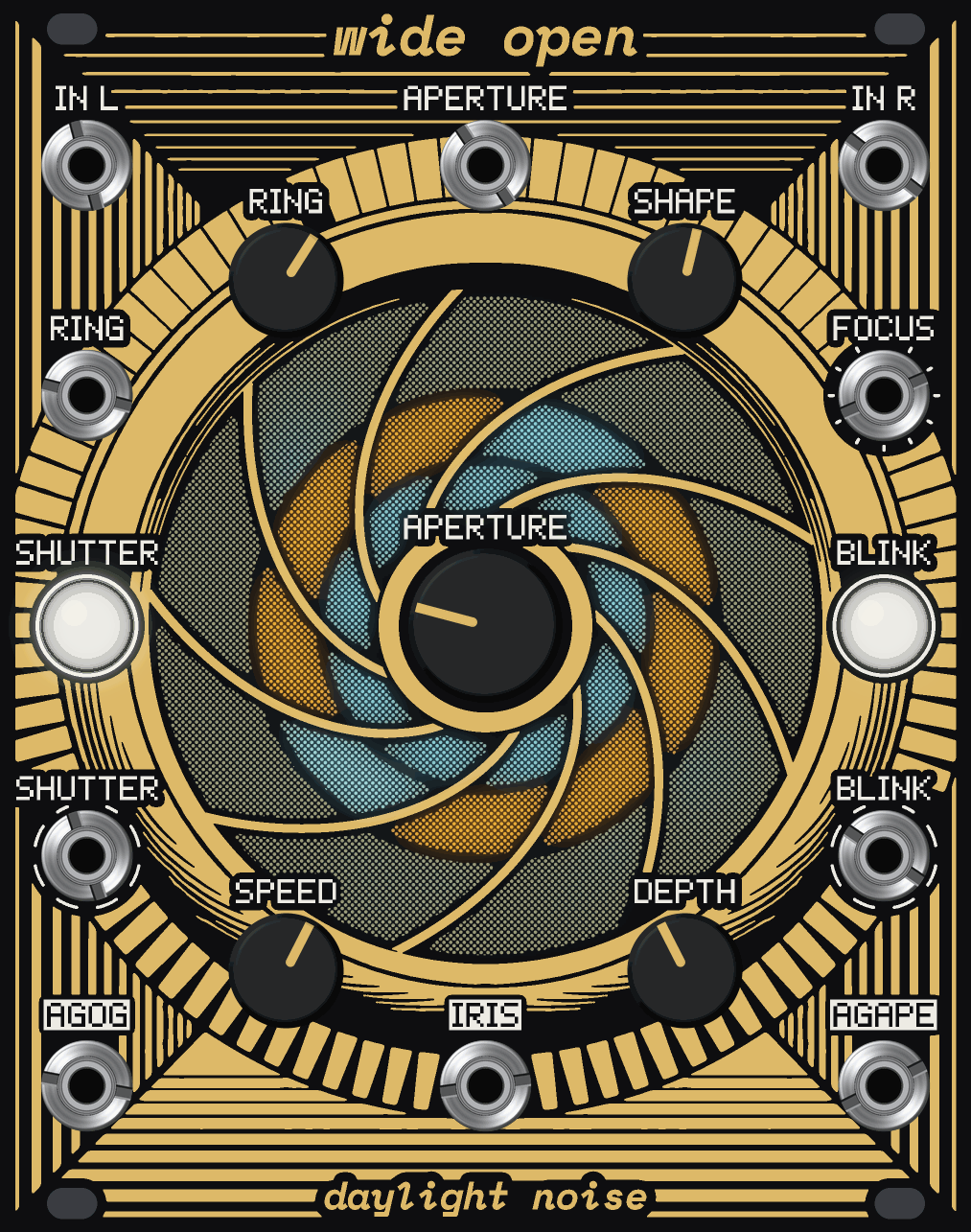
The WIDE OPEN panel, black and gold: a camera lens seen straight on filling the panel, drawn in ink and lit from above, inside a square hood whose walls are ruled in gold lines running in to it, its floor lit and its ceiling dark. The lens's knurled grip ring, its cuts fine on top and deep below, and its smooth barrel ring, hatched along its shaded lower side, carry the jacks, the knobs and the two buttons; inside its bevelled rim an iris of nine gold blades curving the same way round, and between them its opening, 27 windows of bare circuit board in three rings round APERTURE, the big knob at the middle.

Turn a knob: drag it or tap either side of it, roll the wheel over it or use the arrow keys; a double click puts it back. Hold SHUTTER to click the iris open; press BLINK to shut it for a moment.

The module's own engine, in your browser: the iris and its ring, round a stand-in rack's dry players.

Pick a sound file, or drop one here: a loop, a song. Its first minute goes into IN L and IN R. It's opened in your browser and never leaves your computer.

example patches

Everything WIDE OPEN does here is the module's own engine in your browser, and it hears only what comes into its jacks. The stabs, pad, bass, drums and beeps are a stand-in rack, played dry, unless you give it your own.
One cable, a low-pass you can see

IN L (and IN R) in, AGOG and AGAPE, the left and the right, to your mixer; for one cable out, plug it into AGOG. A low-pass lets the low part of a sound through and takes the top away: open, it's bright; closed down, it's warm, then dull, then a thump. Where it cuts is the cutoff.

Here the cutoff is a lens's iris. The glass is its opening, the middle ring the lows, the outer the highs: lit blue where it's open, brightening with what comes through; unlit under the blades.

APERTURE, RING and SHAPE

SHUTTER and BLINK

FOCUS and IRIS

FOCUS takes a note, 1 volt an octave, and the cutoff follows it: the filter moves with a bass line. With RING high the edge rings at the note, in tune, so a click into IN plays a tune. IRIS sends how open it is, 0 to 8 volts.

What it can't do

Inside

The WIDE OPEN panel playing, the iris lit ice blue inside, amber at its edge.

Drag it or use the arrow keys to turn it; click it to take it apart.

Specs

Format

Width
20 HP
Depth
20.6 mm behind the panel
+12 V
about 85 mA dark, 115 to 145 mA playing, 165 at most (estimated)
−12 V
about 5 mA (estimated)
+5 V
not used
Controls
five knobs (APERTURE, RING, SHAPE, SPEED, DEPTH), two lit buttons (SHUTTER, BLINK)
Light
63 RGB LEDs under the iris's 27 windows
Replaces
a stereo filter, a filter envelope, a lowpass gate and a ducker

Inputs

IN L
audio to ±10 V (both sides, nothing in IN R)
IN R
audio to ±10 V
APERTURE
CV, through DEPTH
RING
CV, added to the knob
FOCUS
1 V an octave, within 3 cents over five octaves once calibrated
SHUTTER
gate: clicks it open
BLINK
gate: shuts it

Outputs

AGOG
audio, the left, to 10 V, 8 V at most
AGAPE
the same, the right
IRIS
CV, 0 to 8 V: how open

Engine

Brain
RP2350 at 144 MHz, 46.875 kHz: this page's engine to the last bit
Memory
178 KB of the chip's own; only FOCUS's calibration kept through power-off
Updates
over USB, the panel left on