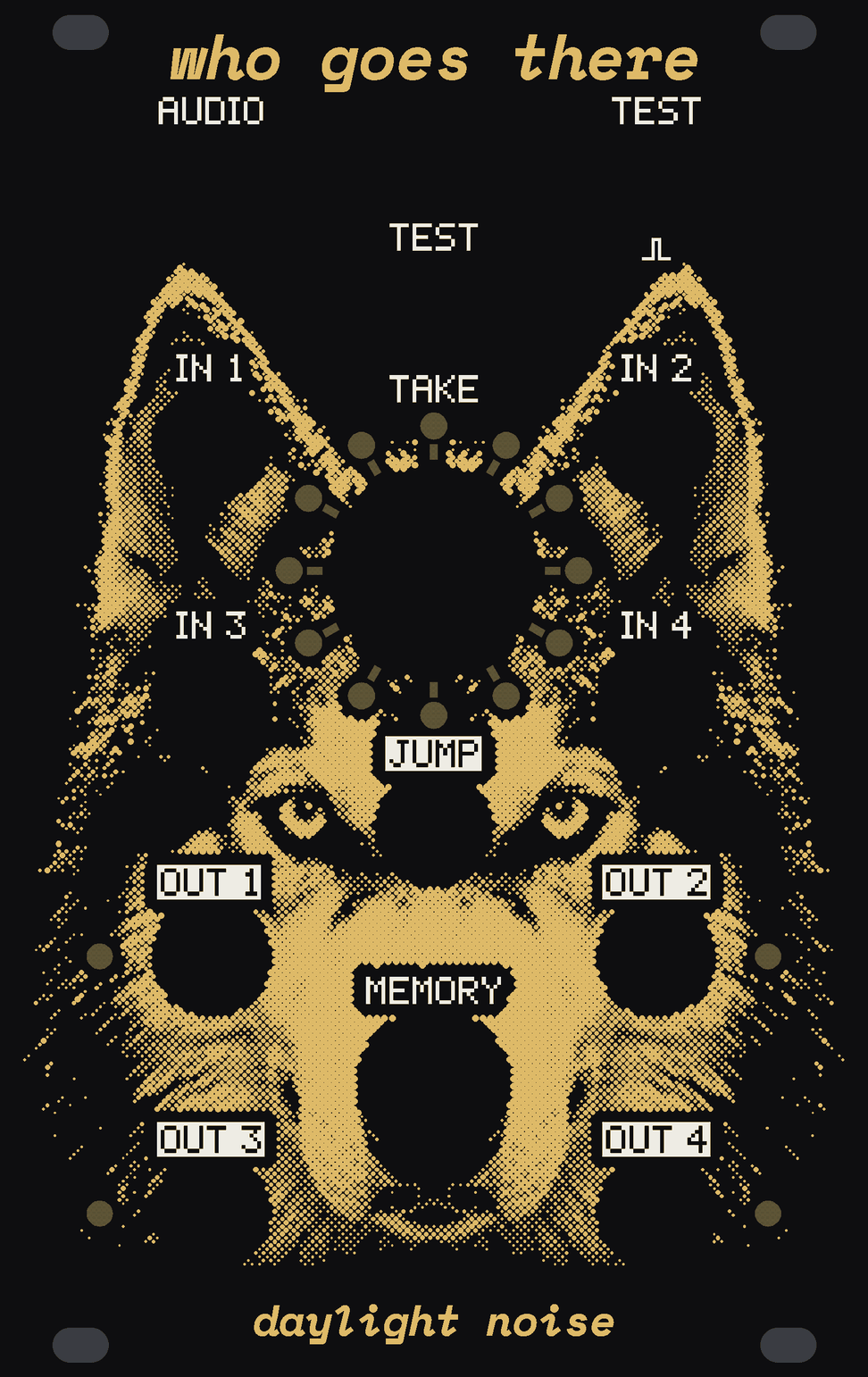
who goes there

it becomes what it hears

20 HP

Patch the band into BAND, the audio in, and four CVs that know nothing about music come out on its notes: in its key, or only on the chord it's playing now, following it when the chord changes.

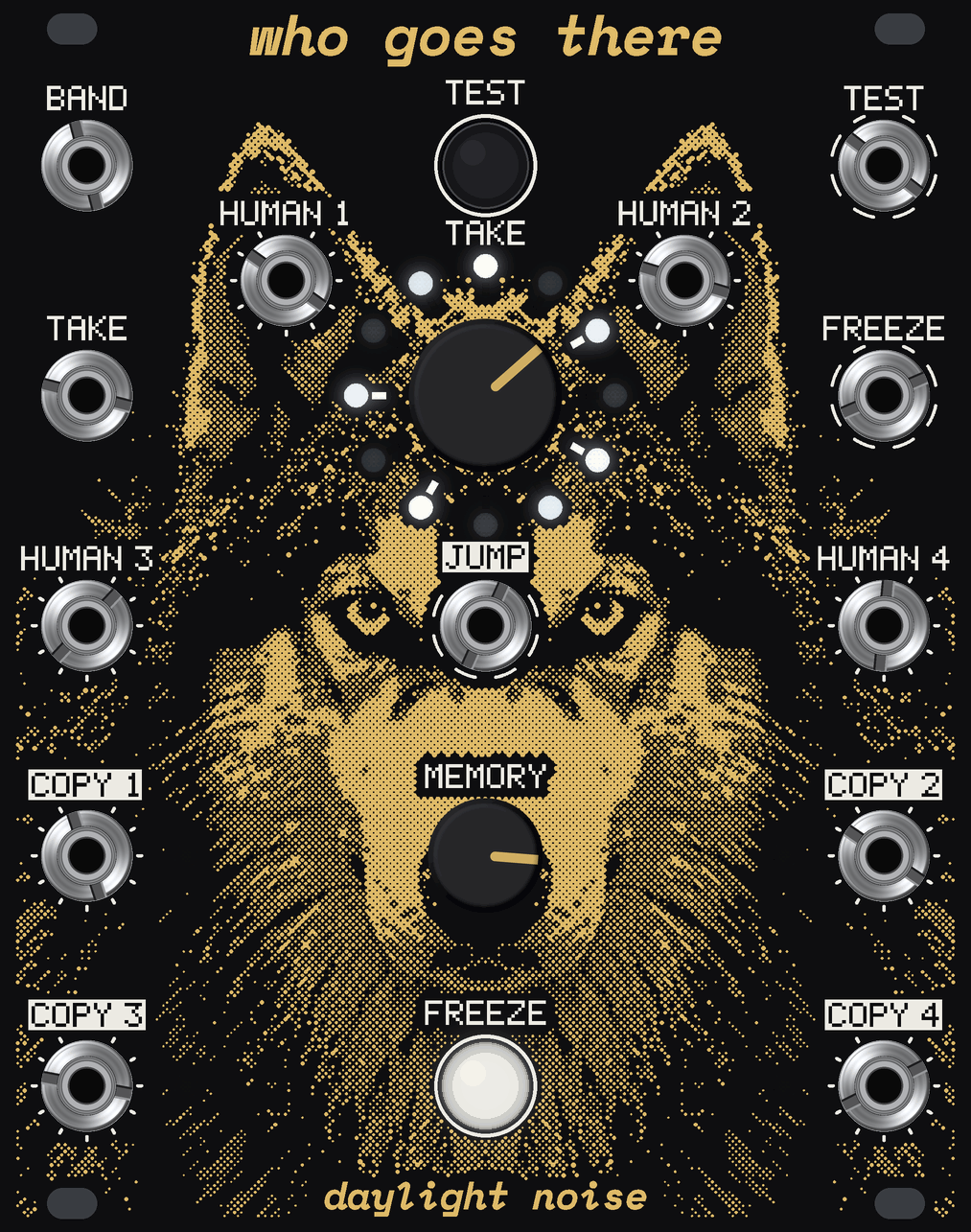
The WHO GOES THERE panel: black, a timber wall at night in gold dots, its weatherboards running across, and a double window in it of bare circuit board, icicles hanging off its head and snow drifted up to the sill. Two sashes of six tall panes stand either side of a centre post, and a row of twelve small fanlight panes runs across the top of the whole window; the glass is frosted, the frost left in black dots, and somebody stands behind it, a dark head and shoulders in the right-hand sash. The big knob TAKE over the window, JUMP, MEMORY and the FREEZE button down the centre post, the TEST button under the name, HUMAN 1 and HUMAN 2 either side of TAKE. Down both edges, BAND and TEST at the top corners, then the TAKE and FREEZE jacks, HUMAN 3 and HUMAN 4, COPY 1 to COPY 4 below them with a small red light inboard of each; twelve white ticks round each of the eight HUMAN and COPY jacks, a ring of dashes round TEST's and FREEZE's jacks and JUMP. who goes there at the top, daylight noise at the bottom.

Turn a knob: drag it or tap either side of it, roll the wheel over it or use the arrow keys; a double click puts it back. TEST and FREEZE are buttons to press. The patches step on by themselves until you touch anything.

The hearing, the window and the notes are WHO GOES THERE's own. The band, the drums, the four CVs and the bells playing its outs are made in the page as you listen.

example patches

The hearing, the window, the notes and every out here are WHO GOES THERE's own engine, the module's firmware ported to run in your browser: every note it takes on, every test. The band, the drums, the CVs, the bells and the hand on MEMORY are a stand-in for the rest of a rack.
What it hears

Patch in the band: the mix, a pad or a bass. It hears which notes are sounding and keeps a running profile of them. The window's twelve panes show it, in rows of four with C at the top left, each lit by how much its note is heard. The notes it has taken on hold steady; the rest stay dim.

Press FREEZE and it stops listening: what it has taken on holds, the window with it, so a breakdown or a solo can't drag the key away. Press again to let go.

Taking on

Four CVs come in and go out on the notes it has taken on, 1 V an octave. A CV sitting between two notes holds one of them and doesn't chatter. The twelve small panes of the fanlight across the top, C to B, light where the channels are.

The test

Each channel's note is checked against what's sounding right then. One that doesn't belong jumps: its out leaps an octave and falls back, and the light beside it flashes red. One that belongs doesn't move. Send TEST a bar's clock and the voices that clash with the chord become accents.

Inside

The WHO GOES THERE panel taking on a key: the panes of its frosted window lit cold white, the fanlight white where the channels are, with its knobs on.

Drag it or use the arrow keys to turn it; click it to take it apart.

Specs

Format

Width
20 HP
Depth
about 21 mm behind the panel, its power header included (estimated)
+12 V
about 135 mA with its lights dark, 300 to 380 mA lit, 395 mA at most (estimated)
−12 V
about 6 mA (estimated)
+5 V
not used; 10-pin header
Controls
2 knobs, TAKE's big; 2 buttons, FREEZE's lit

I/O

BAND
the audio in, ±5 V full scale; 100 k
HUMAN 1 to HUMAN 4
V/OCT ins: CV, ±5 V at 1 V an octave (read to ±6 V); 100 k. HUMAN 2, 3 and 4 follow HUMAN 1 when empty
TEST
trigger or gate, rising past about 1.15 V; 100 k
TAKE
CV, ±5 V, +5 V its whole travel; 100 k
FREEZE
gate, over about 1.15 V; 100 k
COPY 1 to COPY 4
V/OCT outs: −5 to +5 V at 1 V an octave, calibrated to a cent or two; 1 k
JUMP
gate, 5 V for 100 ms; 1 k

Engine

Brain
RP2350, both cores, 144 MHz, 32-bit float
Hearing
PCM1808 at 46.875 kHz, a 4096-point FFT every 21.8 ms
Inputs
ADS131M04, four 24-bit converters, 5.9 kHz each
Outputs
two DAC8563s, 16-bit, from a 4.096 V reference
Quantiser
2 kHz; a CV to its note within about 1.3 ms
MEMORY
a quarter of a second to a minute
Lights
100 RGB LEDs behind the 28 windows: the twelve panes, the fanlight's twelve and the four jump lights
Firmware
over USB-C, at the board's top edge