whistler

a whistle in every hum

20 HP

Every note hides a ladder of higher notes. WHISTLER hears the note coming in and puts two narrow mouths on its ladder: turn WHISTLE and a whistled tune climbs out of your bass, your pad or its own twanging drone, always in tune.

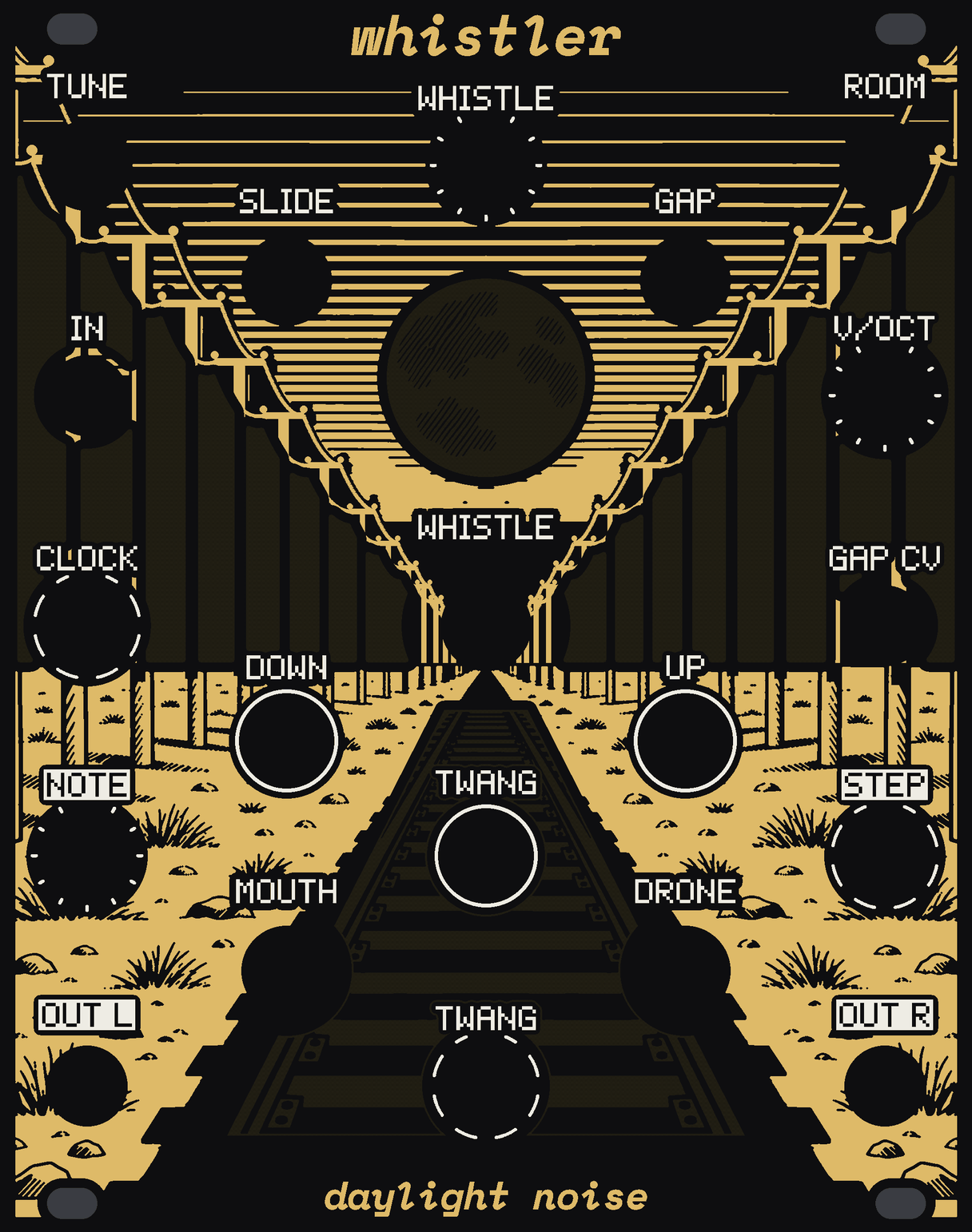
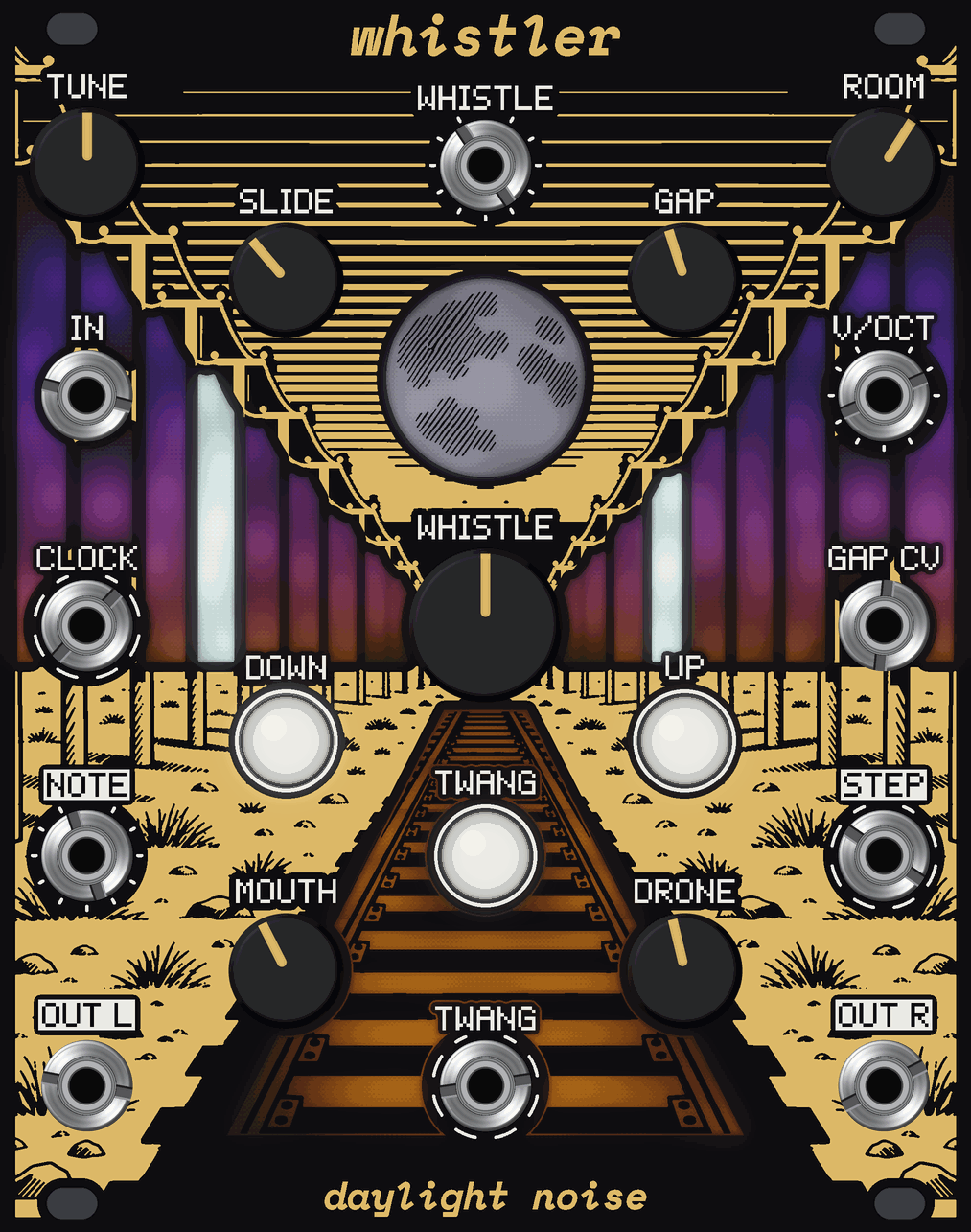
The WHISTLER panel, black and gold, drawn in ink: a straight railroad running away across a flat desert at dusk to the horizon, a line of telegraph poles on each side getting shorter and closer together toward it, each pole a gold T with insulators, two gold wires a side sagging pole to pole. The sky between each pair of poles is glass, deep violet up high warming to amber at the horizon. A big full moon hangs in the open sky in the middle, its seas hatched in black, the sky over the wires ruled in level gold lines, and the big WHISTLE knob sits where the rails meet the horizon. The track below is glass too, its sleepers, rails and tie plates inked black on it; the desert either side is solid gold, its scrub, stones and the poles' shadows inked in black, small mesas on the horizon. The TWANG button sits on the track over its jack, DOWN and UP either side of it, and the other knobs and jacks are round the edges.

Turn a knob: drag it or tap either side of it, roll the wheel over it or use the arrow keys; a double click puts it back. Press TWANG to pluck it; UP and DOWN move the mouths a rung. The patches step on by themselves until you touch anything. Try your own puts a sound file of yours through it.

The listening, the two mouths and its own drone, in your browser, fed by a stand-in rack.

Pick a sound file, or drop one here: a bass line, a drone or a singer works best. Its first minute plays through the module with every knob yours. It's opened in your browser and never leaves your computer.

example patches

Everything WHISTLER does here is the module's own engine in your browser, and it hears only what comes into its jacks. The band, its bass, its choir, the beeps and the sine voice are a stand-in rack, unless you give it your own. Each visit gets its own seed: the module's own tune is new every time.
The notes hidden in a note

A buzzing note isn't one note. Riding on it, quieter, are higher notes: twice its pitch, three times, four times, and on up, closer and closer together. You hear them as the note's colour, not as notes. Call them a ladder: rung 2 an octave up, rung 3 a fifth over that, rung 4 two octaves up, and from there the rungs crowd together like poles along a railroad running away from you.

A jaw harp player's mouth lights them one after another, so a tune comes out of a drone that never changes. WHISTLER does that to whatever comes in. It hears the note, finds its ladder, and puts two narrow mouths on it, each on one rung. Whatever they whistle is in tune with the note, because it's made of it.

Two mouths on the ladder

It hears the note

Its own drone, and TWANG

TUNE, and walking the ladder

NOTE and STEP

ROOM

What it can't do

Inside

The WHISTLER panel playing: the railroad at dusk, the sky between the poles lit.

Drag it or use the arrow keys to turn it; click it to take it apart.

Specs

Format

Width
20 HP
Depth
20.6 mm behind the panel
+12 V
about 115 mA dark, 150 mA playing (estimated)
−12 V
about 5 mA (estimated)
+5 V
not used
Controls
seven knobs (WHISTLE, GAP, SLIDE, MOUTH, DRONE, TUNE, ROOM), three lit buttons (TWANG, UP, DOWN)
Light
97 RGB LEDs under the sky and the track
Replaces
a filter that rings, a vowel filter and a melody source

Inputs

IN
audio to ±10 V (nothing: its own drone)
V/OCT
1 V an octave, 110 Hz at 0 V, within 3 cents once calibrated
CLOCK
gate: a sixteenth an edge (nothing: 96 BPM)
WHISTLE
CV: 1 V an octave of the ladder
GAP CV
CV: 1 V a rung
TWANG
gate: a twang an edge

Outputs

OUT L
audio to 10 V: the left mouth
OUT R
audio to 10 V: the right mouth
NOTE
1 V an octave: the left mouth's pitch, within 3 cents once calibrated
STEP
gate: 20 ms on each new rung

Engine

Brain
RP2350 at 240 MHz on both cores, 46.875 kHz: this page's engine, to the last bit
Memory
292 KB of the chip's own; the calibration kept through power-off
Updates
over USB, the panel left on