wax and wane

give it time to warm up

20 HP

A drone synth that's a wax lamp. Every blob of wax is a voice: high in the glass is a high note, a big blob a loud one. They rise, split and merge, so the chord never stops moving. Switch it on and give it time: it starts as one low hum.

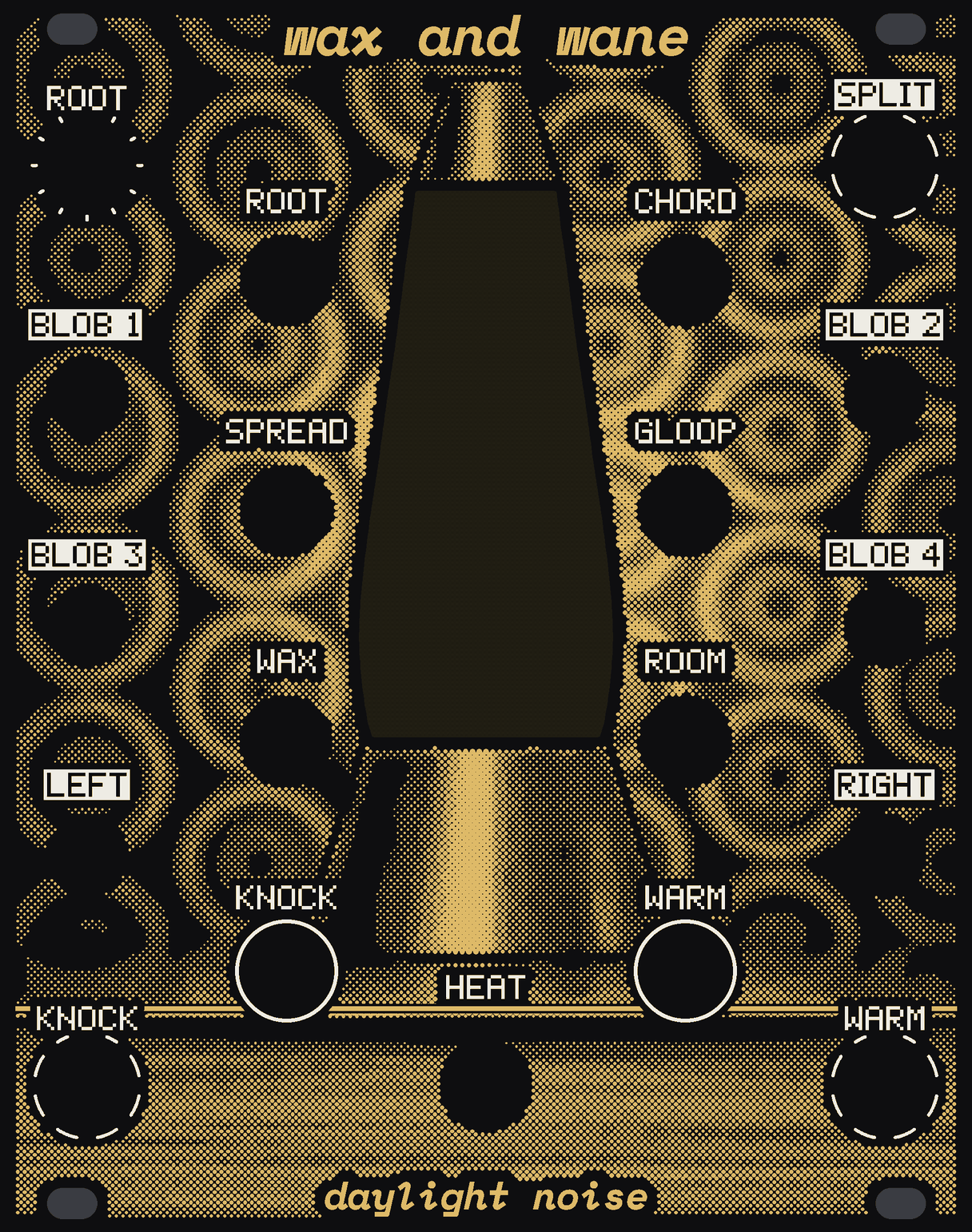
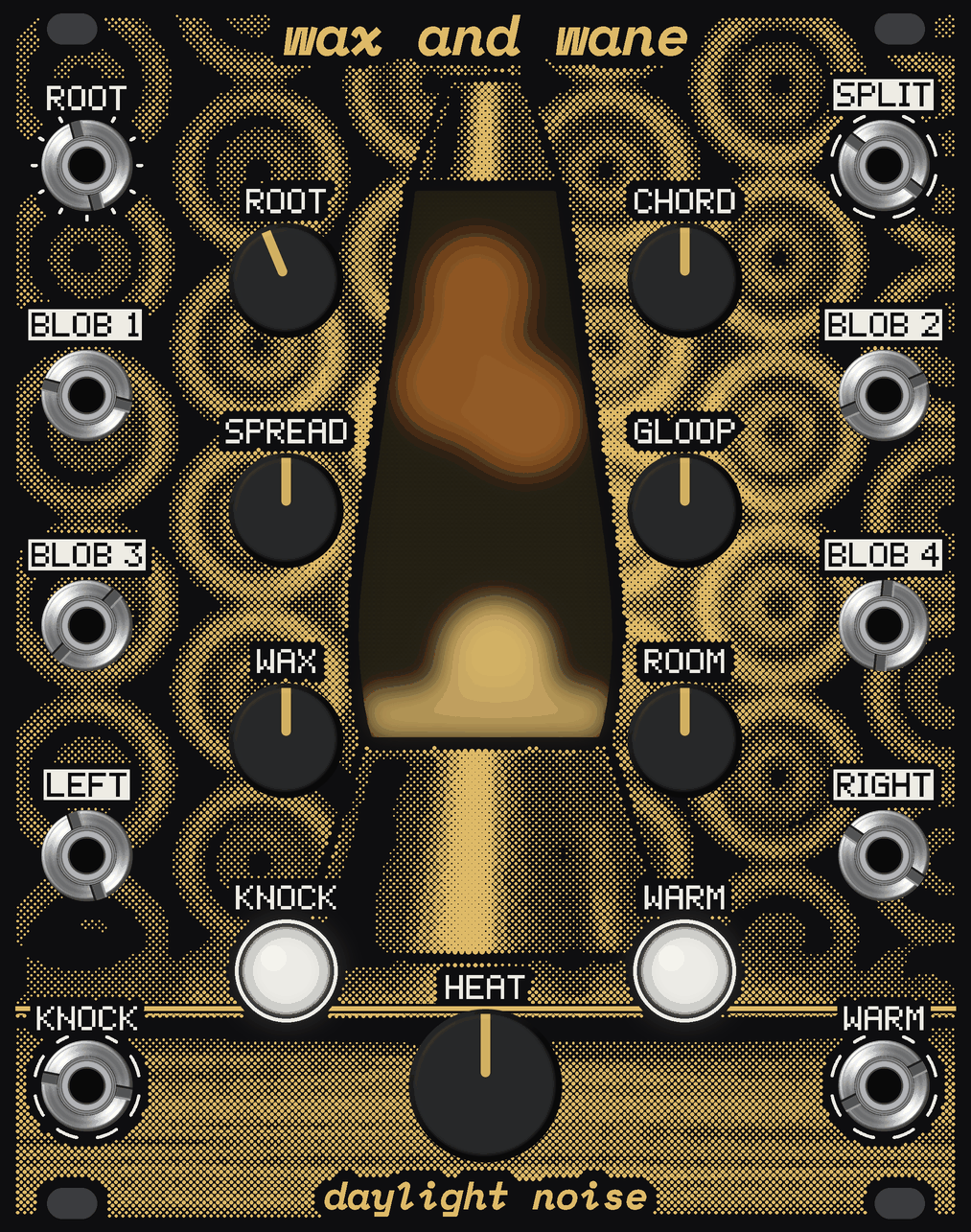
The WAX AND WANE panel, black and gold: a photograph of a wax lamp glowing on a teak sideboard, a 1970s wallpaper of big rings filling the wall behind it, brightest round the lamp, the sideboard's top edge one bright line across the panel and its grain below. A small metal cone caps the tall tapered glass; a wider metal cone, the base, stands under it; HEAT, the big knob, sits on the sideboard below. The glass is one window of bare glass with a screen behind it, where the blobs of wax glow orange. The other knobs sit either side of the glass, the two buttons on the sideboard, the jacks down both edges.

Turn a knob: drag it or tap either side of it, roll the wheel over it or use the arrow keys; a double click puts it back. Press KNOCK to tap the lamp; press WARM to switch it off and on. The patches step on by themselves until you touch anything.

Synthesised here, as the module would make it: every blob's voice and the room, with a stand-in rack playing along.

example patches

Everything WAX AND WANE does here is the module's own engine in your browser: the wax, its voices and its glass, to the bit. The kit, the bass, the plucked voice and the beeps are a stand-in rack.
A lamp you can hear

Each blob of wax is a voice: its height its note, its size how loud and dark it is. The lump at the bottom is always there, on the lowest note.

Take LEFT and RIGHT to your mixer, every knob at noon: a slow, warm chord that plays itself and never repeats. LEFT alone is the lamp in mono.

It has to warm up

Splits and merges

The knobs

Knock on it

In a rack

Inside

The WAX AND WANE panel: a wax lamp glowing on a sideboard in a 1970s room, its glass one window of orange light with blobs of wax in it, the wallpaper's rings, the lamp's cap and base and the sideboard in gold.

Drag it or use the arrow keys to turn it; click it to take it apart.

Specs

Format

Width
20 HP
Depth
20.6 mm behind the panel
+12 V
about 190 mA, 100 of it the screen’s backlight (estimated)
−12 V
about 6 mA (estimated)
+5 V
not used
Controls
seven knobs (HEAT, ROOT, CHORD, SPREAD, WAX, GLOOP, ROOM), two lit buttons (KNOCK, WARM)
Lights
the glass: a 2.9″ colour screen behind it
Voices
up to eight, one a blob
Replaces
a drone voice, a chord source and four slow random LFOs

Inputs

ROOT
1 V an octave, added to ROOT
KNOCK
gate: a rising edge taps the lamp
WARM
gate: switches it off and on; held high, off

Outputs

LEFT
audio, the lamp (both sides with nothing in RIGHT)
RIGHT
audio, the lamp's right
BLOB 1
1 V an octave, a blob's note (0 V is C1)
BLOB 2
the second blob's
BLOB 3
the third's
BLOB 4
the fourth's
SPLIT
trigger, 8 V, 10 ms each time a blob splits

Engine

Brain
RP2350 at 192 MHz, both cores, 31.25 kHz: this page's engine, to the bit
The screen
the wax drawn 30 times a second, as this page draws it