watched pot

it never boils

20 HP

One big motorised dial, and a small eye that knows when you're facing it. While you look at it, it holds dead still and the sound hushes. Look away and the dial creeps round and your sound comes slowly to the boil. Look back and it's somewhere else, and you never saw it go.

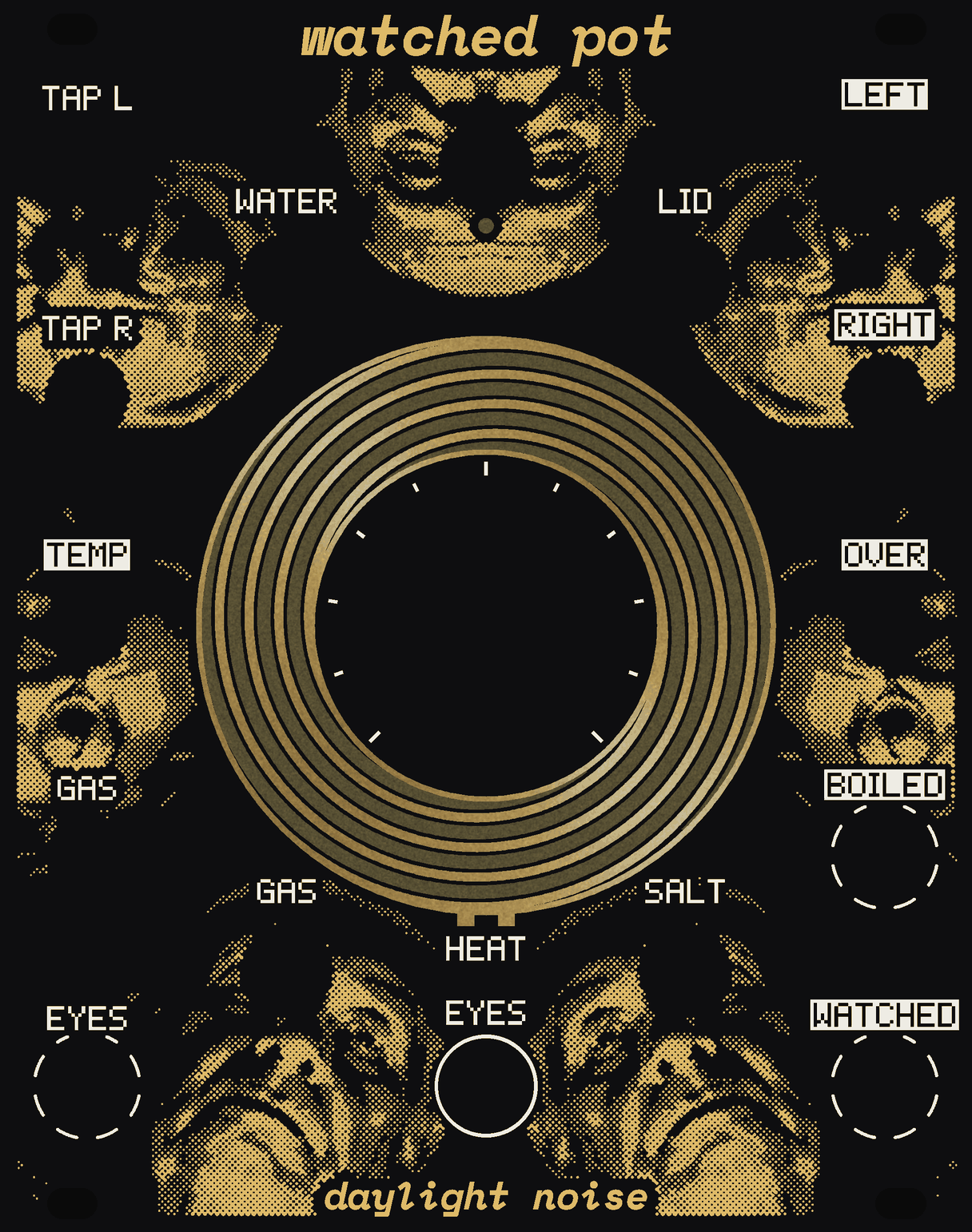
The WATCHED POT panel: black, with seven old faces in gold dots round the edge, seen from inside a pot, looking down. In the middle a gold coil, with a big black dial at its centre. A small lens sits between the eyes of the face at the top. TAP L and TAP R in at the top left, LEFT and RIGHT out at the top right, WATER and LID under them, TEMP and OVER out either side of the coil, GAS and SALT under it, the EYES button at the foot with EYES in and WATCHED out either side of it. watched pot at the top, daylight noise at the bottom.

Turn a knob: drag it or tap either side of it, roll the wheel over it or use the arrow keys; a double click puts it back. HEAT turns the same ways, heavily, under your hand. EYES is a button: press it and it thinks it's watched until you press it again. The patches step on by themselves until you touch something.

A dark band in A minor through it, and somebody standing at the rack. Listen plays the patch from its top.

Hold it. Or take your pointer off the panel, scroll away, or leave the tab: it goes on without you.

example patches

Everything WATCHED POT does here is its engine as designed, running in your browser. This page stands in for the eye: your pointer on the panel is you looking. No camera, none asked for. The module's eye reads a face and keeps nothing. The band is a stand-in rack.
The eye

A small camera in the panel looks for a face turned towards it. It's your head it reads, not your eyes: turn away and it's alone. A small light under the lens stays on while the camera's on, and brightens when it sees you. No pictures leave it, and it keeps none.

While it's seen the dial doesn't move, not by a hair, and the coil is black. It waits most of a second after you've gone, to be sure, so a glance every second holds it for ever. It can't see in the dark. Turn the lights out and nobody's looking.

The pot

HEAT is where the dial is and nothing else: cold it's clean; warm, the first tiny pops, grains of your own sound; at a simmer it moves and rolls and the low end thickens; at a rolling boil it feeds back on itself, big bubbles in the key of what's playing, and a whine climbing towards the top.

Boiling over

At the boil it goes over. BOILED fires, the flood comes out, the lid rattles on your own hits, and the motor spins the dial back to cold while a long hiss runs out. Look at it in the middle of boiling over and it stays over, the dial at the top and the flood on, for as long as you stare. You can stop a build by looking at it. You can only stop a boil-over by looking away.

What goes in

What comes out

Inside

One board 10 mm behind the panel, everything on its front. Under the coil, 64 LEDs, two red and two white a cell, shine through a black printed baffle. The printed dial sits on a gimbal motor that sinks through a hole in the board into a printed cup, a magnet on its shaft over an angle sensor. The camera sits in a printed block on the board.

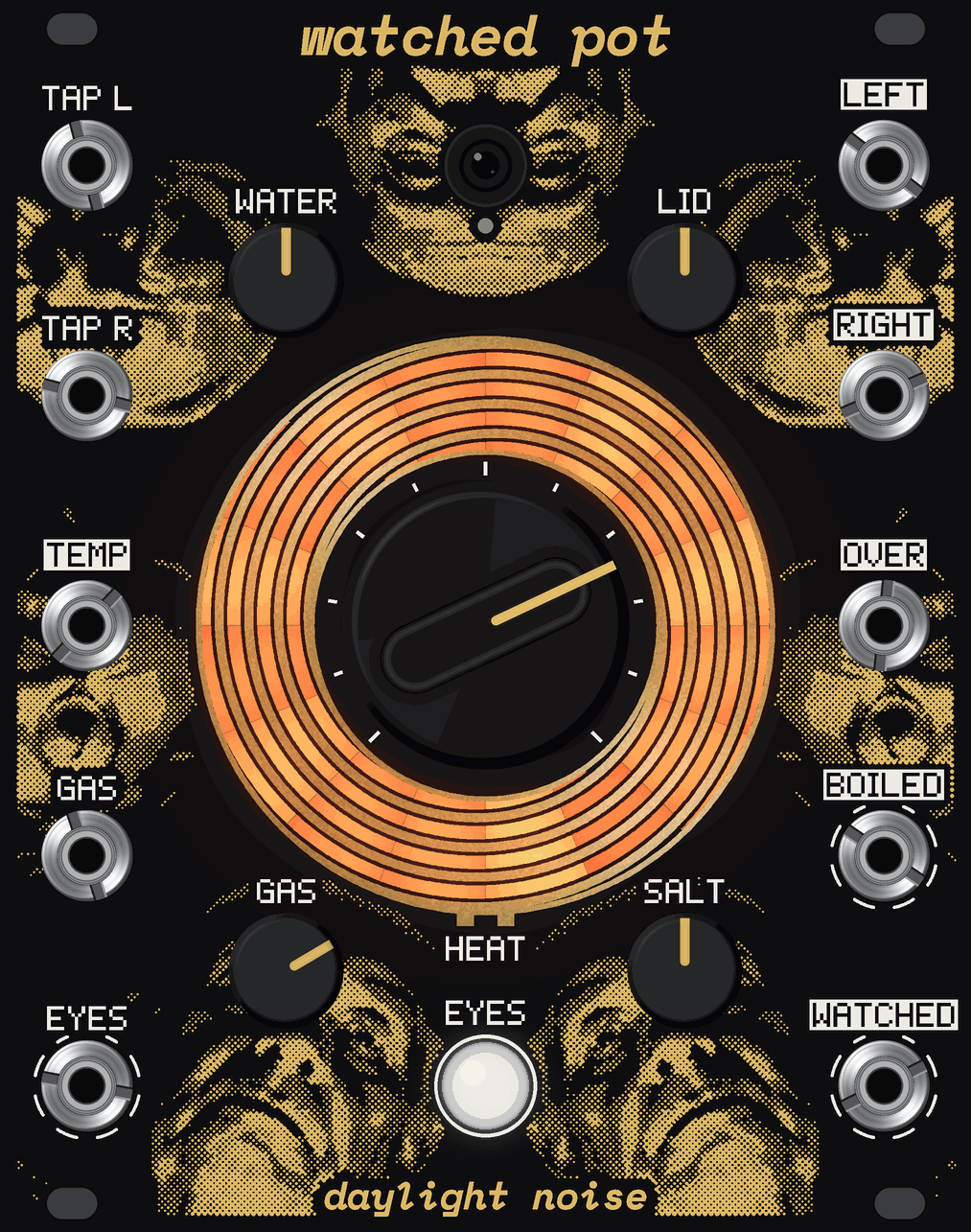
The WATCHED POT panel: a gold woodcut of faces round a coil of copper rings glowing orange, one big black dial with a gold line in its middle, a small eye at the top, four knobs, ten jacks and the EYES button.

Drag it or use the arrow keys to turn it; click it to take it apart.

Specs

Format

Width
20 HP
Depth
20.8 mm behind the panel, 20.2 at the motor’s cup; the dial 14.6 mm in front
+12 V
about 75 mA starting, 150 to 180 in use, 390 at most for 2.4 s boiling over (on paper, not yet measured)
−12 V
about 8 mA, 12 at the most (on paper)
+5 V
not used
Board
99.3 × 110 mm, 4 layers, parts on the front; a Ø16 sensor board
Controls
a motorised dial, 4 knobs, a lit button, a small camera

I/O

TAP L, R
audio in, ±5 V, unclipped to ±9 V
GAS
CV, ±5 V for half the knob’s travel
EYES
gate, high past 1 V, low under 0.5 V
LEFT, RIGHT
audio out, ±5 V, a soft ceiling at 4.3 V
OVER
audio out, the same
TEMP
CV, 0 to 8 V: the dial
WATCHED
gate, 0/5 V
BOILED
trigger, 0/5 V, 10 ms

Engine

Brain
RP2350, two cores, 32-bit float, 46.875 kHz
The eye
a 160 × 120 grey camera behind a Ø8.6 mm hole, a frontal face finder, 8 to 25 looks a second; a face 0.3 to 0.8 m away (estimated)
The dial
a gimbal motor and a 14-bit magnetic angle sensor, 270°, its stops hard
Light
a coil of 16 cells, 32 red and 32 white LEDs, and a light under the lens
Power cycle
the heat is where the dial was left; nothing else is kept