washed up

the sea sends it back

20 HP

A delay for the long times. Hold SEAL and what you play goes into a bottle; let go and it's thrown in the sea. You watch it drift out and come back, and it washes up seconds or minutes later, when the tide likes, worn by the trip.

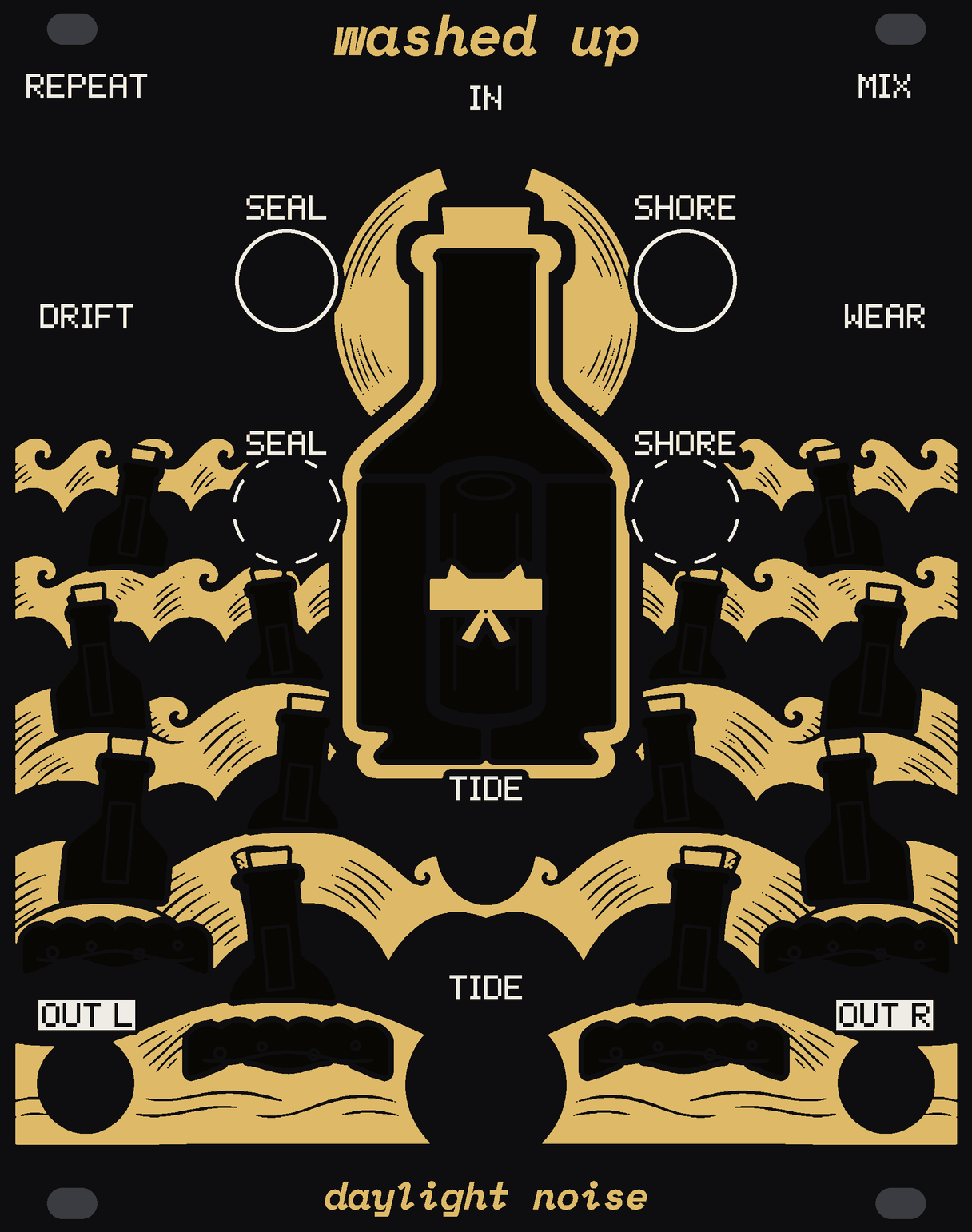
The WASHED UP panel, black and gold: a big glass bottle with a cork stands upright up the middle in a hand-inked night sea, a full moon behind its neck, its note rolled up inside it and tied with a ribbon. Below and round it the sea in four rows of curling gold waves, and on them twelve small bottles in four lanes, two each side, small and far near the top, big and near at the foot, with a strip of surf in front of each lane's nearest. The bottles' glass and the surf are bare glass, lit from behind. The knobs and buttons sit in the night sky round the bottle; TIDE, the big knob, is on the sand at the foot.

Turn a knob: drag it or tap either side of it, roll the wheel over it or use the arrow keys; a double click puts it back. Hold SEAL to bottle what's playing; let go to throw it. SHORE calls the next bottle in now. The patches step on by themselves until you touch anything.

Synthesised here, as the module would make it: the bottles, the tide, the sea's wear, round a stand-in rack's seaside band.

example patches

WASHED UP here is its engine as designed, in your browser: it hears only what comes into its jacks. The harp, the pad, the bass, the flute and the beeps are a stand-in rack, played dry.

One cable and a button

Your sound into IN, OUT L and OUT R to your mixer. It plays straight through. Hold SEAL while you play a phrase: the big bottle fills (up to sixteen seconds). Let go and it's thrown into the sea. A small bottle lights at the foot of a lane, drifts out up it, waits far out, and later comes back down and washes up in the surf, where it plays what you sealed, worn by the trip. An echo comes back in a second; this comes back when you've moved on, like something you played a while ago heard across the water. Noon on every knob: back in about sixteen seconds, give or take.

TIDE and DRIFT

WEAR

WEAR is what the sea does to it. Fully left, it comes back clean. Turn it up and it comes back filtered (the lows and the highs worn off, until at full it's as thin as a radio across the water), warbling (its pitch wavers like old tape, about fifteen cents at noon), salted with crackle, and wet: smeared, with a wash of surf under it and a tail. The bottle's glass goes from bottle green toward pale sea glass as it wears.

REPEAT

What washes up can go back out. REPEAT fully left, each bottle comes back once. Turn it up and whatever washes up is sealed again as it plays and thrown back, a little quieter each trip (three decibels at noon) and worn again, the wear baked in on top of the last: a phrase that comes back again and again, thinner, darker and saltier, until it's a ghost. Fully right it never gets quieter, only more worn.

SHORE and four at sea

Specs

Format

Width
20 HP
Controls
five knobs (TIDE, DRIFT, WEAR, REPEAT, MIX), two lit buttons (SEAL, SHORE)
Lights
a bottle that fills, twelve places out on the waves and four surfs: 21 windows, 65 LEDs
Memory
four bottles of 16 seconds
Replaces
a looper with long memory, the random timing it never has, and a tape-wear effect
Here
a demo: the parts and the engine as designed, no board yet

Inputs

IN
audio: into the bottle while SEAL is held, and on to both outs dry
TIDE
CV: added to TIDE, a tenth of its turn a volt
SEAL
gate: bottles what comes in while it's high
SHORE
gate: a rise calls the next bottle in; held, they keep coming

Outputs

OUT L
audio: your sound and what washes up, the left lanes on the left
OUT R
audio: your sound and what washes up, the right lanes on the right