vacancy

the sign's on the blink

20 HP

An analogue voice made of three real neon lamps. Each one charges till the gas strikes, flashes and goes out, over and over, and that flashing is the note. A loop holds them in tune. Tie them together and they fight. Take their supply away and they fail, the way a sign does.

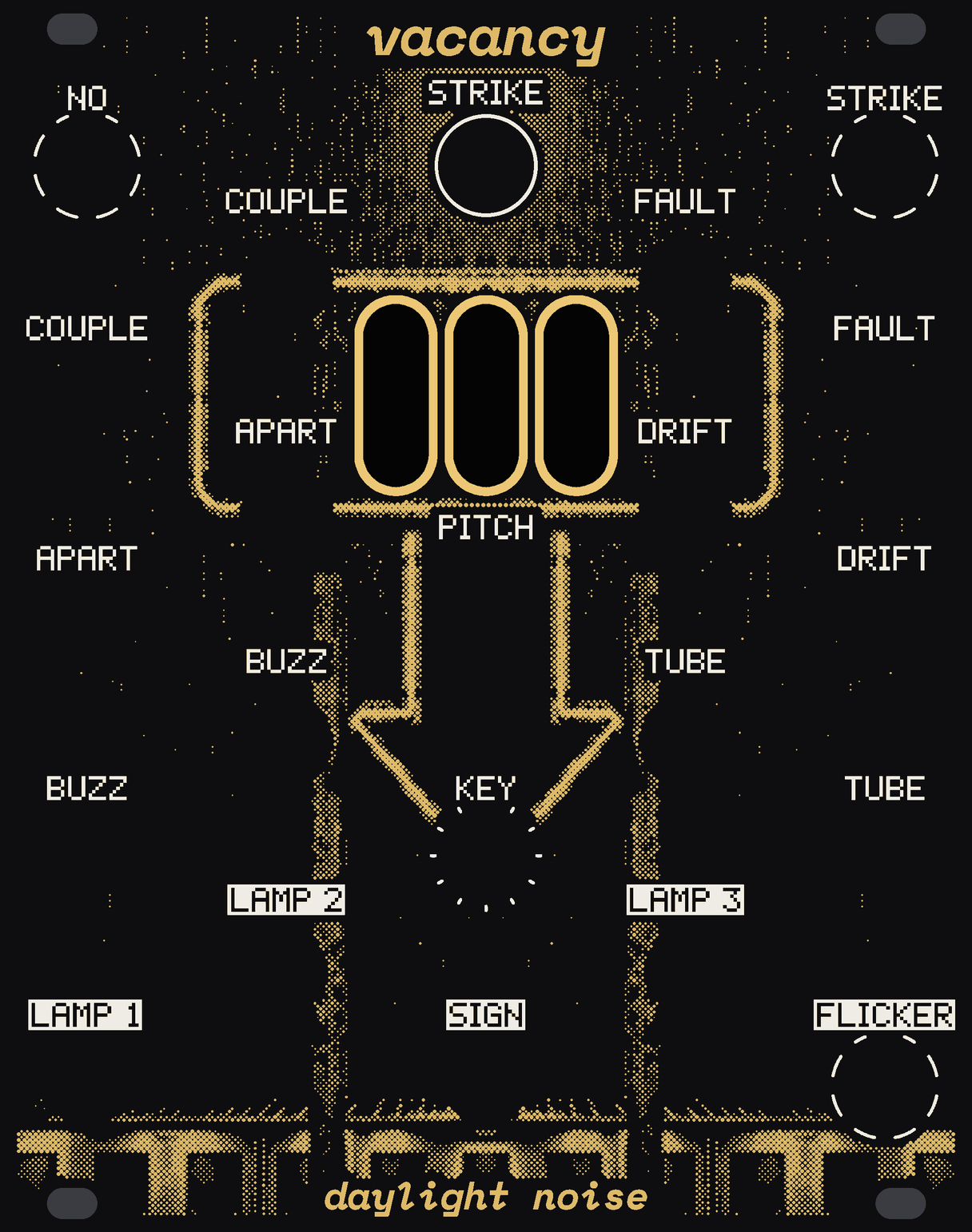
The VACANCY panel: black, a blank roadside sign in gold dots on two posts in the rain, three small glass neon lamps standing side by side in its box, each in a bare gold surround, an arrow under them pointing at KEY, and a row of doors along the foot.

The lamps: your pointer or a finger is your thumb. Lay it across them and your skin joins them: over the gap between two it's those two, in the middle it's all three, and they drag each other together. Slide along to change the pair, or use the arrow keys. STRIKE is a button: press it. Turn a knob: drag it or tap either side of it, roll the wheel over it or use the arrow keys; a double click puts it back.

A kick, a snare and hats in C minor at 100 BPM round VACANCY. The lamps are the only voice. Listen plays the patch from its top.

example patches

Everything VACANCY does here is its engine as designed, running in your browser: a model of the three lamps and their circuit, and the firmware that times them and steers them. Your pointer stands in for your thumb, and the rack round it is a stand-in. The real thing has real gas in it, so no two are alike.

The lamps are the sound

A neon lamp and a capacitor make one of the oldest oscillators there are. The capacitor charges until the gas strikes, the lamp flashes, the capacitor empties through it, it goes out, and it starts again. There are three of those behind the panel, and what you hear is their voltage: a raw, rough saw. A chip times each flash and steers each lamp's current to keep it on the note, and it never touches the sound.

The lamps run on about a hundred volts, behind the panel, where nothing reaches them. They're dim, because a lamp only keeps going out on a sliver of the current it's made for: it's an ember more than a light. Below about 20 Hz you can count the flashes.

They fight

Join two lamps with a capacitor and each flash shoves the other back. Gently, they fall into step. Harder, they can't stand to flash together, and they fall into turns: one, two, three, one, two, three, pushing each other off the note. Open DRIFT and they hang on near a ratio, stutter and slip. Your thumb goes the other way: it pulls them together.

It fails

The lamps need their supply to reach the voltage they strike at. Take it down to there and they don't stop neatly: a lamp fires when the gas lets it. It spits, drops out, sits dark and comes back late and hard, because a lamp left in the dark strikes high. Nothing in the module is making that up.

The body

What comes out

Specs

Format

Width
20 HP
Controls
a big knob, 6 knobs, a lit button, three neon lamps

Inputs

KEY
V/OCT
STRIKE, NO
gates
Knob CVs
COUPLE, FAULT, DRIFT, APART, BUZZ, TUBE: added to their knobs, 10 V the whole way

Outputs

SIGN
audio, about ±5 V
Lamps
LAMP 1, LAMP 2, LAMP 3: audio, ±5 V
FLICKER
gate, 5 V