umbilical

20 HP · a stereo effect that runs on a cable

While a cable is in UMBILICAL, it runs clean. Pull the cable out and it's on its reserve: the digits count down, faster the harder it's played, and the sound sags as the reserve runs out. At zero it dies. Sometimes it comes back on its own, roaring, and won't stop until it decides to.

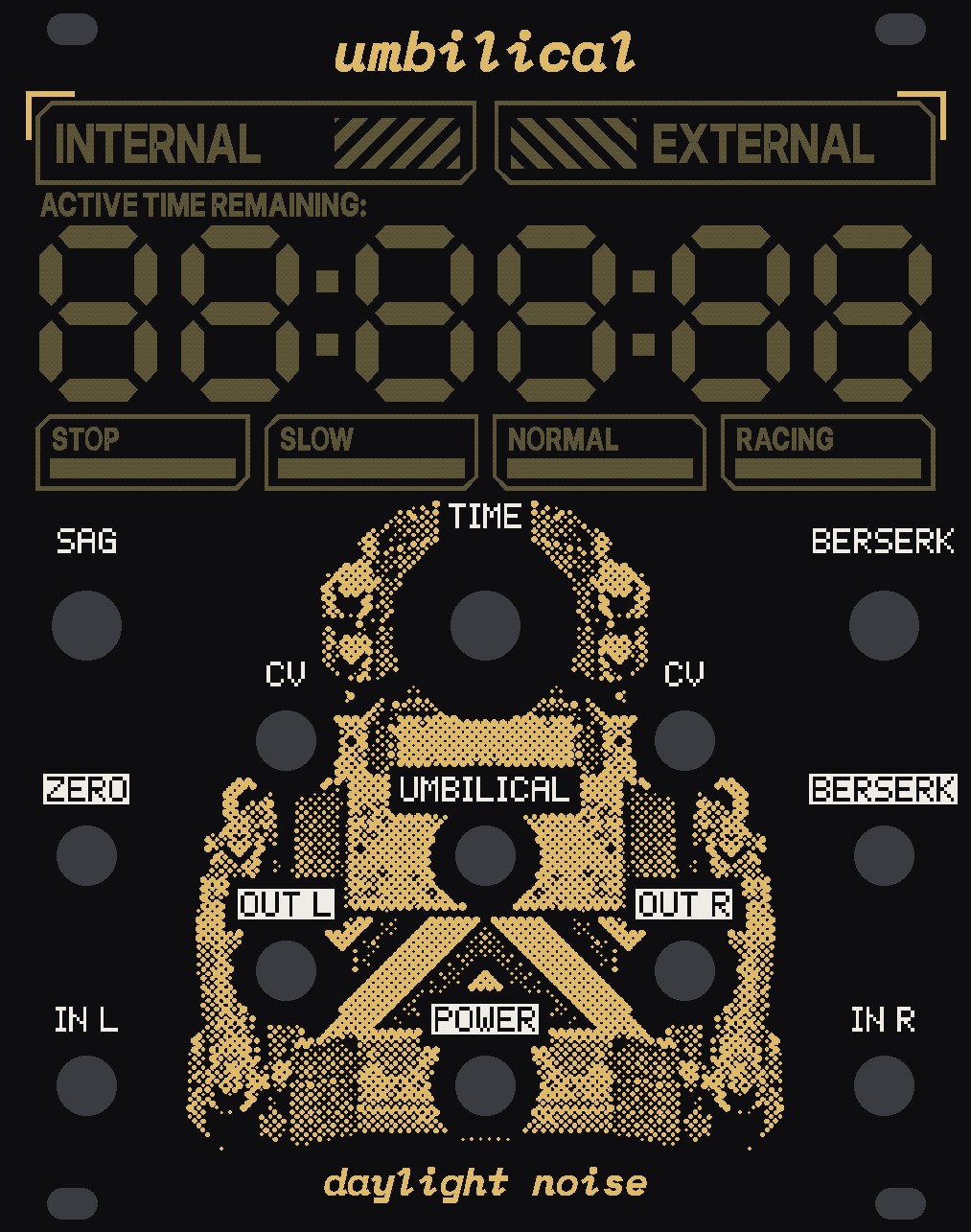
The UMBILICAL panel: black, its top third a screen of windows in bare circuit board, INTERNAL and EXTERNAL in boxes with hazard stripes, ACTIVE TIME REMAINING over six seven-segment digits, then STOP, SLOW, NORMAL and RACING with a bar under each. Below, a heavy plug in gold halftone comes down the middle, round the knobs SAG, TIME and BERSERK and the jacks. umbilical at the top, daylight noise at the bottom.

Turn a knob: drag it, roll the wheel over it or use the arrow keys; a double click puts it back. Pull the cable out of UMBILICAL: drag the plug away or click it, and put it back the same way or click the jack. Until you do, it pulls and replugs its own.

ZERO out
0 V
BERSERK out
0 V
POWER out
8.0 V
SAG
TIME
BERSERK

silent until Listen · On the mains.

The input and OUT L/R, made in the page.

example patches

The module's own engine, running in your browser: the firmware's C, ported line for line and checked against it bit for bit.

The cable

UMBILICAL is a switched jack. With nothing in it, it reads low. With a cable in it, it reads high, even with the cable's other end hanging loose, so the cable itself is the mains: while it's in, the module runs clean, IN L/R straight through to OUT L/R. Pull it and the module is on its reserve.

Patch a gate into it instead and the gate is the mains: high, it runs clean; low, it's on its reserve. A clock makes it breathe, draining and filling in turn.

The reserve

TIME is how long a full reserve lasts at a normal pace: 10 seconds to 10 minutes, 5:00 at noon. The pace follows how hard IN L/R are working, and the digits count down at it:

On the mains the pace is still shown, as a meter. Plug back in and the reserve refills in about three seconds, the digits running up, and the sound comes back with it. POWER is the reserve as a CV, 0 to 8 V.

SAG

SAG sets how the sound fails as the reserve runs down. At zero it's a plain fade. Turned up, the pitch sags, a granular shifter falling as far as an octave; a starved fuzz cuts in, sputtering and gating the way a dying battery does; and a low-pass closes over the top. Most of it happens in the last third: fine, fine, fine, then going.

At zero it dies. The outputs go silent, and ZERO goes high (+5 V) and stays high for as long as it's dead. SAG and BERSERK each have a CV in beside them: ±5 V adds or takes half the knob.

BERSERK

BERSERK is the chance, decided the moment it dies, that it comes back. At zero it never does; fully up, it always does. After a second to six of silence it returns on its own, roaring: louder, driven hard, the filter wide open, a little sharp.

The BERSERK gate is high while it rages, and POWER flickers between 5 and 8 V. It ignores the cable, and stops when it decides to, after 5 to 40 seconds, longer the higher BERSERK is. Then it's dead again, or charging if it's plugged in.

The screen

There's no display. The panel is a circuit board, and every word, outline, bar, stripe, segment and colon on the screen is a window: no copper and no solder mask on either side, just the glass-cloth board, which glows when the LEDs behind it light. Between the windows the copper stays on both faces under black mask, so a lit window can't leak into its neighbour through the board. Every segment of the six digits has its own window, its own LED and its own cell of a black printed baffle behind the panel.

On the mains, EXTERNAL lights and the digits are amber. On the reserve, INTERNAL and its stripes go red and the digits count down. Dead, it's dark but for a dim 00:00:00 and INTERNAL's stripes, pulsing slowly. Berserk, all of it is red, flickering hard (this page softens the flicker). How the light looks through the board is the one thing a drawing can't settle, so a small test panel comes first.

Inside

One board sits right behind the panel: the jacks, the pots and 69 RGB LEDs on its front, an RP2350 and the converters on its back. IN L/R go through a 24-bit converter 46,875 times a second, and the same engine that runs on this page runs there, the page's copy checked against it bit for bit. The LEDs have their own supply, and the firmware caps their current so the whole module stays inside its power budget.

The UMBILICAL panel, flat.

Drag to look around. Lift the panel to see the baffle and the board behind it.

Specs

Format

Standard
Eurorack, 3U
Width
20 HP (101.3 × 128.5 mm)
Depth
About 25 mm with the power cable (an estimate until one is built)
Panel
FR4, black mask, bare-board windows, gold (ENIG) art
Power
+12 V about 220 mA at most (the LEDs capped), −12 V about 12 mA: estimates until one is built

I/O

IN L/R
Audio, about ±5 V; IN R takes IN L when it's empty
OUT L/R
Audio, about ±5 V
UMBILICAL
A cable in it, or a gate: high above 1.5 V
CV in
SAG, BERSERK: ±5 V
Gates
ZERO, BERSERK: 0 / +5 V
CV out
POWER: 0 to +8 V

Engine

Brain
RP2350
Audio
Stereo, 24 bits at 46.875 kHz
Reserve
10 s to 10 min at NORMAL
Screen
59 windows, 69 RGB LEDs

Nothing's for sale yet.

UMBILICAL is being designed, and its engine runs here. Nothing's built yet, and there's no date.