two heads

no continues

20 HP

A chip voice from inside a 1980s games console: two square waves, the heads, kept to the chip's own limits. A sequencer plays the left head through PITCH and GATE; the right head plays your line back behind and apart, and its notes come out to play another module.

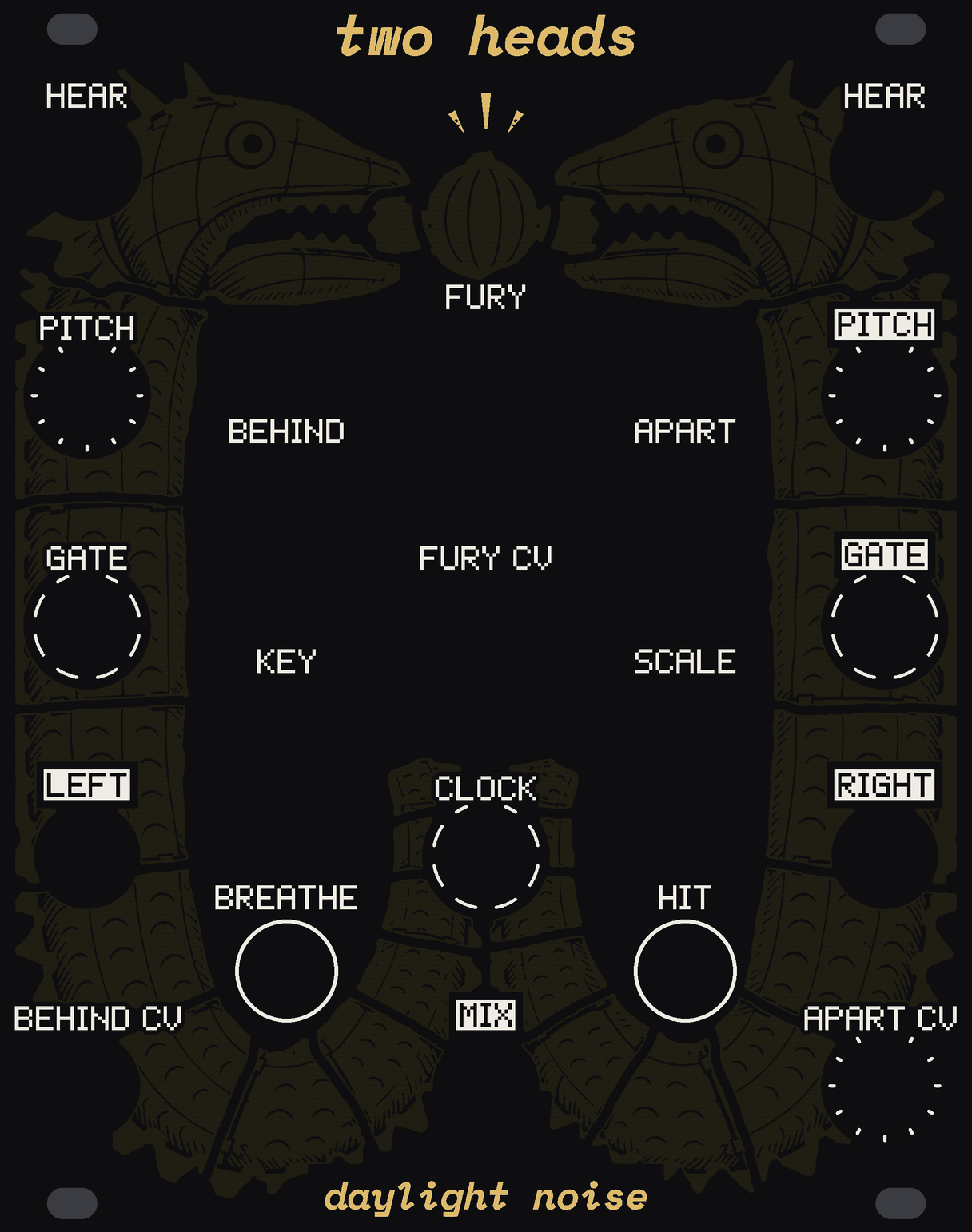
The TWO HEADS panel, black and gold: two Chinese-style lantern dragons made of red, orange and yellow paper over bent wire, mirrored about the middle, their big heads at the top facing each other with their jaws wide open and paper teeth showing, a small round paper lantern of flame between them. Each dragon's body is a tube of paper segments joined by dark wire hoops, running straight down the panel's edge, curling in along the floor at the bottom and up again in the middle, where the two tails nearly touch. The heads, the segments, the flames and the ball are bare glass for light, drawn over in black ink like a print: the wire frame of each skull, the eyes, the wire hoops and their tape, the ribs, rows of painted scales and a little hatching where the paper turns away. Three small gold sparks fly up over the ball. FURY, the big knob, sits under the ball of flame; a small chrome toggle switch sits on the back of each dragon's head, HEAR printed over it; the four other knobs and the two buttons sit inside the curl of the bodies, the jacks down the outer edges on the dragons' necks, and one more where the two tails meet in the middle.

Turn a knob: drag it or tap either side of it, roll the wheel over it or use the arrow keys; a double click puts it back. FURY is how much the chip shows off. BEHIND is how far the right head trails the left. Hold BREATHE down to breathe fire; press HIT to land a hit. Flip a HEAR switch down to take its head out of MIX.

Synthesised here, as the module would make it: the chip's own square waves and noise, played by a stand-in rack.

example patches

Everything TWO HEADS does here is its engine as designed, in your browser. The sequencer that plays it in every patch, the LFO, the chip bass and drums, the synth, the rock band and the beeps are a stand-in rack.

A voice from a games console

Inside a 1980s games console was a sound chip with three square waves and a noise, switched on and off sixty times a second. That was the whole band. TWO HEADS is two of those square waves, the heads, kept to the chip's own limits: the same plain squares, the same sixteen steps of loudness, the same slightly out-of-tune top notes.

Play it like any other voice. Put a sequencer's notes into PITCH and its gates into GATE, on the left dragon's neck, and take a cable out of MIX. The left head plays each note the moment its gate goes up. With nothing in GATE it's quiet.

One chases the other

The right head plays your line back: the very same notes, a moment later, a little quieter. That's the module's idea, and it's an old trick: with only three notes at a time, the music of the day made one voice into two by having a second one echo the first. One sequencer line, two parts.

FURY

Fire and hits

In a rack

Specs

Format

Width
20 HP
Controls
five knobs (FURY, BEHIND, APART, KEY, SCALE), two lit buttons (BREATHE, HIT), two switches (HEAR, one for each head: up, it's in MIX)
Lights
the two dragons in 27 cells: each head, eleven body segments each, the two jaws' flames, the ball of flame

Inputs

CLOCK
clock, a pulse every sixteenth: BEHIND counts in sixteenths; unpatched, BEHIND is a time
PITCH
1 V an octave, the left head's note (0 V is C3)
GATE
gate: the left head plays a note while it's high
FURY CV
CV, added to the knob, 5 V the whole turn
BEHIND CV
CV, added to BEHIND, 5 V the whole turn
APART CV
1 V an octave, the harmony: 0 V (C3) the same notes, below it the right head goes below

Outputs

MIX
audio, both heads and the fire (less a head whose HEAR is down, or with its own cable)
LEFT
audio, the left head
RIGHT
audio, the right head
PITCH
1 V an octave, the right head's notes (0 V is C3)
GATE
gate, high while the right head holds a note