twice

don't repeat yourself

20 HP

It holds every bar up against the bar before and counts the repeats. When its patience runs out it changes something in the next bar. Play something new and it relaxes.

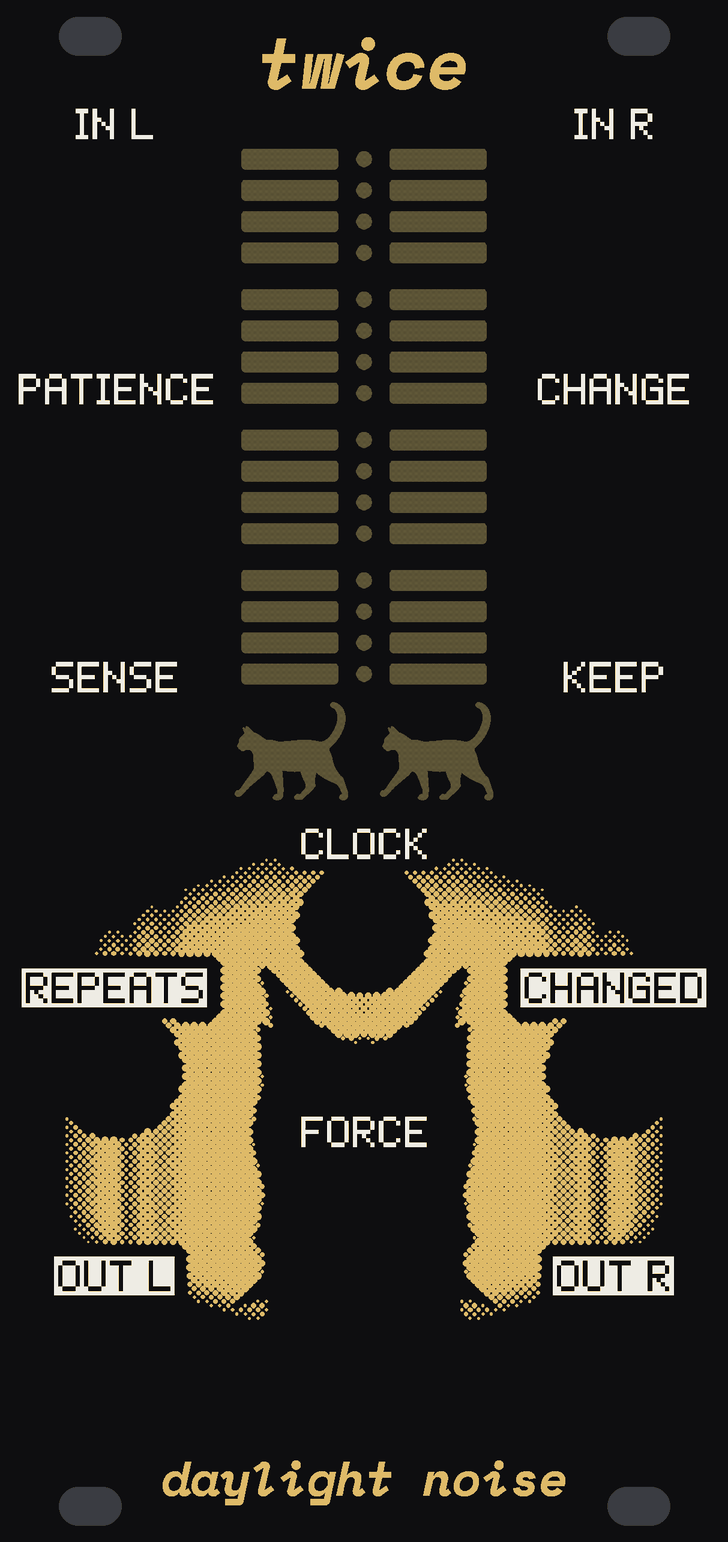
The TWICE panel: black, with long curtains in gold dots hanging either side from top to foot, and a cat sitting with its back to you between them, on a floor, its ears either side of the TEMPO jack. Across the top half, in the place of a window, sixteen rows of bare circuit-board bars, three to a side, with a column of dots between them; two small walking cats out on the curtains under them. White labels: LEFT and RIGHT, the ins, at the top corners, PATIENCE and CHANGE then SENSE and KEEP down the sides, TEMPO on the spine, AGAIN on a black button on the cat's back, FORCE and CHANGE's second jack either side of the cat, the outputs REPEATS, CHANGED, LEFT and RIGHT at the sides' foot; TEMPO, FORCE and CHANGED ringed with dashes. twice at the top, daylight noise at the bottom.

Turn a knob: drag it or tap either side of it, roll the wheel over it or use the arrow keys; a double click puts it back. AGAIN plays the last change once more: wait for one you like, then press it.

What you hear is the rack through TWICE. The drums, the bass and the arp are made in the page as you listen.

example patches

The bars, the count and the sound here are TWICE's engine as it's designed, running in your browser: every bar it hears, every change it makes. The drums, the bass and the arp are a stand-in for the rest of a rack.

Hearing the loop

Everything goes straight through, on the clock. TWICE hears every sixteenth of the bar in three bands, low, middle and high, and keeps how hard a hit starts in each and when. Then it holds the bar up against the bar before, sixteenth by sixteenth. The bars show it: the bar before on the left, this bar on the right, each with the low band by the middle and the high band outside.

The count

A bar the same as the one before adds one to the count, and the pips climb from the foot. Anything different clears it. When the count reaches PATIENCE it acts on the next bar. That bar isn't counted, so it starts again from the one after.

What it changes

It records every bar. Because the loop repeated, the bar it just recorded is the bar that's coming, so it plays the next bar from the recording, rearranged a sixteenth at a time, on the grid. Nothing comes in late, and the seams are crossfaded. The cats light, one after the other.

Specs

Format

Width
20 HP
Controls
4 knobs, 1 button

Inputs

LEFT, RIGHT
audio, ±10 V; RIGHT normalled to LEFT
TEMPO
clock, quarter notes, rising past 1.5 V
FORCE
gate or trigger, rising past 1.5 V
CHANGE
CV, adds to the knob, 5 V the whole way

Outputs

LEFT, RIGHT
audio
REPEATS
CV, 0.5 V a repeat
CHANGED
trigger, 5 V for 10 ms