turnabout

meet in the middle

20 HP

A delay that plays every phrase back twice at once: forwards on the left, backwards on the right, from opposite ends. Half way through they play the very same moment together, in the middle, then pass through each other. On the beat.

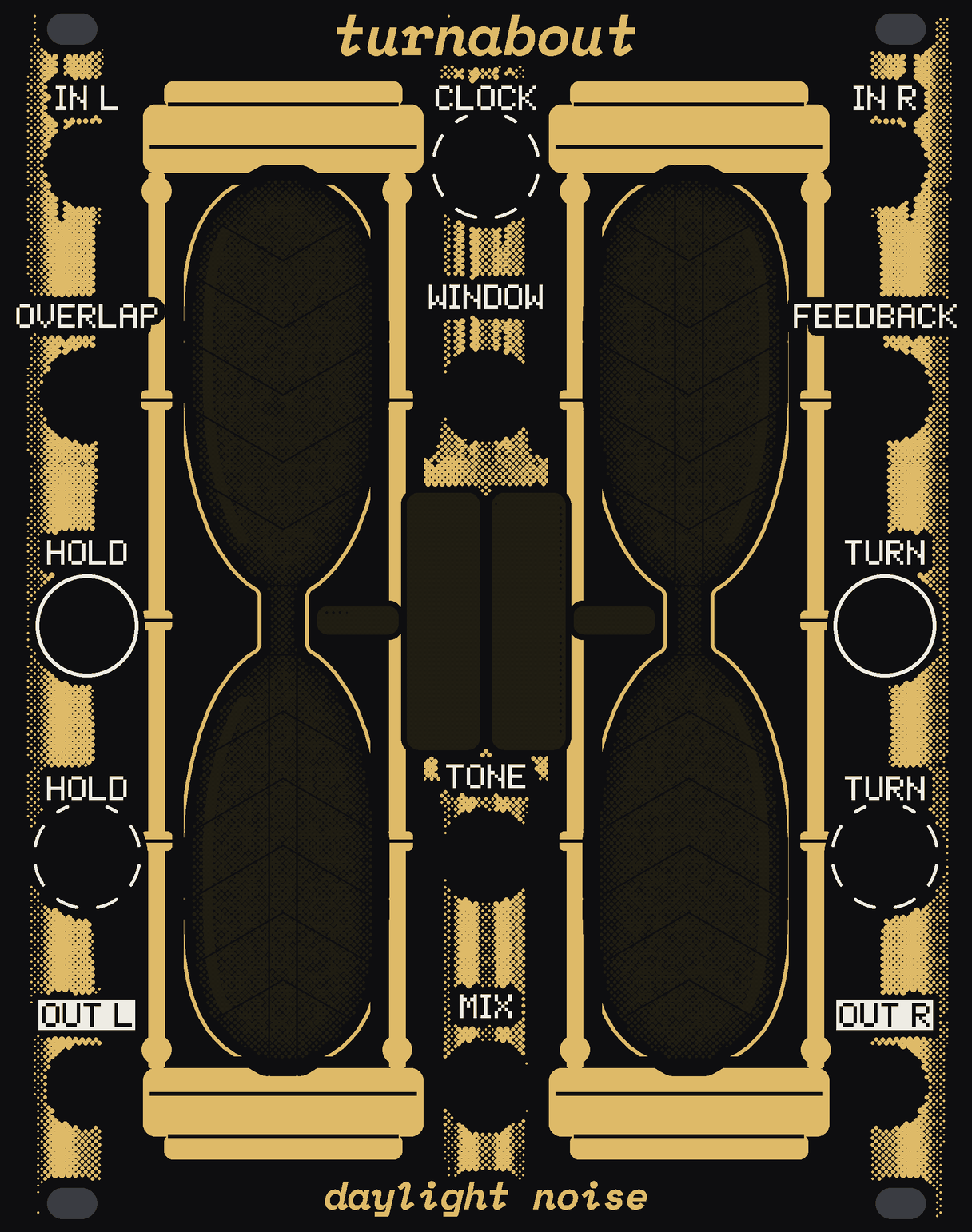
The TURNABOUT panel, black and gold: two tall hourglasses stand side by side in drawn brass frames, each with a plate top and bottom and posts with rings, brass pillars printed in gold dots down the panel's edges. Their glass is bare and lit from behind, cut into bands that follow the sand's own slopes, the left hourglass for red light and the right for blue; short glass tubes run from each waist to a small glass drum on the middle line, between the big WINDOW knob above and TONE below. The jacks and the HOLD and TURN buttons run down both edges, MIX at the foot between the two outputs.

Turn a knob: drag it or tap either side of it, roll the wheel over it or use the arrow keys; a double click puts it back. HOLD keeps the phrase turning; TURN turns now. The patches step on by themselves until you touch anything.

Synthesised here, as the module would make it: its two copies and their meeting, round a stand-in rack's dry band.

example patches

TURNABOUT here is its engine as designed, in your browser: it hears only what comes into its jacks. The kalimba, the snaps, the kick, the marimba and the beeps are a stand-in rack, played dry.

One cable, two ways

Your sound into IN L, your clock into CLOCK, OUT L and OUT R to your mixer. Each bar you play comes back during the next, forwards on the left and backwards on the right, both starting at once from opposite ends. On the third beat they reach the same moment and play it together, in the middle, then pass through each other. Noon on every knob does that.

WINDOW

OVERLAP

OVERLAP is how much of the phrase each copy plays. Fully left they take turns: forwards plays the first half, then backwards plays it back from that very note, so a phrase that goes up comes back down. At noon they cross in the middle. Fully right both play all of it.

FEEDBACK and TONE

HOLD and TURN

MIX, and mono

MIX: your sound fully left, half and half at noon, only the copies fully right. Through one speaker a sound and its mirror image can hollow each other out where they meet, so round the meeting the right side hands over to the forwards copy: in stereo the sides close to the middle, in mono you hear one clean copy.

Specs

Format

Width
20 HP
Controls
five knobs (WINDOW, OVERLAP, FEEDBACK, TONE, MIX), two lit buttons (HOLD, TURN)
Lights
two hourglasses of light: 54 cells, 119 LEDs
Replaces
a reverse delay, a second delay to play it forwards, a way to sync both to the bar, and a crossfader
Here
a demo: the parts and the engine as designed, no board yet

Inputs

IN L
audio: your sound (both sides with nothing in IN R)
IN R
audio: the right side
CLOCK
gate: each rise a beat, 30 to 300 a minute (faster is counted down)
HOLD
gate: it holds while it's high
TURN
gate: each rise turns now

Outputs

OUT L
audio: your sound and the forwards copy
OUT R
audio: your sound and the backwards copy