tuning up

an orchestra you conduct

20 HP

An orchestra in a module. Left alone it warms up, every player on their own. Turn GATHER and they drift onto one note, then your chord, swelling. Hold HUSH for silence. Press DOWNBEAT and they land it, all at once.

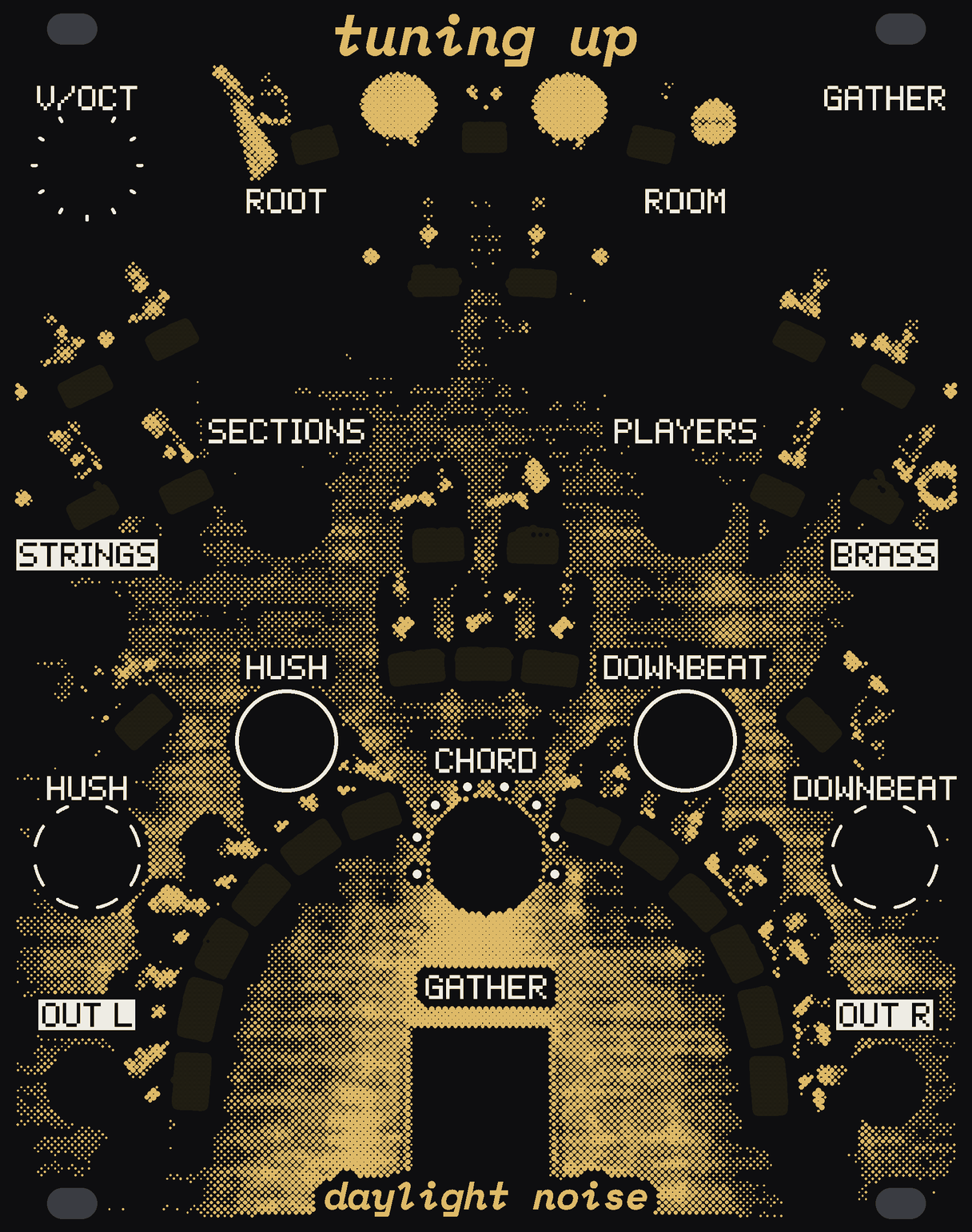
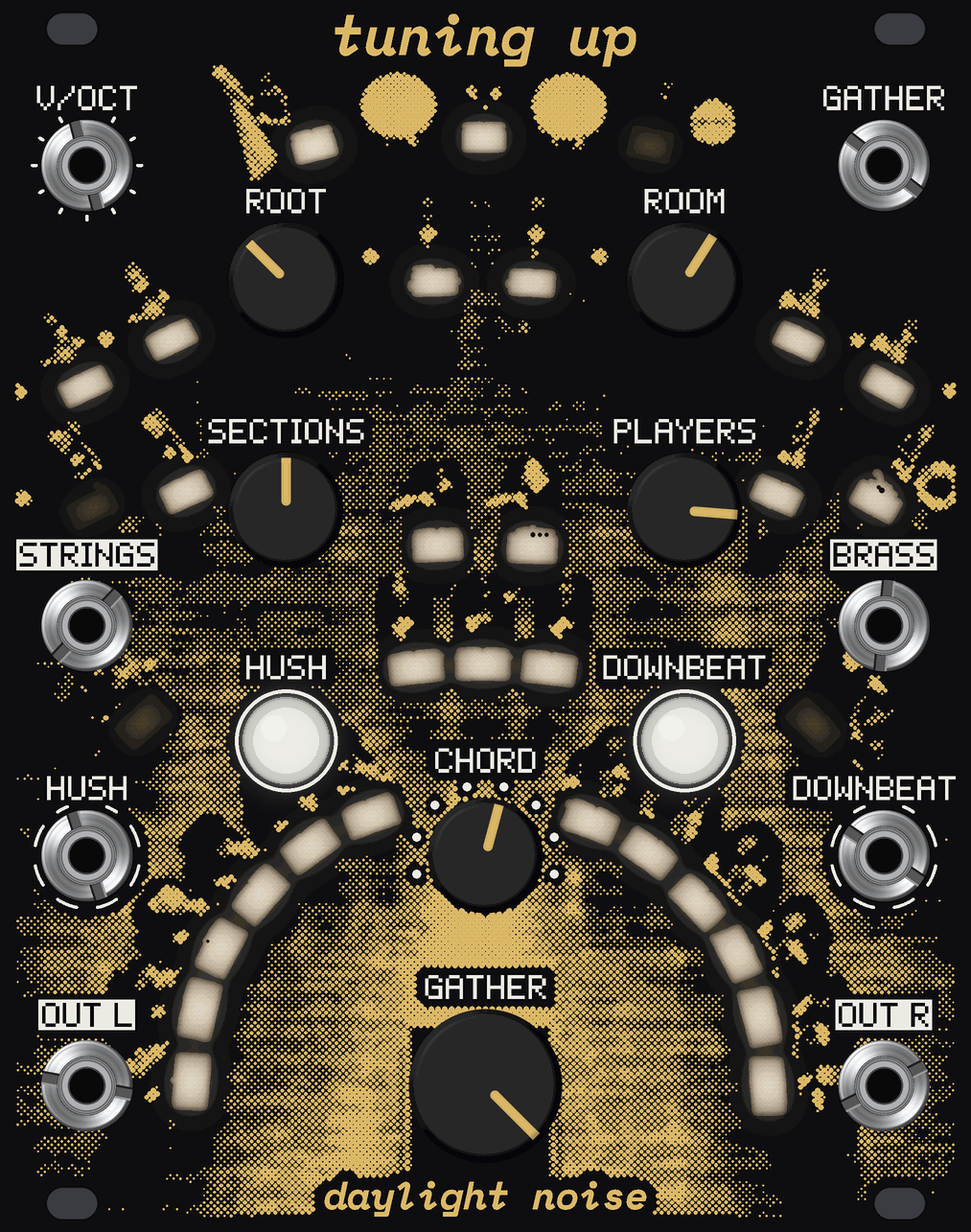
The TUNING UP panel, black and gold: a photograph of an orchestra on a dark stage, seen from straight above. The players sit in arcs fanning out from the conductor's empty podium at the foot: the violins and the cellos in a horseshoe round it, the flute and the oboes in the middle, clarinets and bassoons behind them, horns, trumpets, trombones and a tuba farther back, and the harp, two timpani and a cymbal at the top. Each music stand's small lamp lights its sheet music: thirty-two bright pages of light in the arcs, bare glass, their notes showing as fine black dots. The stage's boards, the players and their instruments are gold. GATHER, the big knob, sits on the podium, CHORD just above it; the other knobs and the two buttons sit among the arcs, the jacks down both edges.

Turn a knob: drag it or tap either side of it, roll the wheel over it or use the arrow keys; a double click puts it back. Hold HUSH for silence, DOWNBEAT for the chord. The patches step on by themselves until you touch anything.

Synthesised here by the module's own engine, with a stand-in rack.

example patches

Everything TUNING UP does here is the module's own engine, running in your browser. The drums, the pulse and the beeps that play with it are a stand-in rack.
Before the first note

The best sound in a concert hall comes before the music: dozens of players warming up on their own, then the oboe's long note and everyone drifting onto it, then silence, then the first chord, all together. TUNING UP is that orchestra, and you're the conductor.

OUT L and OUT R into your mixer and it's already playing. Every knob at noon is a good orchestra.

Players, not a pad

Gather

Downbeat, and hush

Who plays, and where

In a rack

Inside

The TUNING UP panel lit: an orchestra on a dark stage seen from straight above, the players in arcs round the conductor's podium, each music stand's lamp lit on its sheet music, the stage and the players in gold.

Drag it or use the arrow keys to turn it; click it to take it apart.

Specs

Format

Width
20 HP
Depth
20.6 mm behind the panel
+12 V
about 107 mA, 186 mA on a DOWNBEAT, 206 mA at most (estimated)
−12 V
about 5 mA (estimated)
+5 V
not used
Controls
five knobs (GATHER, ROOT, SECTIONS, PLAYERS, ROOM), an 8-stop switch (CHORD), two lit buttons (HUSH, DOWNBEAT)
Lights
thirty-two stand lamps, one a player: 32 RGB LEDs, one a lamp

Inputs

V/OCT
1 V an octave, added to ROOT
GATHER
CV added to its knob, 0 to 5 V the whole way
HUSH
gate: silence while high
DOWNBEAT
gate: the chord, held while high

Outputs

OUT L
audio, the orchestra's left with the hall
OUT R
audio, its right with the hall
STRINGS
audio, the strings alone, dry
BRASS
audio, the brass, timpani and percussion alone, dry

Engine

Brain
RP2350 at 192 MHz, both cores, 37.5 kHz: this page's engine, to the bit