tumbler

feel for it

20 HP

A low-pass gate you have to crack. A motor in the dial makes every note a notch you can feel: right to the first number, left to the second, right to the third. Stop on the one that gives and turn back. Each bolt opens a band, the three make a chord, and the door lands on the next kick.

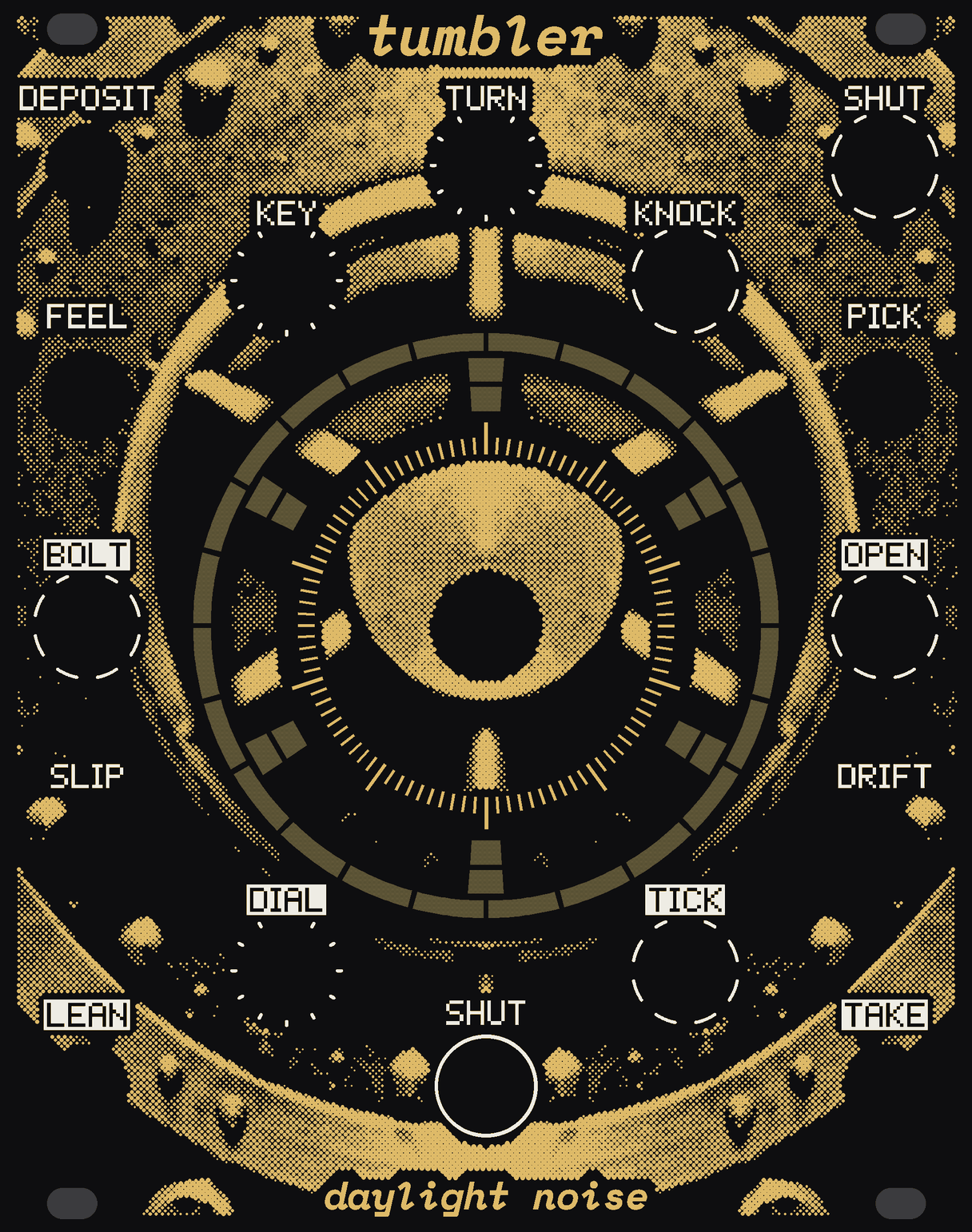
The TUMBLER panel: black, with gold dots of a round steel door. In the middle a graduated ring of a hundred fine ticks, and round it in bare circuit board a wheel of six spokes and a rim. Four knobs, FEEL, PICK, SLIP and DRIFT, eleven jacks, and a button, SHUT, at the foot.

Turn the dial or a knob: drag it or tap either side of it, roll the wheel over it or use the arrow keys; a double click puts a knob back. SHUT is a button: press it and the door slams. The patches step on by themselves until you touch something.

A dark loop in A minor at 112 BPM locked in TUMBLER, and a plucked voice for the dial. Listen plays the patch from its top.

example patches

Everything TUMBLER does here is its engine as designed, running in your browser, the dial's weight and motor included. The loop and the voice are a stand-in rack.

The door

Patch a sound into DEPOSIT and it's locked in: low, heavy, barely there. Right to the first number, left to the second, right to the third, as you would a real safe. Stop on the right one and turn back and a bolt draws. Three bolts and the door swings, and it lands on the next knock.

What it feels like

What else it does

The dial is in the sound. Lean it out of a notch or turn it quickly and the door gives, so every notch is a pluck and a spun dial opens the sound until it coasts to rest.

What comes out

Specs

Format

Width
20 HP
Controls
a motorised dial, 4 knobs, a button

Inputs

DEPOSIT
audio, ±5 V
KEY
1 V an octave
TURN
1 V an octave, half a turn
KNOCK
gate or a kick, past ±1 V
SHUT
gate, rising past 1 V

Outputs

TAKE
audio, ±5 V
DIAL
1 V an octave
TICK
trigger, 5 V, 5 ms
BOLT
trigger, 5 V, 30 ms
OPEN
gate, 5 V
LEAN
CV, 0 to 8 V