20 HP · a double of you
A double of you that comes to life. Play a voice, a lead or a bassline into it: TULPA hears your notes and the colour of your sound, and makes a copy of you out of pure tones, golden and clean and a little wrong. Turn WILL up and it stops copying. It says the ends of your phrases back, then answers them, then plays on when you stop, in your manner.
Turn a knob: drag it, roll the wheel over it or use the arrow keys; a double click puts it back.
example patches
The sound and the lights here are TULPA's own engine: the module's firmware, ported to the page and checked against it sample for sample. The drums, the bass, the pad, the lead, the singer and the voices are stand-ins for the rest of a rack.
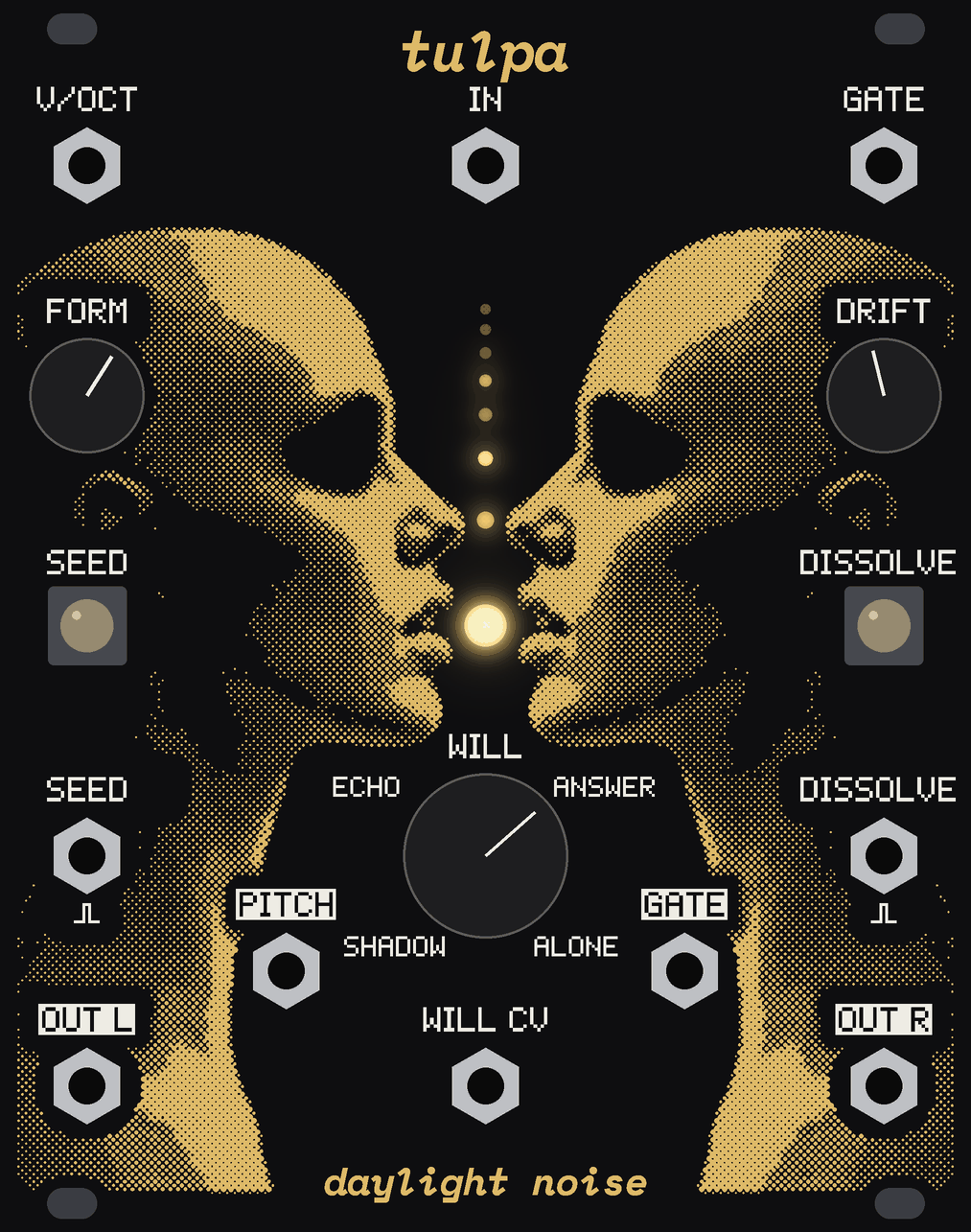
Whatever comes into IN, TULPA listens for one note at a time: its pitch, where it starts and ends, and its colour, the levels of its first eight partials. With V/OCT and GATE patched, the notes come from them instead, exactly, and IN gives only the colour. With nothing in IN, the colour is a plain one, each partial quieter than the last.
The tulpa is made of nothing but sine waves: up to eight of them at your pitch, at your colour's levels, following your loudness. It has no breath, no hiss, no grit. That's what gives it away. FORM sets how solid its body is: one pure tone fully anticlockwise, then each partial opening in turn from the bottom up, to all eight. It stays as loud as you all the way, so FORM changes its colour, not its level.
With OUT L and OUT R both patched, you come out of OUT L untouched and the tulpa out of OUT R, so it can stand beside you in the mix. With only OUT L, you're both in it together.
WILL, the big knob, is how much it does on its own. It's one sweep, and the behaviours fade into each other by chance rather than switching: halfway between ECHO and ANSWER, it echoes some phrases and answers others.
WILL CV adds a tenth of the knob's travel a volt, so a sequencer can call it closer or send it off on its own.
From every note you play it learns the interval from the one before, how long after it came, how long you held it, which notes of the scale you use and how high and low you go. It keeps your last eight phrases and the gaps between them. Its own phrases take the shape of one of yours, with your intervals and your timing, in your range and your key.
DRIFT is how far it strays the longer it lives. Its tuning, its timing, its habits and its colour each wander slowly from yours, a little at first and more over the minutes, until it's plainly something of its own. At zero it doesn't stray at all, and stays in tune however long it lives.
SEED, a lit button and a trigger in, makes a new one. It forgets everything and waits, and at your next note it's born: one pure tone at first, growing over a couple of seconds into as many partials as FORM allows. Hold SEED for a second and it stops learning: you keep this one, and the cap stays lit until the next tap.
DISSOLVE, also a lit button and a trigger in, ends it. Its partials glide down into the fundamental, the top one first, so for a second you hear its harmonics fall and beat against each other into a single golden tone. That tone fades over a few seconds, and it's gone. When you play again it grows back from its seed, young, but remembering how you play.
PITCH and GATE are its notes, 1 V an octave, to play another voice in the case: a bassline in your manner, from your lead.
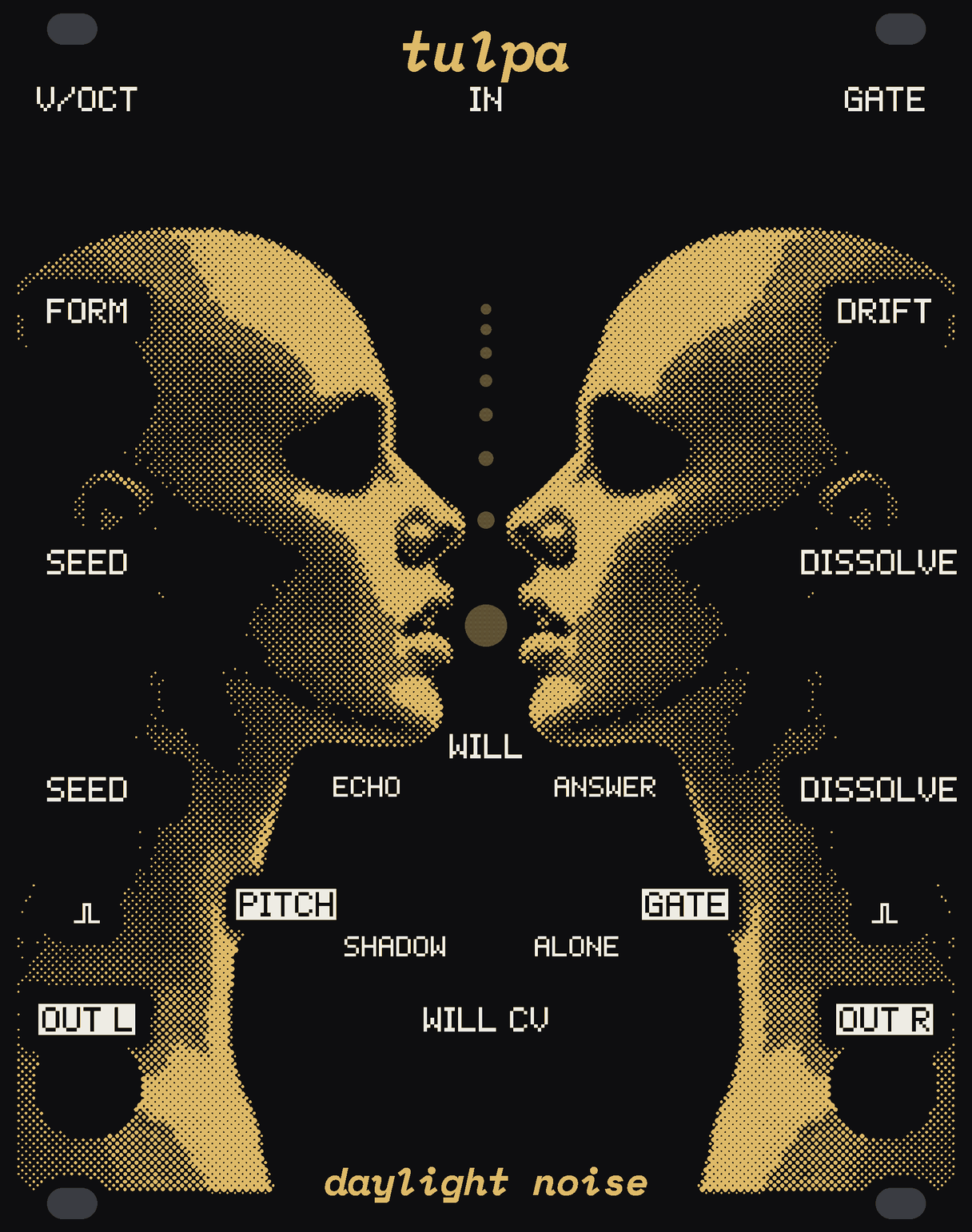
Twenty HP, every part on the line's staggered grid and mirrored about the middle. The art is two identical faces in profile, nose to nose across the middle in gold dots on black: the panel's mirror is the double. The black between them is a vase.
Between the parted lips is the seed, a round window of bare glass lit golden from behind: dark before it exists, dim as a shadow, bright when it plays alone, breathing with its notes. Above it, seven small windows rise between the noses and brows, spaced as the partials are, an octave every 11 mm, so they crowd together as they climb. Each is lit as loud as its partial sounds. FORM opens them from the bottom up; DISSOLVE pours them down into the seed.
One four-layer board sits 10 mm behind the panel, with the jacks, the knobs, the two buttons and eight tiny RGB LEDs on its front and everything else on its back. A black printed baffle stands on the board up the middle, a cell for each window, so the seed and each partial light only their own glass. An RP2350 runs it on both of its cores: one listens, finding your pitch and your colour, and the other plays, 46,875 times a second. PITCH and GATE come from a 16-bit DAC, and both PITCH and V/OCT can be calibrated over USB with a meter and two readings.
Drag to look around. Lift the panel: the knobs and the nuts go with it, and the baffle stays on the board, its cells lit from the LEDs at their feet. SEED and DISSOLVE stand on the board too.
TULPA is designed and its firmware builds. Nothing has been made, so the numbers here are the design's and the engine's, not measurements, and there's no date.