topple

does it fall?

20 HP

A spinning top as modulation. Spin it and it circles, slows, leans out and nods until it falls and lies still. Its lean is two LFOs, its nod a vibrato, its spin an envelope, its fall a trigger. Unless you're dreaming.

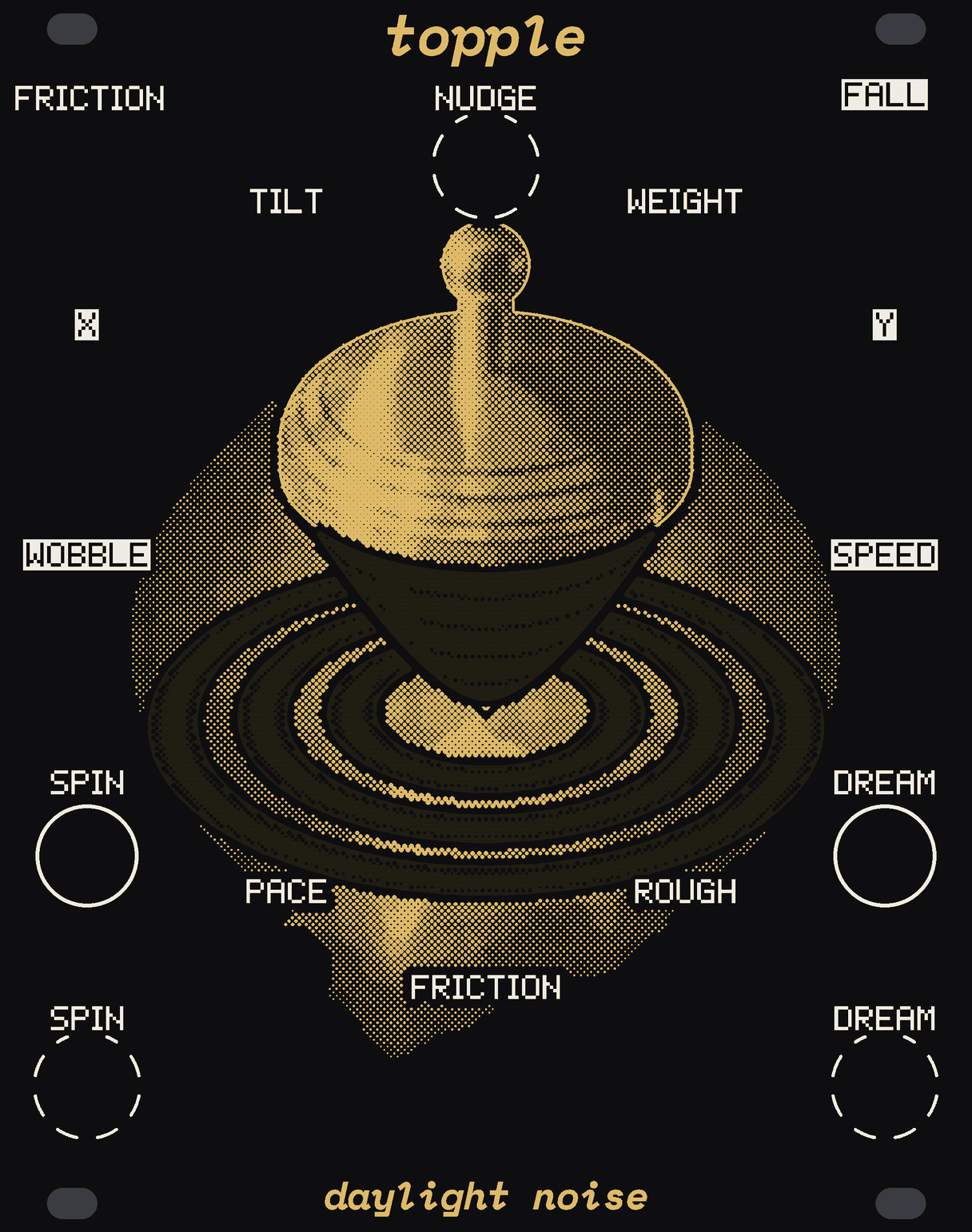
The TOPPLE panel, black and gold: a photograph in gold halftone of a polished brass top standing on its point on a dark polished table, seen from a little above and lit from the left, turned rings round its brass dome and a ball on its handle, its lower half a cone of clear glass. The table is black but for a pool of lamplight round the top and the top's faint reflection under its point. Round the point, three thin bands of light lie on the table in perspective, their backs passing behind the glass: the inner band where the top spins upright, the outer where it leans hard just before it falls. The bands and the glass are bare glass for light. FRICTION, the big knob, sits at the foot of the table; TILT and WEIGHT by the top's shoulders, PACE and ROUGH by its point; the SPIN and DREAM buttons either side, each over its gate jack; NUDGE at the head of the spine over the handle; the outs and FRICTION's CV up the sides.

Turn a knob: drag it or tap either side of it, roll the wheel over it or use the arrow keys; a double click puts it back. Press SPIN to spin the top; press DREAM to keep it dreaming, and again to let go. The patches step on by themselves until you touch anything.

Synthesised here. TOPPLE makes no sound: you're hearing a stand-in rack, played by the module's outs.

example patches

Everything TOPPLE does here is its engine as designed, in your browser: the spin, the lean, the nod, the fall. The pad, the glass lead, the bass and the brushes are a stand-in rack.

Spin it and watch it fall

A top spun hard stands up straight and sleeps. As it slows it leans out, and its lean goes round: a slow circle that gets wider and faster as it runs down. It nods as it goes, a little at first, wildly at the end. Then it falls, and lies still where it fell.

TOPPLE is that top as voltages. Patch X into a pan and Y into a filter and press SPIN: your sound goes round you, gently at first, then wider and faster, until it stops dead, wherever the top fell. FALL fires as it hits the table: patch it to whatever should happen next.

The panel shows it all. The light on the table round the top's point is where it leans: a bright streak sweeping round the inner band while it spins upright, moving out band by band as it slows, its colour going from ice blue through violet and rose to red as the spin runs out. The glass body glows with the spin and goes dark when it falls. Afterwards one red light shows where it lies.

The top

Five outs, one top

Dreaming

Press DREAM and the top is dreaming: its spin holds where it is, for ever. It settles upright, its nod fades to the faintest, the trail turns gold, and it never falls. Press it again and it carries on slowing from where it was. A gate into the DREAM jack does the same while it's high: dream through the verse, wake for the chorus.

Knocks and bumps

In a rack

Specs

Format

Width
20 HP
Controls
a big knob (FRICTION), four knobs (TILT, WEIGHT, PACE, ROUGH), two lit buttons (SPIN, DREAM)
Lights
4 windows on 49 RGB LEDs: the trail's three bands round the top's point, and its glass body
Replaces
two LFOs, a slow envelope, a vibrato LFO, a random trigger, a sample and hold and a slew
Parts
a demo for now: the line's knobs, jacks and buttons, no board yet

Inputs

SPIN
gate: spins it on each rising edge, as hard as the gate is high (5 V full)
DREAM
gate: dreaming while it's high
NUDGE
gate: knocks it on each rising edge (5 V a full knock)
FRICTION
CV: adds to FRICTION, a fifth of its turn a volt

Outputs

X
its lean side to side, ±5 V
Y
its lean front to back, ±5 V, a quarter turn behind X
WOBBLE
its nod, up to ±5 V
SPEED
its spin, 0 to 8 V
FALL
trigger, 5 V, as it hits the table