20 HP · vocal chops
Vocal chops you play as notes. Sing, or patch any voice, into IN while TAKE is held, and TONGUES cuts the take into syllables. Then every gate sings the next one at the pitch on V/OCT, in tune, its consonants intact: a voice turned into an instrument.
Turn a knob: drag it, roll the wheel over it or use the arrow keys; a double click puts it back.
Hold TAKE, the lit button at the foot of the panel, while the voice sings, to take it again; let go and it's cut into syllables.
example patches
The module's own engine, running in your browser: the firmware's cut, its four voices and its lights, ported from its C and checked against it bit for bit. The drums, bass and pad are made in the page; the four voices are short spoken lines, cut into syllables here as TONGUES cuts a take.
Hold TAKE, the button or a gate at the TAKE jack, and TONGUES records IN, up to 8 s, in place of the take it had. It listens as it records, following the voice's loudness and the moments its sound changes and tracking its pitch to tell what's voiced from what isn't, so when you let go the cut is done a moment later. It cuts in the dip between two vowels, on the consonant that starts the next one.
Silences are dropped. A syllable is 70 to 600 ms long (a longer one is split at its deepest dip), and a take holds 32 of them at most. While TAKE is held you hear what it's taking at the outs; the old take keeps singing until the new one is cut, and a press too short to hold a syllable leaves it alone.
CUT is how much of each syllable plays: 15 ms at the bottom, just its consonant, a click; about 95 ms at noon; all of it at the top. It's taken when the gate rises, so turning it changes the next syllable, not the one sounding.
If the gate is still high when it gets there, it holds: the pitch period at that point is repeated, a period of the note apart, for as long as the gate lasts. A short CUT under a long gate holds a buzzing consonant. A full CUT holds the vowel, since a syllable holds at the end of its vowel at the latest.
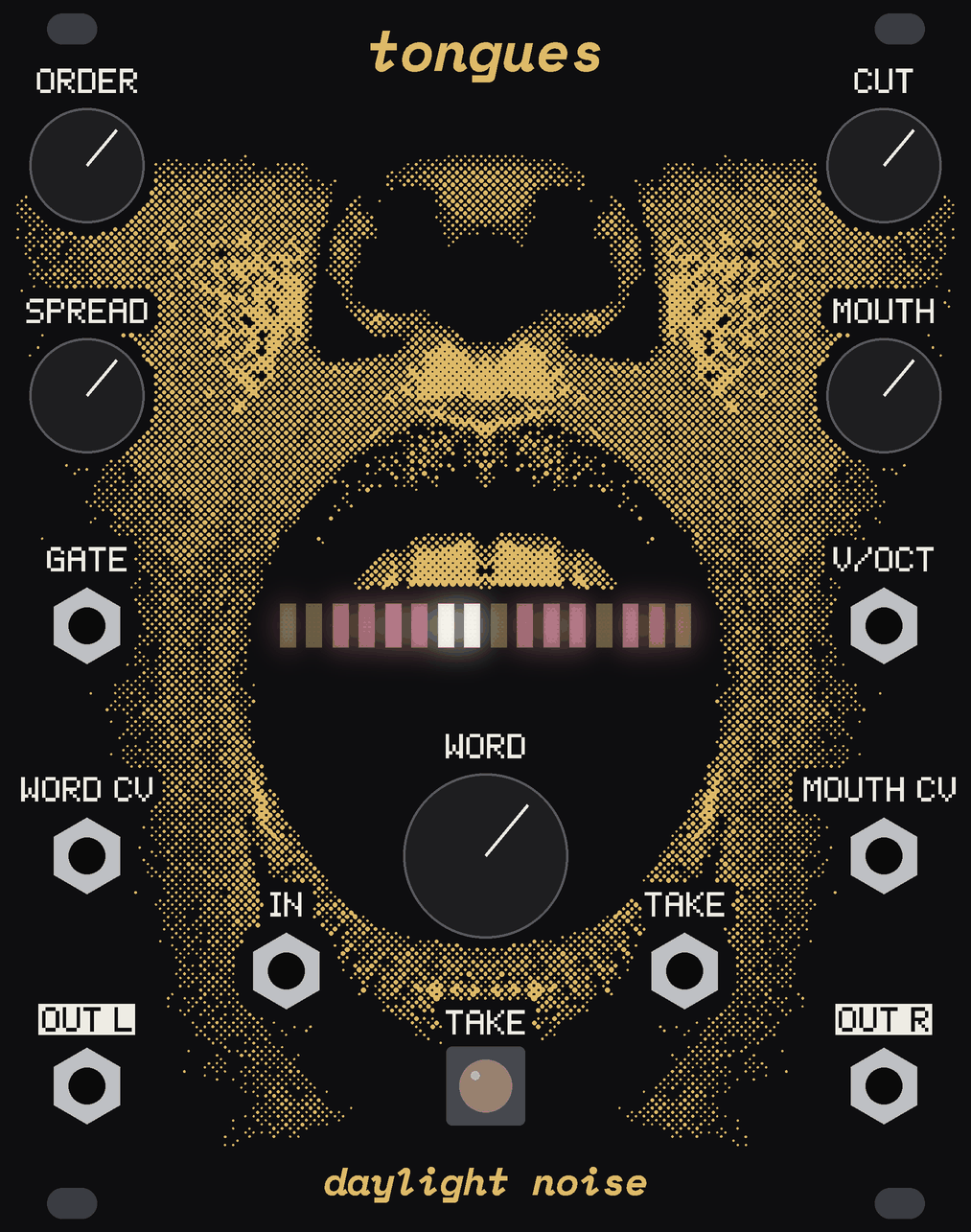
Sixteen windows in a row, lit from behind in a dusty rose, are the take laid out as a strip. Each is a sixteenth of it, dim where there's voice and dark in its silences, and bright under the syllable being sung. While TAKE is held they fill from the left as the take grows, one for each half second of the eight.
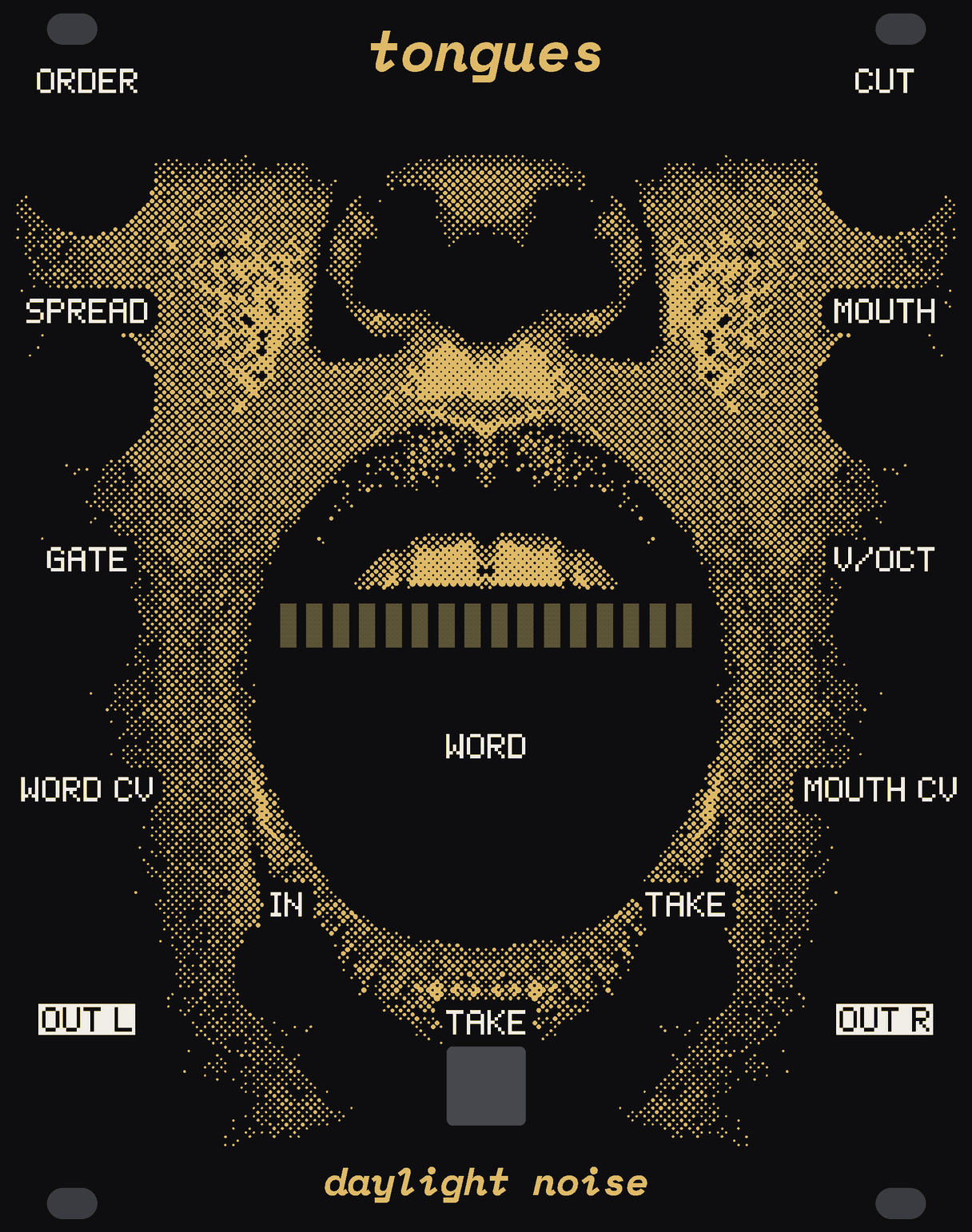
Twenty HP, every part on the line's staggered grid and mirrored about the middle. The art is an open, singing mouth in gold dots on black, the face from the nose down. The lights sit in a row just behind the upper teeth, and WORD lies in the dark of the mouth, where the tongue would be. The windows are bare circuit board, pale in room light. TAKE is a lit button at the foot; its cap glows red while it takes.
Drag to look around. Lift the panel: the baffle stays on the board, a black block with a cell for each window, its LED at the foot. One RP2350 does it all: one core sings, the other cuts each take as it comes in, into 8 MB of memory beside it.
TONGUES is designed and its firmware builds. Nothing has been made, so the numbers here are the design's and the engine's, not measurements, and there's no date.