thunder sheet

lay your hand on it

20 HP

A real sheet of steel on the front of the module, shaken by whatever you patch in and heard by two pickups. Press it and the ring dies under your fingers; tap it and the rack hears a tap. Turn up HOWL and it sings a note of its own, and you move that note with your hand.

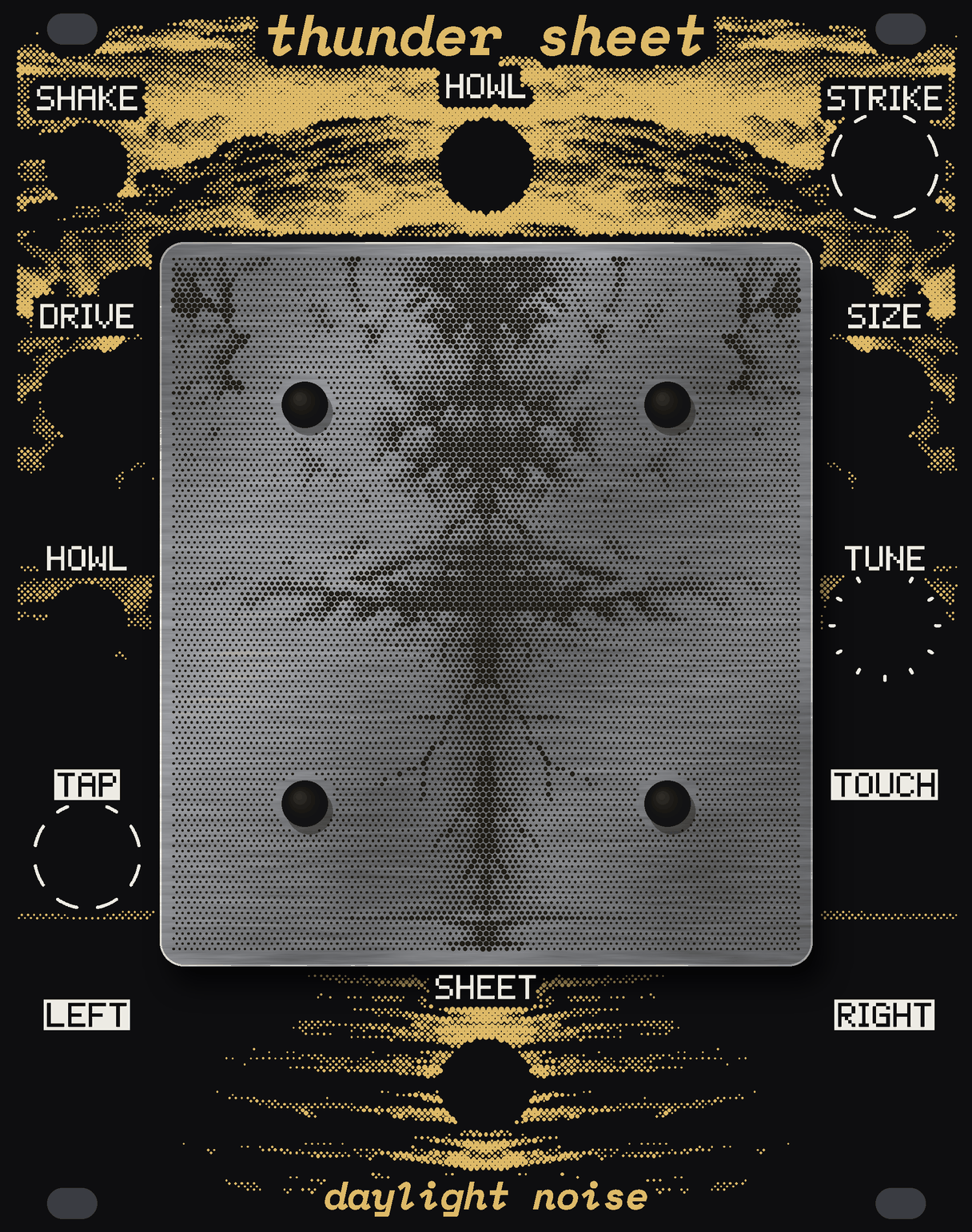
The THUNDER SHEET panel: black, a gold thunderhead along the top, a sheet of bare steel filling the middle, pierced all over with fine holes and with one bolt of lightning, on four small black rubber pins. HOWL a knob over it, SHEET a big knob under it, the jacks and two more knobs down both sides.

Turn a knob: drag it or tap either side of it, roll the wheel over it or use the arrow keys; a double click puts it back. The sheet is yours: press and hold it, tap it, drag across it, use two fingers; or tab to it, steer with the arrow keys, hold Space to press and Enter to tap. The patches step on by themselves until you touch anything.

A dark loop in the sheet's own key. Listen plays the patch from its top.

example patches

Everything here runs in your browser. The module's mix, SIZE, the HOWL loop and the lights are its engine as designed; the steel is a model of the real sheet, its notes worked out from its size. The rack is a stand-in.

The sheet

Thin steel on soft pins, an exciter shaking it from behind, two pickups stuck to it. It isn't a smooth reverb: a sheet this size has about seventy notes, none of them related, and rings for about a second. What goes in comes out as metal, short and dark at noon. It also sounds, quietly, in the room.

Your hand

Light comes through the holes from behind and shows where the steel is moving: bright where a note is strong, dark along the lines where it stands still. Those lines are the map. A finger on a bright patch kills that note in a few hundredths of a second. A finger on a dark line leaves it ringing.

HOWL

The pickups feed the exciter. A little and the ring lengthens. Past about one o'clock the sheet finds the note it likes best and blooms. Press where that note lives and it dies, and the loop jumps to the next one that can sing. That's the tuning: your hand, or TUNE.

SIZE

What comes out

Specs

Format

Width
20 HP
Controls
1 big knob, 3 knobs, a sheet of steel

Inputs

SHAKE
audio, ±5 V
STRIKE
gate
HOWL
CV, added to the knob, 5 V the whole way
TUNE
1 V/oct

Outputs

LEFT, RIGHT
audio, ±5 V
TAP
gate, 5 V
TOUCH
CV, 0 to 8 V