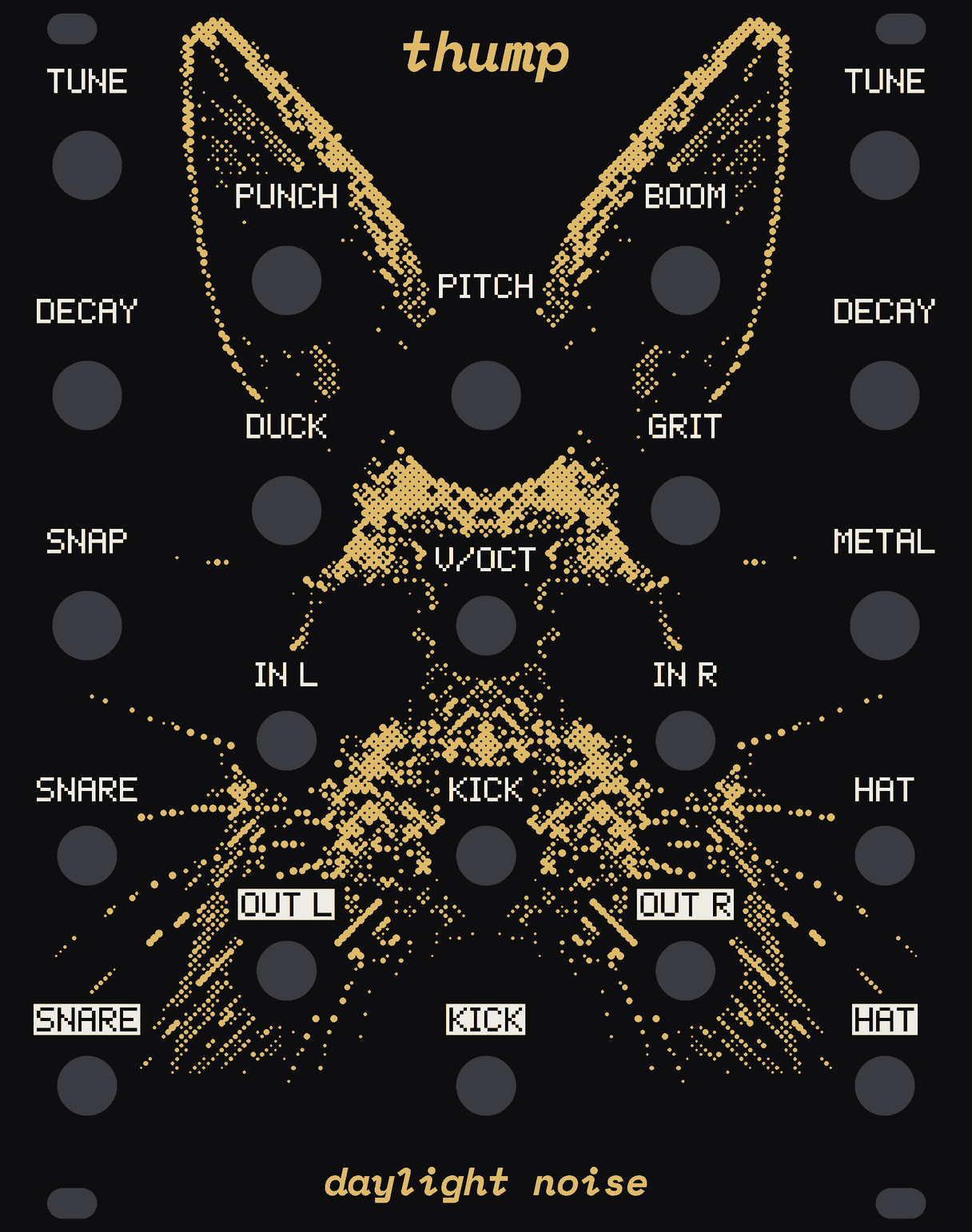
20 HP · drums
The rack's drums: an 808-style kick that plays basslines from V/OCT, a snare that turns into a clap, and a hat that runs from six detuned squares to an industrial clang. Patch the rest of your rack into IN and every kick pushes it down, for as long as the kick booms, so the whole case pumps. GRIT drives, folds and crushes the drums, and every trigger is velocity. Rabbits thump the ground to warn the warren. This one keeps time.
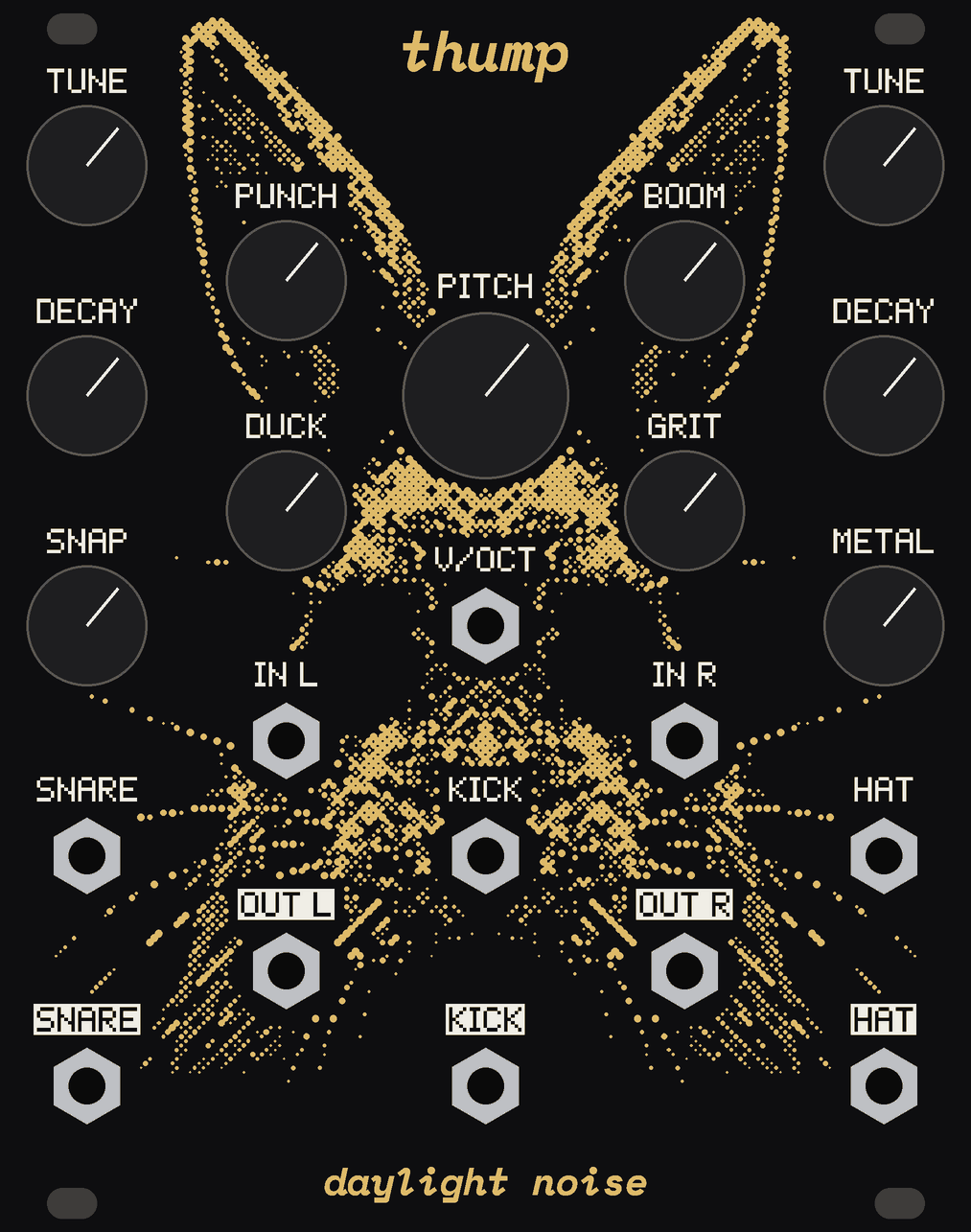
Turn a knob: drag it, roll the wheel over it or use the arrow keys; a double click puts it back. Press a trigger jack (KICK, SNARE, HAT) for a hit, Shift for an accent.
example patches
The module's own engine, running in your browser: the firmware's three voices, GRIT, the velocity detectors and the duck, ported from its C and checked against it bit for bit, with a model of the analog path the kick pushes down.
A sine that starts high and falls into its note, the way an 808's kick does, with a click on top. With a sequencer in V/OCT it plays the bassline.
Two tuned tones that drop a little as they strike, and a band of noise. SNAP goes from tone to noise, a fat thud to a crack; past three quarters it's a clap, three or four quick bursts of noise, then the tail. TUNE moves the tones and the noise together; DECAY sets how long it rings.
The 808's hat: six square waves at odd ratios through a band-pass. METAL narrows the band, then rings the squares against each other into an industrial clang. TUNE moves all six an octave either way; DECAY runs from closed to open.
Every kick pulls IN L and IN R down at once, holds them a moment, then lets them swell back over about as long as the kick booms: short kicks flutter, long ones heave. The path is analog end to end: nothing patched into IN touches a converter.
There's no accent jack: a trigger's voltage is its velocity. The firmware finds each trigger's edge, waits for the top, and plays the hit at that height, within a millisecond.
One knob through three stages, on the drums only. The ducked path stays clean.
A black rabbit lit from straight above, in a halftone of exposed gold, its eyes two dark hollows either side of V/OCT. The outputs are knocked out of white blocks; everything else is an input.
The name is from Watership Down, where the thump is the first thing a young rabbit learns to trust.
Drag to look around. Nothing on the board has been soldered yet.
THUMP is designed and its firmware builds. Nothing has been soldered, so the numbers here are the design's, not measurements, and there's no date.