threnody

12 HP · string cluster voice

One pitch in, forty-eight bowed strings out. THRENODY opens a single V/OCT from unison into a cluster two octaves wide, sends every player sliding on a path of its own, and presses the bow until it scrapes. Its name is Penderecki's, from the piece whose score drew clusters as black bands. The voices spread across a stereo pair, so it fills a room.

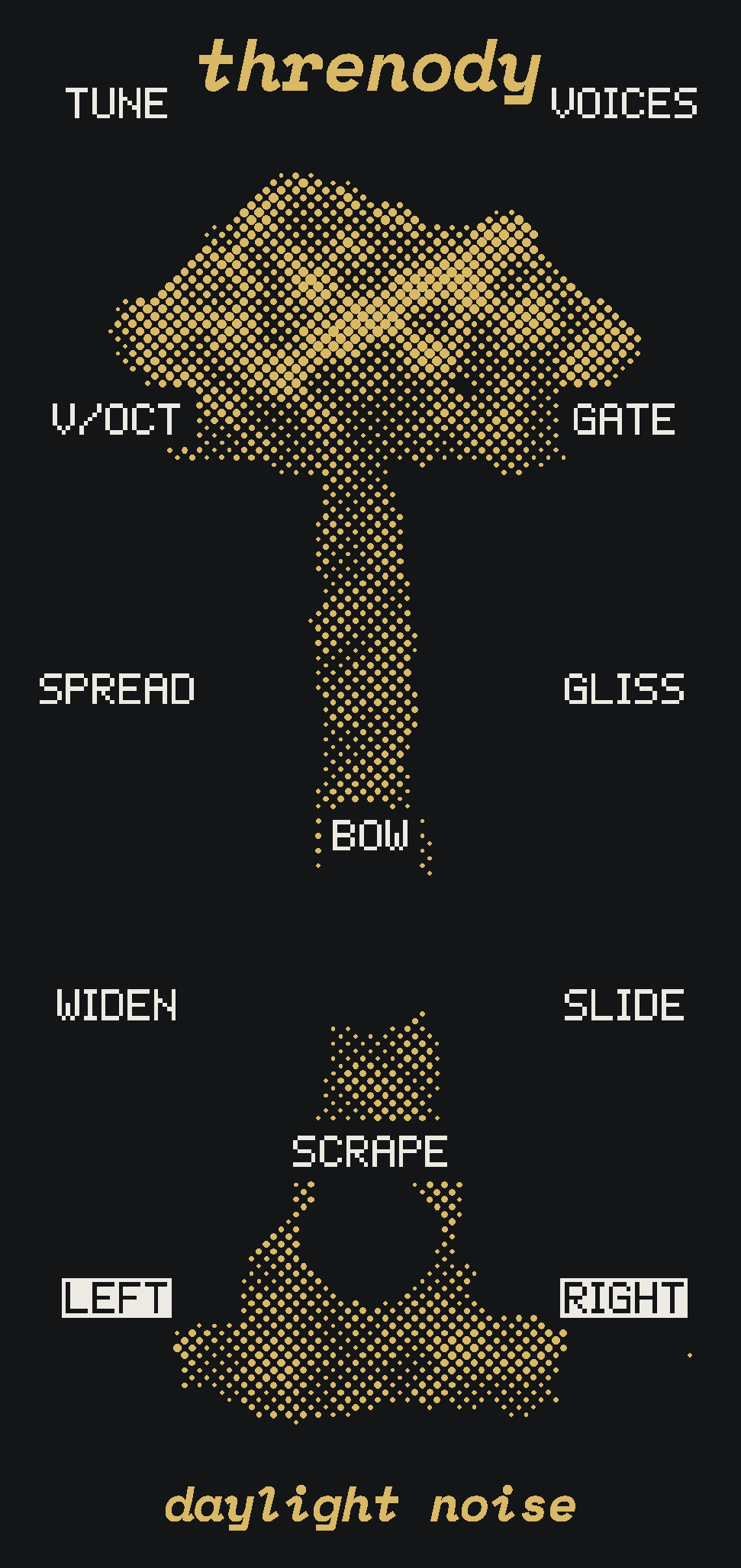
The THRENODY panel: black, a mushroom cloud in gold halftone dots, its cap between the top knobs and jacks, its stem running down past BOW and SCRAPE to a skirt of dust between LEFT and RIGHT. Five knobs and seven jacks with white pixel-font labels; LEFT and RIGHT knocked out of white blocks. 'threnody' at the top, 'daylight noise' at the bottom.

Turn a knob: drag it, roll the wheel over it or use the arrow keys; a double click puts it back. A knob you've turned stays where you leave it while the patch plays on round it.

Headphones help: it's wide.

example patches

The module's own engine, ported from its firmware and checked against it sample for sample, running in your browser. Every sound is computed as you hear it: nothing is sampled or recorded.
The voices

THRENODY is a room of players, not one sound made thick. Each of the 48 has its own bow, vibrato, slow drift and slight mistuning, and its own seat in the stereo field.

Turned right: wander. Every player slides up and down a range of its own, four to twelve semitones, at its own speed: the band frays and gathers.
Turned left: mirror. Every player swings through the centre to its mirror image and back: the band narrows and opens as they cross.

Eleven seconds of each, drawn by the engine in this page. Pitch runs up, octaves marked.

The bow

A bowed string sticks to the hair, is dragged along, and snaps back once every period. The bridge feels a sawtooth, and where the bow sits takes a comb of partials out of it. Every player is that motion, computed sample by sample and never quite on time: each period a little long or short, a little loud or soft, with a rasp of rosin at every slip.

The section plays into two fiddle bodies, left and right, that follow the register from a violin's down toward a cello's, then into a room.

One player at three settings of BOW, 25 ms of each, drawn by the engine in this page.

The panel

The art is a mushroom cloud printed the way a newspaper prints a photograph: gold dots on a 45-degree screen, each dot's size following the brightness. Its cap fills two places the panel's grid leaves empty for it; its stem runs down the middle to a skirt of dust along the foot.

Inside

The engine is portable C. On the module, an RP2350 splits the 48 players across its two cores, and one of them also runs the bodies and the room.

48 is an estimate of what the two cores can bow with every player in the scrape, not yet measured. If a block ever runs late, the firmware takes four voices off the top of VOICES rather than click, and says so on the USB console.

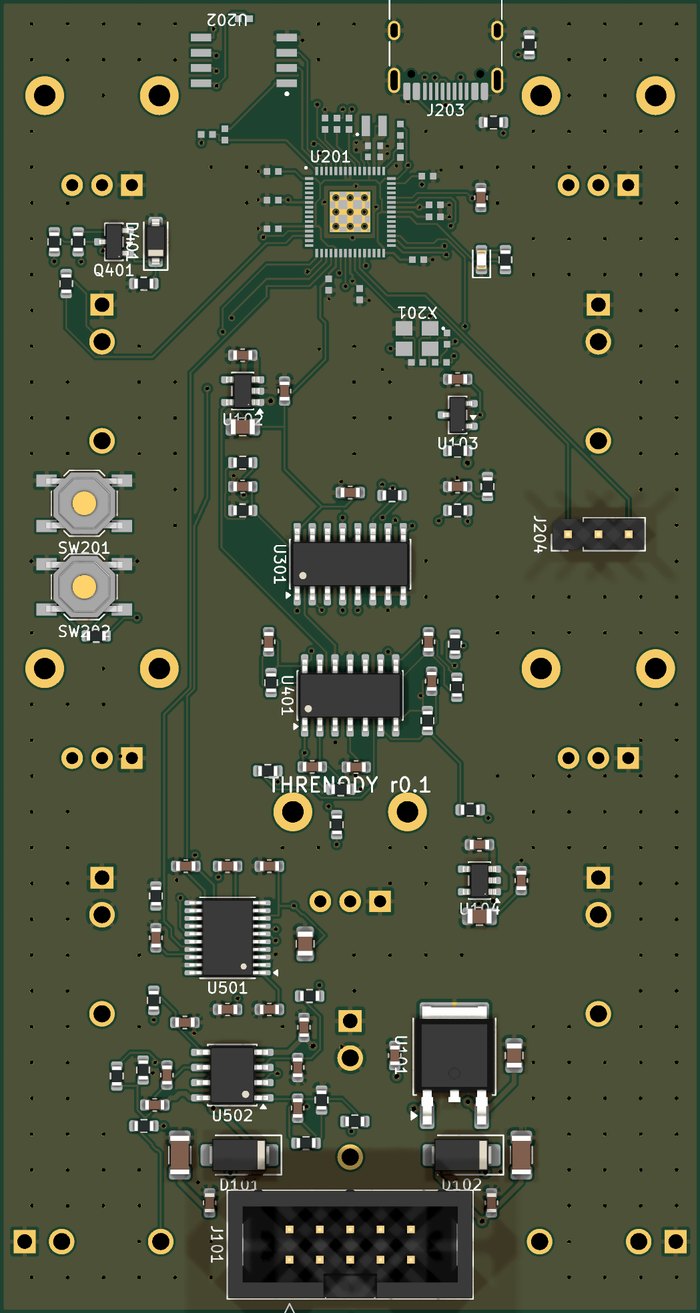
The back of the routed main board, as KiCad renders it: the RP2350 near the top with its flash and crystal, the multiplexer and the op-amp in the middle, the DAC and the output op-amp lower down, the regulator and the eurorack power header at the foot.
threnody

Drag to look around. Lift the panel off its board, or turn it round for the board's back: both are built from the files that would be sent to be made.

Specs

Format

Standard
Eurorack, 3U
Width
12 HP (60.66 × 128.5 mm)
Depth
About 21 mm, plus the power cable's plug
Panel
FR4, black mask, gold (ENIG) art, white silkscreen
Controls
TUNE, VOICES, SPREAD, GLISS, BOW
Power
About 90 mA at +12 V, 5 mA at −12 V (from the datasheets, not measured)

I/O

V/OCT
−2 to +8 V, calibrated at 1 V and 3 V
GATE
High above 1.4 V; nothing patched: a drone
CV in
WIDEN, SLIDE, SCRAPE: ±5 V, each adds to its knob
Out
LEFT, RIGHT: ±5 V
USB-C
Firmware, and a console for calibration (data only)

Engine

Voices
1 to 48 bowed strings
Cluster
Unison to 24 semitones, evenly spaced
Gliss
Wander (right) or mirror (left)
Bow
Flautando to ponticello to the scrape
Brain
RP2350, both cores, at 153.6 MHz
Audio
PCM5102A DAC, 32-bit, 48 kHz; TL072 to ±5 V
Inputs
MCP6004 into the ADC; one 3.000 V reference for every reading

Nothing's for sale yet.

Its engine runs and passes its tests, its firmware builds, and its board and panel are routed, ready to be made. Nothing has been built or heard on hardware yet.