three days

a clock for a whole set

20 HP

It runs three days at whatever length the set is, from a minute to an hour, with a moon that climbs the whole time; when the time runs out, the moon falls. Its outputs give the set its shape: dawns and dusks, nights, a clock that tightens towards the end, and the end itself.

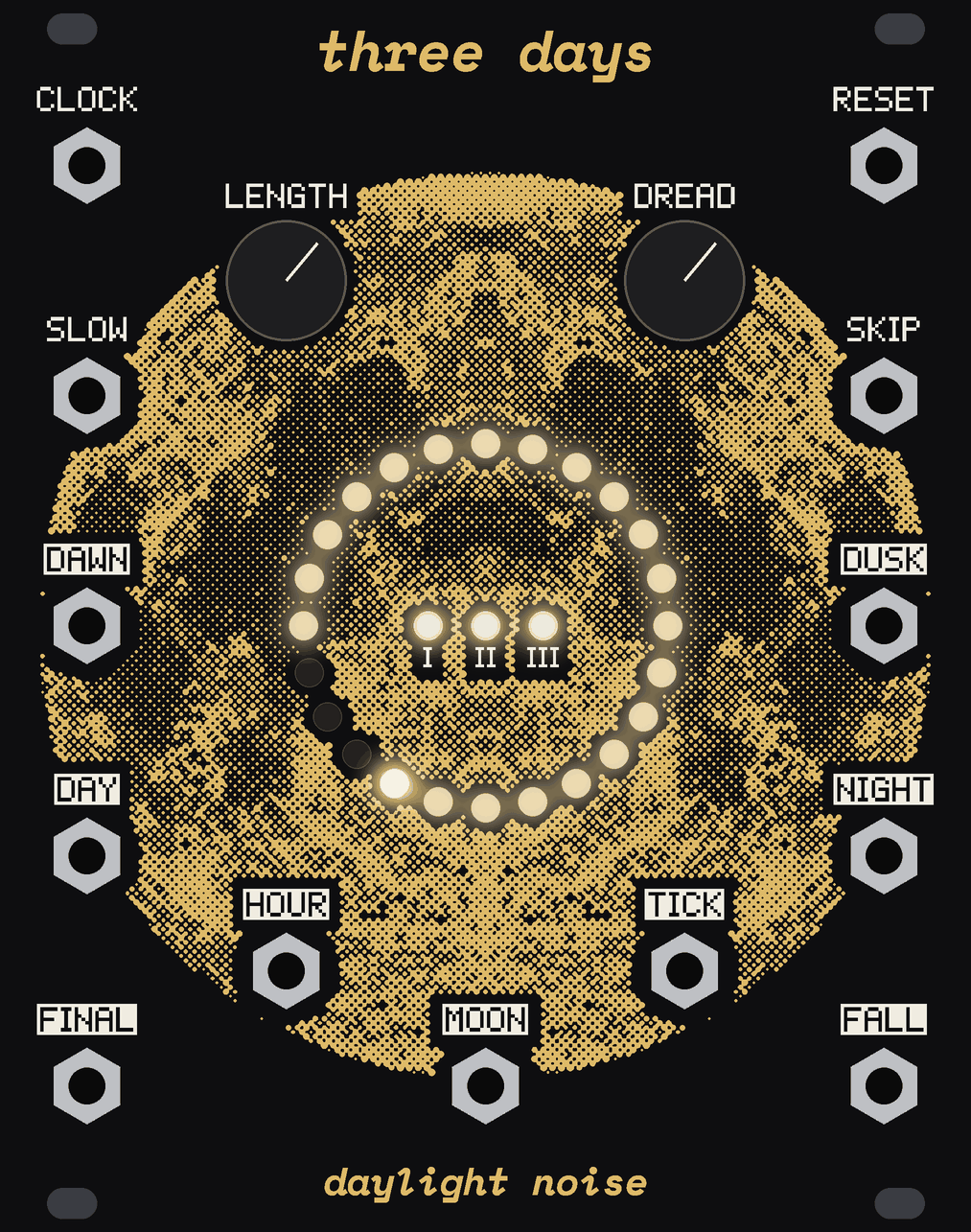
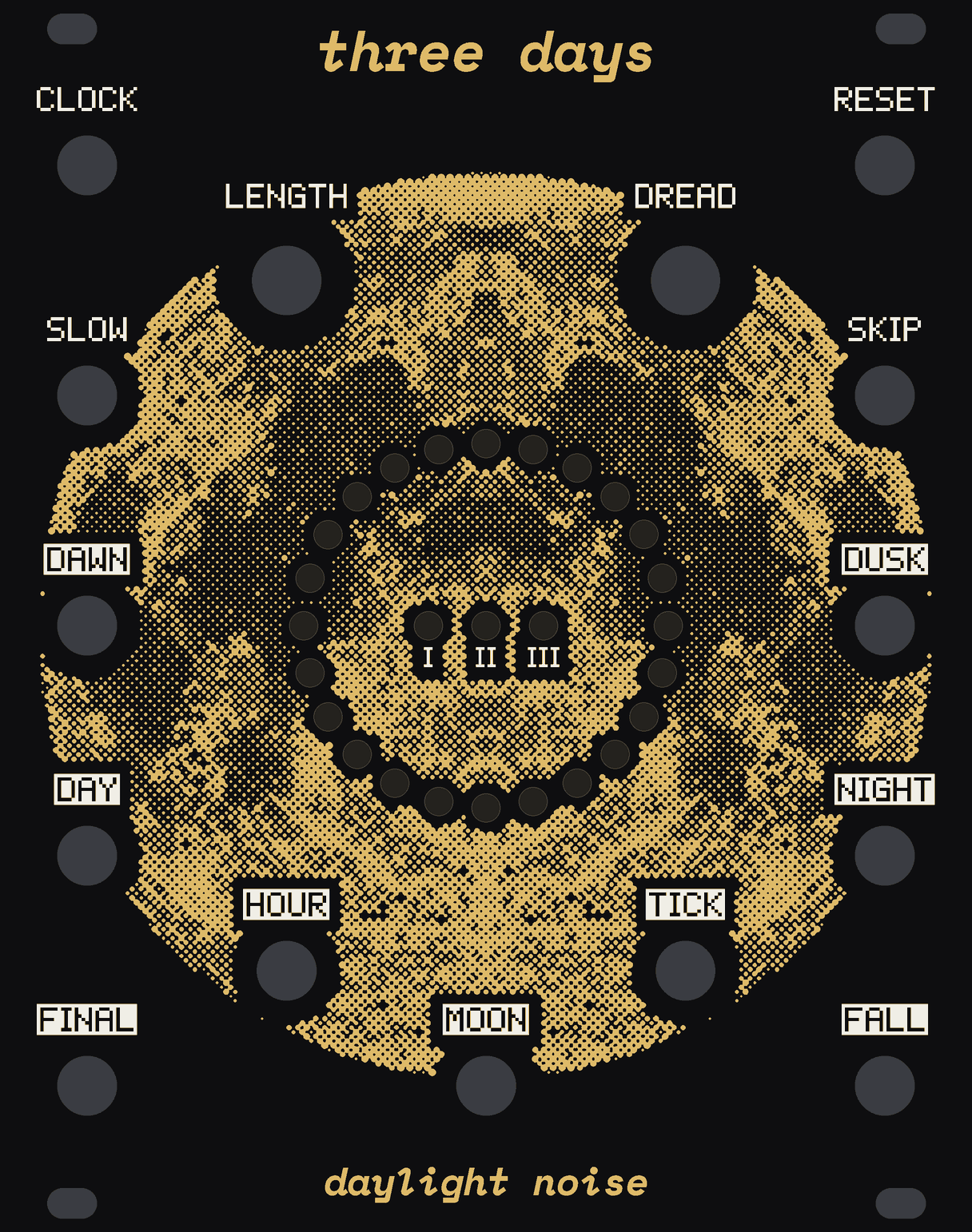
The THREE DAYS panel, switched off: black, with a moon 84 mm across filling most of it, a window of bare board with its seas in gold dots, set in an old 24-hour clock dial in gold: two thin rings round it with Roman numerals between them, and the clock's engraved plate faint in the corners. Every part on it stands on an island of black: LENGTH and DREAD, the two knobs, on its top edge, and the jacks in it and on its rim. Under the name, over the dial, sit three small round windows, I, II and III written over them. TIME, REWIND, SLOW and SKIP are the inputs beside them; the nine outputs below are labelled in white blocks: DAWN, DUSK, DAY, NIGHT, HOUR, TICK, FINAL, FALL and MOON. A ring of white dashes circles every jack that takes or gives a gate, a trigger or a clock, and twelve ticks circle DAY. three days at the top, daylight noise at the bottom.

Turn a knob: drag it or tap either side of it, roll the wheel over it or use the arrow keys; a double click puts it back. Press REWIND or SKIP for a trigger, and hold SLOW for a gate.

A small rack round the module, all made in the page: its outputs play a pad, a line, a hat, bells, a drone and a crash.

Day I · dawn

example patches

The module's own engine, the firmware's, running in your browser and checked against it tick for tick.

Three days

Time runs from the first dawn to the end of the third night: seventy-two hours, however long that is. LENGTH sets it, from a minute to an hour, with noon at about eight minutes. Patch a clock into TIME, the clock in, and LENGTH counts clocks an hour instead, in twelve steps from one to sixty-four, so the three days come out on the beat.

The face is a moon, one a day. At each dawn it's new; it waxes from its left side, half lit at dusk and full by the next dawn, and the third full moon is the end. It's one window of bare board 84 mm across, lit from behind in twelve slices, its seas in gold over the light. Above it, I, II and III light as each day begins, today's the brightest. In the last six hours the moon catches fire: embers that grow into flame, flickering and flaring on every TICK. At the end everything goes dark for a moment, then the first dawn: day I, and a new moon.

The moon on the panel shows the day. The MOON jack climbs over the whole three days.
One whole cycle, with DREAD at 0.6, drawn by the engine in this page: every output from the first dawn to the FALL.

What comes out

Nine jacks, knocked out of white on the panel. The triggers are 10 ms and the gates 5 V. A ring of dashes round a jack says it gates or triggers; DAY's twelve ticks say 1 V an octave.

DAWN · DUSK

A trigger as each day begins and as it turns to night. The first dawn fires at the start, after REWIND and after the FALL.

DAY

0, 1 and 2 V for days I, II and III. At 1 V an octave, a sequence through it goes up an octave every dawn.

NIGHT

A gate, high from dusk to dawn. Open a drone with it, or patch it into SLOW so the nights take three times as long.

HOUR · TICK

HOUR fires on every hour. TICK is a clock that runs faster each day: four an hour, or the incoming clock, times 1 + DREAD × 0.5 on day II, × 1 on day III and × 2 in the last six hours.

FINAL · FALL

FINAL is a gate for the last six hours. FALL fires when the time runs out, and on the same tick the clock starts again at the first dawn.

MOON

Alone on the spine: 10 V × (t / 72)1 + 4 × DREAD. With DREAD down it climbs in a straight line; all the way up, it hardly moves until the third day, then comes down on you. The moon on the panel is the day's; this one is the whole set's.

DREAD

One knob for how much the end bunches up. It shapes MOON's climb and TICK's speed together, so as the third night comes on the voltage rises faster and the clock tightens.

  • Down: MOON climbs straight, five volts at the half way, and TICK never changes.
  • Half way: MOON at 1.25 V by the half way and TICK twice as fast by the end.
  • Up: MOON barely past 0.3 V at the half way, and TICK half as fast again on day II, twice on day III and three times in the last six hours.
MOON over the three days at DREAD 0, 0.5 and 1, from the engine.

The inputs

Inside

The THREE DAYS panel with its knobs on and its moon lit: dusk on day II, half a moon, I and II lit.

Drag it or use the arrow keys to turn it; click it to take it apart.

Specs

Format

Width
20 HP
+12 V
94 mA at a new moon, 235 mA at a full one, 250 mA on fire (estimated)
−12 V
about 7 mA (estimated)
+5 V
not used; 10-pin header
Controls
2 knobs

I/O

Inputs
TIME (clock), REWIND (reset), SKIP, SLOW: high past about 1.2 V; 100 k
Triggers
DAWN, DUSK, HOUR, TICK, FALL: 5 V for 10 ms; 1 k
NIGHT, FINAL
gates, 0 or 5 V; 1 k
DAY
0, 1 or 2 V, 1 V an octave; 1 k
MOON
0 to 10 V; 1 k

Engine

Brain
RP2350, the engine once a millisecond
Converters
an MCP4822, 12 bits, for MOON and DAY
LENGTH
1 to 60 minutes free; 1 to 64 clocks an hour clocked
DREAD
MOON's curve, (t/72)^1 to ^5; TICK up to ×3
Face
a moon 84 mm across, lit from behind in twelve slices by 126 RGB LEDs, 78 in white and 48 in amber for the fire; three more in warm white for the day lights
Firmware
over USB-C, on the board's right edge