thermoptic

a cloak for a sound

20 HP

Patch a sound into FIGURE and the mix it stands in front of into BEHIND, and the sound disappears into the mix. You only hear it when it moves: the mix itself bending round its edges at a consonant, a chord change or a hit. VISIBLE and DECLOAK make the cloak fail.

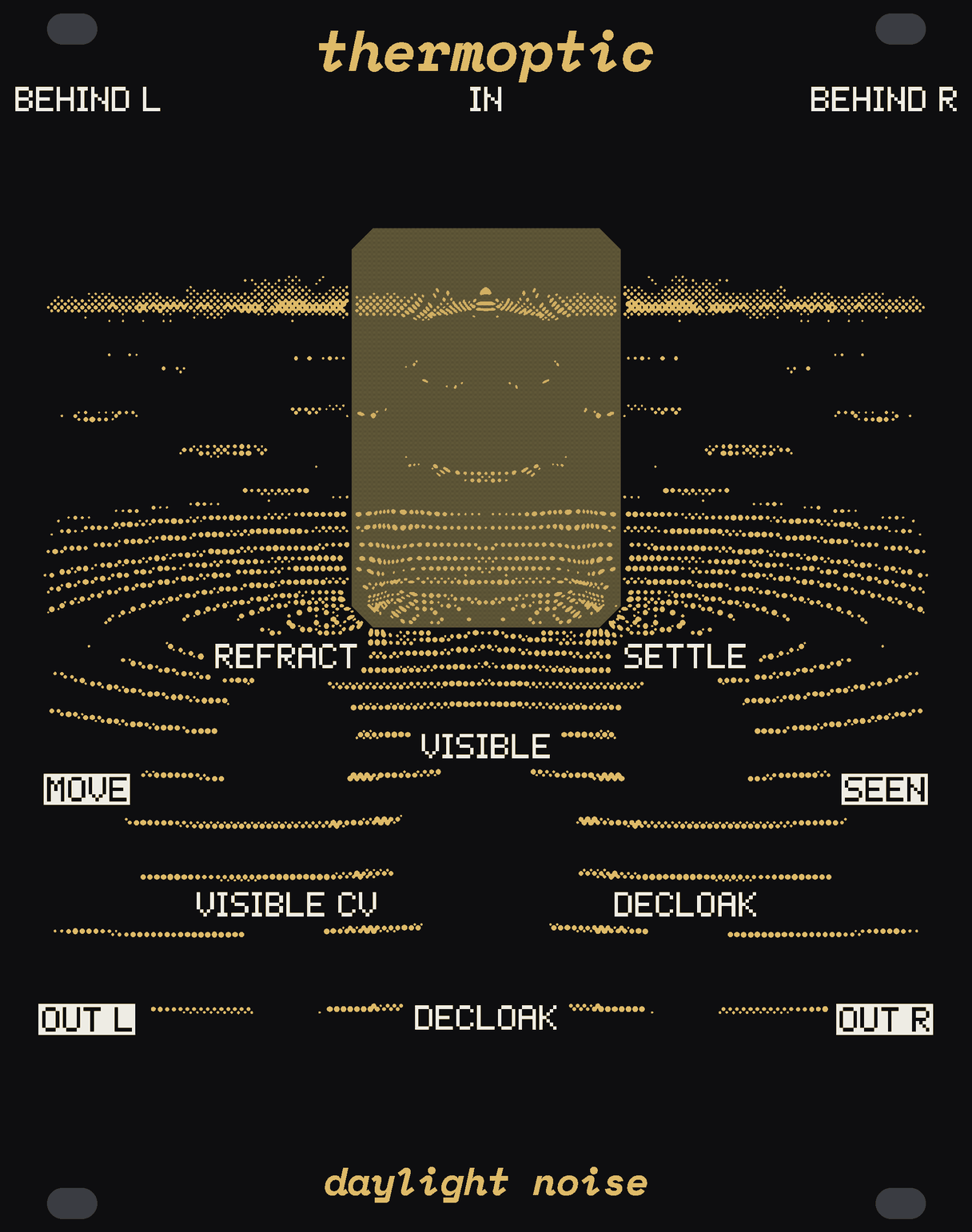
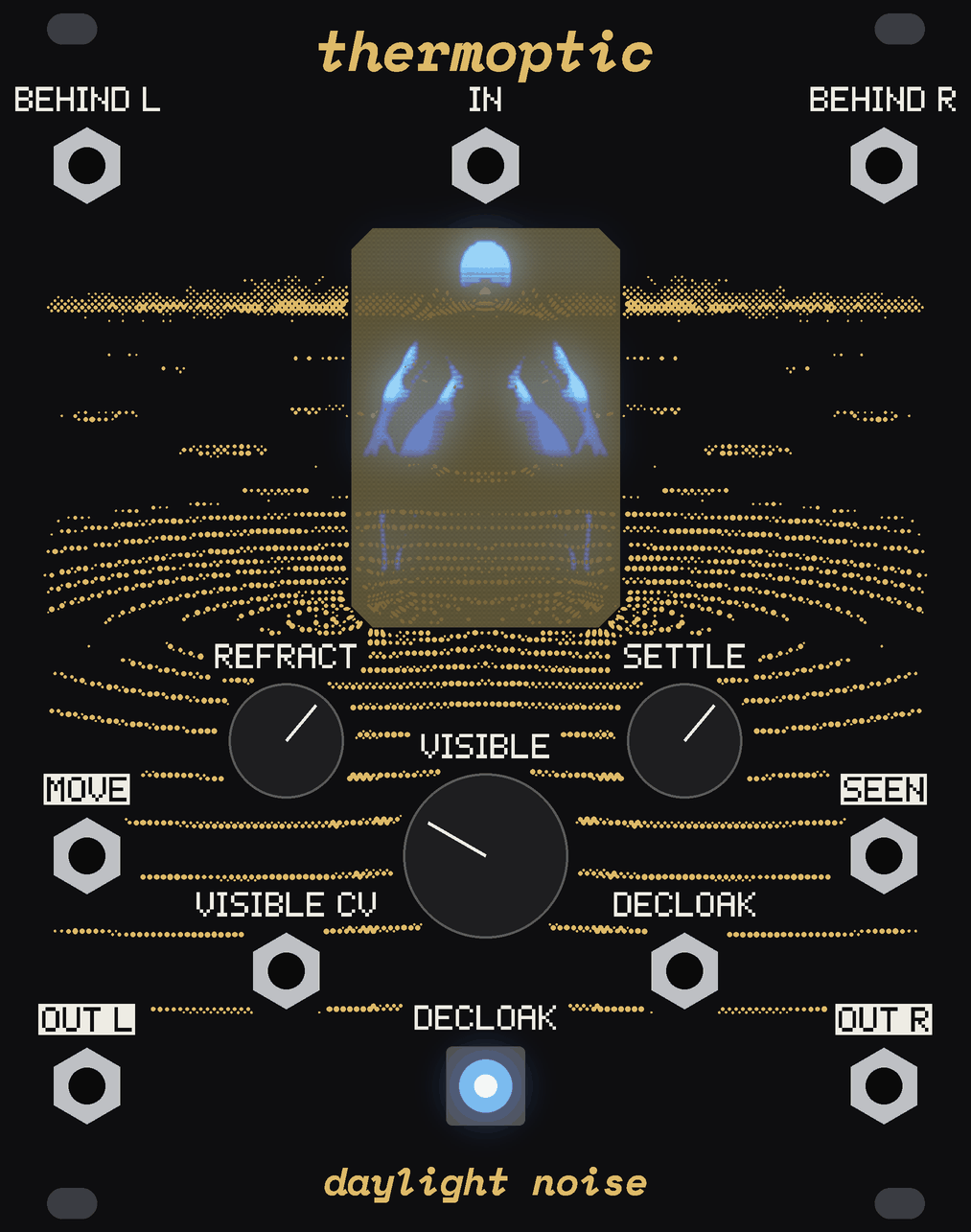
The THERMOPTIC panel: an old CRT security monitor seen face on in gold dots, its case and bezel filling the panel, a speaker grille round DECLOAK; on its curved screen a high CCTV view of an empty office corridor in gold scan lines, CAM 04 and 14:22:09 burned in, and a man in a dark suit standing in it only as faint lines of bare board. White labels for the knobs REFRACT, SETTLE and VISIBLE, the DECLOAK button in a white ring, and the jacks FIGURE, BEHIND L, BEHIND R, VISIBLE, DECLOAK, MOVE, SEEN, THIN and AIR, DECLOAK and SEEN ringed in white dashes. thermoptic at the top, daylight noise at the bottom.

Turn a knob: drag it or tap either side of it, roll the wheel over it or use the arrow keys; a double click puts it back. Hold DECLOAK down to make the cloak fail.

Everything but the four spoken lines is made in the page as you listen. Headphones help.

example patches

The engine running here is THERMOPTIC's firmware, the code the module runs, in the page; the rack round it, the track and its bodies, is made in the page too. The man on the screen is lit by the engine.
What it hides

The mix at BEHIND goes through THERMOPTIC to THIN and AIR, the outs, in stereo. When nothing moves it comes out exactly as it went in, 27 ms late. The sound at FIGURE, the body, never reaches the outs on its own while the cloak is on: it lives inside the mix as a distortion of it.

Movement

In each band two followers track the body's level: a fast one, a few milliseconds behind, and a still one that takes SETTLE to catch up. When they disagree by more than 3 dB the band is moving, fully at 18 dB. A held note has nothing to show once the still follower has caught it; an onset, a consonant or a chord change pulls them apart in exactly the bands that changed. That's the difference from a vocoder, which lays one sound's shape over another all the time: THERMOPTIC only shows a sound's movement, and only as the mix bending.

Refract

REFRACT is what the bending sounds like, in the moving bands and nowhere else.

Settle

SETTLE is how long the body has to hold still to vanish, from 30 ms to 2 s. Down low only hits and consonants show, and a sung vowel is gone almost as soon as it starts. Up high, everything that's changed lately shows, smeared: a voice talking quickly keeps the mix rippling the whole time.

Visible and decloak

VISIBLE makes the cloak fail. At 0 the body is never heard. As it rises, each of the body's bands flips between hidden and shown at random, 20 to 60 ms apart, shown more often the higher VISIBLE is, the highs first, so the reveal runs from the top down. Where bands are failing there's crackle, short crushed fragments of the body. At 1 the body is plain and nothing is bent. The VISIBLE jack adds to the knob, 5 V for its whole travel.

DECLOAK, a button and a gate in, is the reveal: while it's held VISIBLE sweeps to the top in 300 ms, through the crackle, and back in 600 ms when it's let go. Gate it for a chorus and the hidden voice fails into view on the drop.

Move and seen

MOVE is the body's movement as a voltage, 0 to 8 V: it jumps on every onset and falls away with SETTLE, an envelope of change rather than of level. SEEN is a gate, high while MOVE is over 3 V and low again under 2 V: the moments someone looking would catch it. In the last example patch, MOVE opens the bass and SEEN plays an open hat.

Inside

The THERMOPTIC panel with DECLOAK held, its knobs on, the man on the monitor's screen lit in lines of cool light.

Drag it or use the arrow keys to turn it; click it to take it apart.

Specs

Format

Width
20 HP
Depth
about 21 mm behind the panel, its power header included
+12 V
about 140 mA with the window dark, 320 mA at the most (every band lit, DECLOAK's light on)
−12 V
about 15 mA
+5 V
not used; 10-pin header
Controls
3 knobs, VISIBLE's big; a button that lights white

I/O

FIGURE
the input, the body: audio, ±5 V with room to ±9; 100 k
BEHIND L, R
audio, ±5 V with room to ±9; 100 k. R follows L when it's unpatched; with both unpatched, the air
VISIBLE
±5 V, a fifth of the knob a volt; 100 k
DECLOAK
gate, rising past about 1.1 V; 100 k
THIN, AIR
the outs, left and right: ±5 V, 1 k
MOVE
0 to 8 V, 1 k
SEEN
gate, 0 or 5 V, 1 k

Engine

Brain
RP2350, both cores, 46.875 kHz, 32-bit float
Converters
two PCM1808 in, a PCM5102A out, on one I2S clock
Spectra
1024-point frames, a quarter-frame hop, 32 bands; 27 ms from BEHIND to OUT
Figure
33 RGB LEDs behind him in seven bands, head to feet; one band runs across the screen as its rolling bar
Firmware
over USB-C or the debug header, on the back