sympathy

shout into the piano

20 HP

The inside of a grand piano with the dampers up. Whatever you put in sets its strings ringing in the chord you choose: drums come back as chord changes, a shout as a ghostly chord, a bass line as a trail of its own notes.

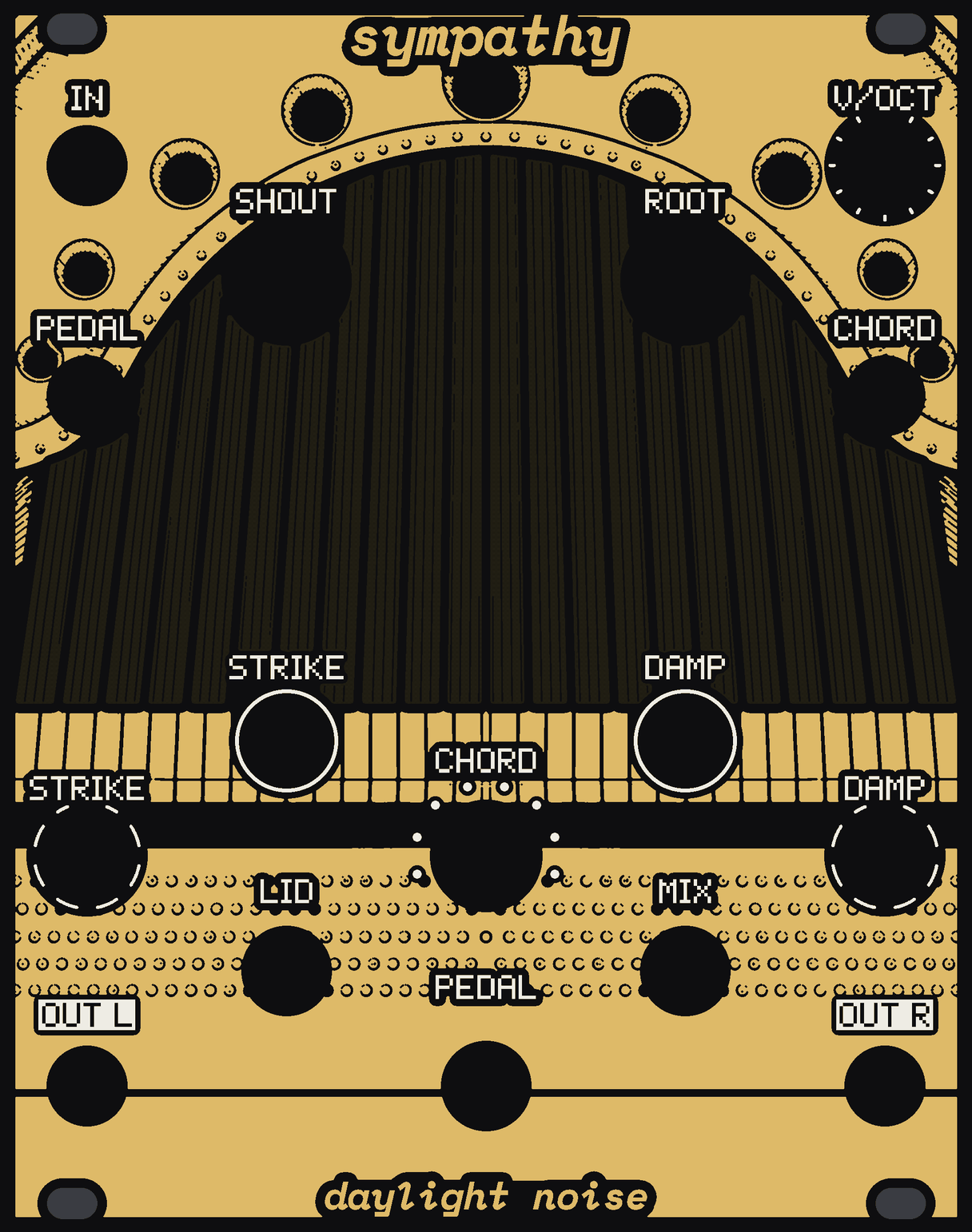
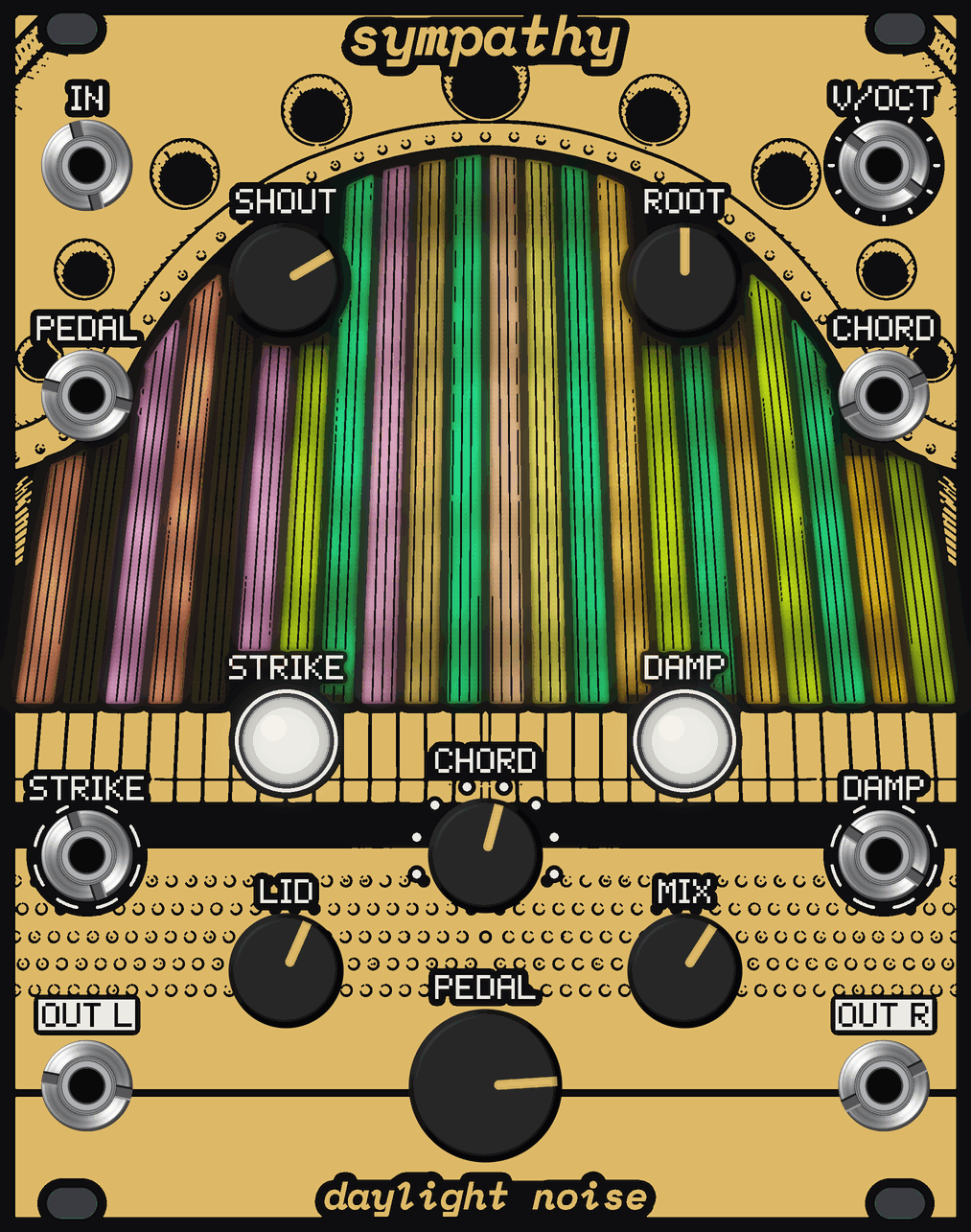
The SYMPATHY panel, black and gold: a hand-inked drawing looking straight down into an open grand piano from the keyboard end. The cast-iron frame, solid gold with black ink outlines and hatching, arches over the far ends of the strings under the name, a row of hitch pins along its rim and round holes cast in it. The strings run up the middle of the panel side by side, the copper-wound bass on the left and the bright steel treble on the right, longest in the middle under the arch. Low down a row of felt dampers crosses them, lifted, and below that rows of tuning pins on the frame. The strings are bare glass for light, cut into 22 strips from bass to treble, the gaps between the strings drawn up them in fine black ink lines. The big PEDAL knob sits at the foot like the piano's own pedal; the other knobs, the CHORD switch and the two buttons sit on the frame and the dampers, the jacks down both edges.

Turn a knob: drag it or tap either side of it, roll the wheel over it or use the arrow keys; a double click puts it back. CHORD clicks from stop to stop; let go of STRIKE to strike, hold DAMP to damp. The patches step on by themselves until you touch anything.

Its strings, hammers and body, in your browser.

example patches

Everything SYMPATHY does here is the module's own engine in your browser, and it hears only what comes into its jacks: what plays into it is a stand-in rack.
One cable, a piano

Hold a piano's sustain pedal down, lean in and shout, and the strings sing it back. SYMPATHY is the inside of that piano: 88 notes, their strings, the felt over them and the wooden body under them. Put anything into IN and take OUT L and OUT R to your mixer: every knob at noon is half pedal on F major ninth.

Strings that answer

Which strings are free

The pedal, and DAMP

Striking it yourself

The lid, and the mix

Inside

The SYMPATHY panel playing: looking down into an open grand piano, the gold iron frame over the strings, the strings of the chord lit, each in its note's colour, the dampers' row and the tuning pins below in gold.

Drag it or use the arrow keys to turn it; click it to take it apart.

Specs

Format

Width
20 HP
Depth
20.6 mm behind the panel
+12 V
about 143 mA dark, 279 mA ringing a chord, 311 mA with every string lit (estimated)
−12 V
about 5 mA (estimated)
+5 V
not used
Controls
five knobs (PEDAL, ROOT, LID, SHOUT, MIX), an eight-stop switch (CHORD), two lit buttons (STRIKE, DAMP)
Light
138 RGB LEDs under the strings' 22 cells
Replaces
a resonator bank, a reverb and a chord module

Inputs

IN
audio to ±10 V
V/OCT
1 V an octave: ROOT by semitones
PEDAL
CV added to the knob, 1 V a tenth
CHORD
CV: 1 V a stop
STRIKE
gate: strikes as hard as it's high
DAMP
gate: the dampers down while high

Outputs

OUT L
audio to 9 V, the bass side; both sides with nothing in OUT R
OUT R
audio to 9 V, the treble side

Engine

Brain
RP2350 at 240 MHz, both cores, 46.875 kHz; the strings at 24 kHz, at most 128 at once, the quietest dropped first; this page's engine, to the bit