strings attached

pull the strings

20 HP

A wooden marionette on six jacks. Tilt its bar and its head, hands, feet and body follow, each a little late, each swinging past and settling at its own pace. Make it hop, walk it on your clock, and every landing is a trigger.

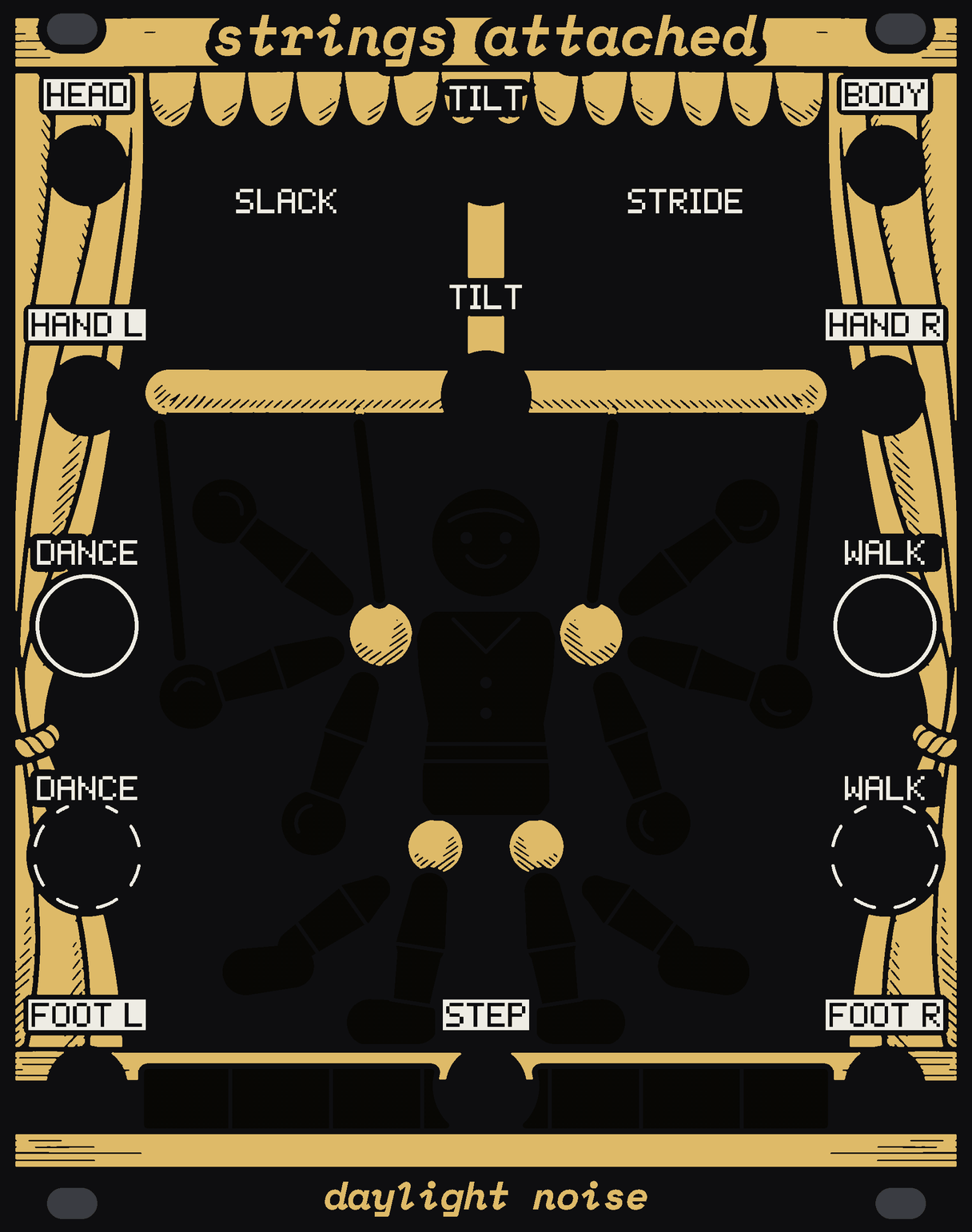
The STRINGS ATTACHED panel, black and gold: a little puppet theatre drawn in bold ink, a header beam across the top with the name on it and a scalloped valance under it, a curtain drawn back and tied at each side, the stage floor and its apron at the foot. In the dark stage a jointed wooden marionette with a round painted face hangs from a control bar on four strings, its arms drawn three times each and its legs twice, every place each one can swing to, all of them windows; the big knob is the bar's middle.

Turn a knob: drag it or tap either side of it, roll the wheel over it or use the arrow keys; a double click puts it back. Press DANCE to make it hop, or hold it to hold it up; press WALK for a step. The patches step on until you touch anything.

Synthesised here. STRINGS ATTACHED makes no sound of its own: its six outs move the parts of a stand-in band.

example patches

STRINGS ATTACHED here is its engine as designed, in your browser: it hears only what comes into its jacks. The tuba, the banjo, the clarinet, the drums, the bell and the theatre are a stand-in rack.

Pull the strings

TILT, the big knob, is the marionette's control bar. Turn it right and the bar's left end goes up: the left hand rises, the right hand drops, the head turns toward the raised side and the body leans away. Patch a voltage into its jack and the voltage tilts the bar instead.

Each of those is an out: HEAD, BODY, HAND L, HAND R, FOOT L and FOOT R, each one's height, 0 to 8 V. But none of them just copies the bar. Each hangs on its own string with its own weight, so it arrives a little late, carries on past and swings back before it settles. The head is light and quick, the body heavy and slow. One turn of one knob, and six things move, each in its own way.

Slack

Dance

A gate into DANCE, or a press of its button, flicks the bar up. Everything jumps at once and comes down at its own speed. The feet land a few milliseconds apart, and each landing fires STEP: a short trigger, 3 to 8 V by how hard the foot came down.

Hold DANCE and the bar stays up: the marionette hangs in the air, feet off the floor, everything held high. Let go and it drops, lands with a thump and bounces back to where it was. A break and a drop on one gate.

Walk

On the panel

The marionette on the panel is drawn in every place each limb can be: each arm three times, hanging, held out and raised, and each leg twice, standing and kicked out. Only the one where the limb is now lights, in its own colour, so you can watch it dance. The strings glow as hard as they pull, and the stage floor flashes where a foot lands.

In a rack

Specs

Format

Width
20 HP
Controls
a big knob (TILT), two knobs (SLACK, STRIDE), two lit buttons (DANCE, WALK)
Lights
18 windows on 52 RGB LEDs: the marionette's head and body, each arm in three places and each leg in two, four strings, the stage floor
Replaces
six slew limiters with a swing each, a macro control, an envelope pair and a trigger source for a walking rhythm
Parts
a demo for now: the line's knobs, jacks and buttons, no board yet

Inputs

TILT
CV, added to TILT, ±5 V tilts the bar end to end
DANCE
gate: each rising edge a hop; held, it holds it up
WALK
gate: each rising edge a step

Outputs

HEAD
the head's height, 0 to 8 V
BODY
the body's height, 0 to 8 V
HAND L
the left hand's height, 0 to 8 V
HAND R
the right hand's height, 0 to 8 V
FOOT L
the left foot over the floor, 0 to 8 V
FOOT R
the right foot over the floor, 0 to 8 V
STEP
trigger, 3 to 8 V: a foot lands