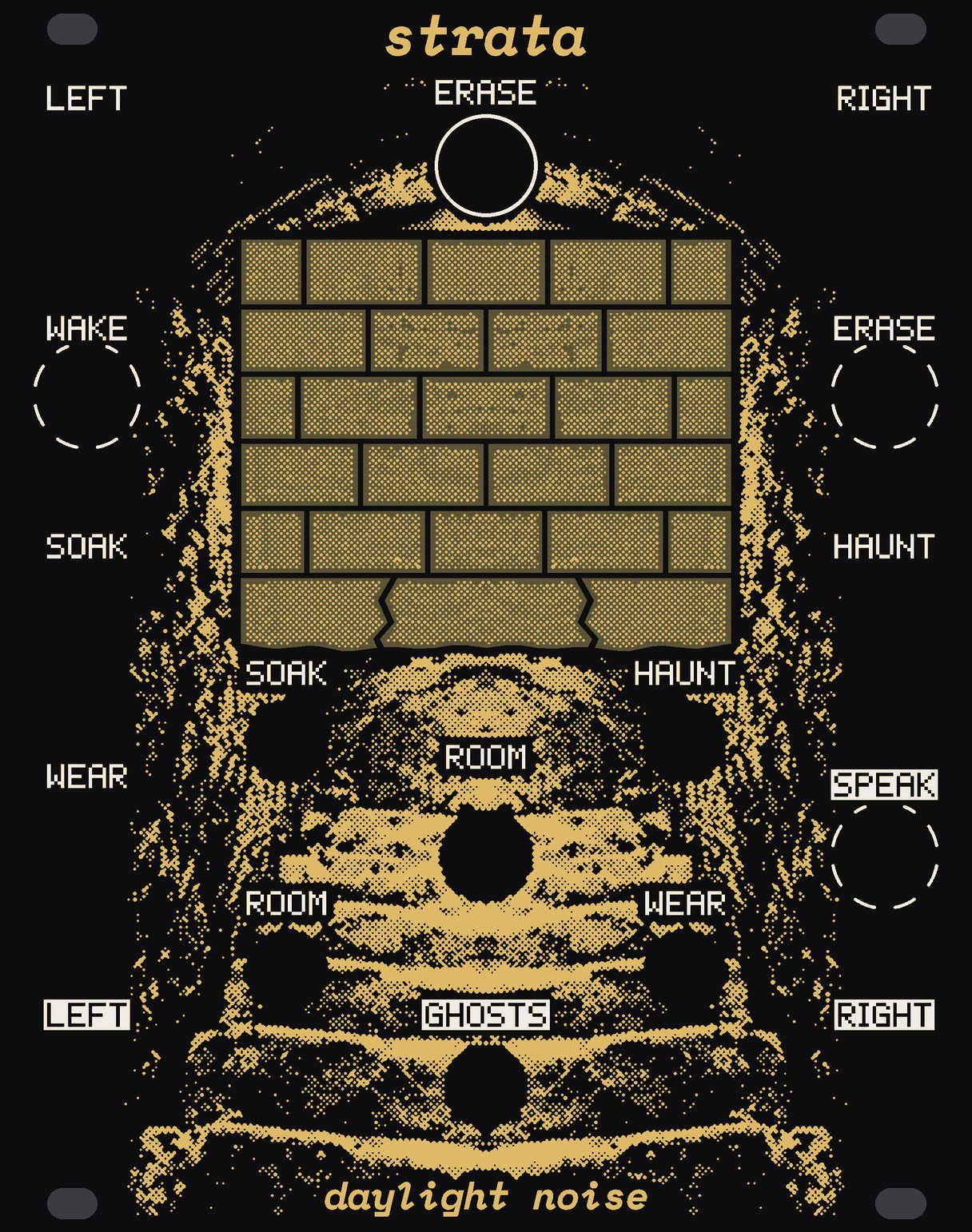
the walls remember
20 HP
A reverb in a stone cellar whose walls keep whatever's played loud enough, and play it back later, on their own, a little more worn each time. ERASE doesn't empty them: what you erase is pressed down a layer, and up comes what was erased before, older, lower and slower.
Turn a knob: drag it or tap either side of it, roll the wheel over it or use the arrow keys; a double click puts it back. ERASE is a button: press it and the walls stop saying what they're saying, and something older comes up. The patches step on by themselves until you touch anything.
example patches
The walls, the room, the replays and every out here are STRATA's engine as it's designed, running in your browser. The drums, the bass, the lead and its screams are a stand-in for the rest of a rack.
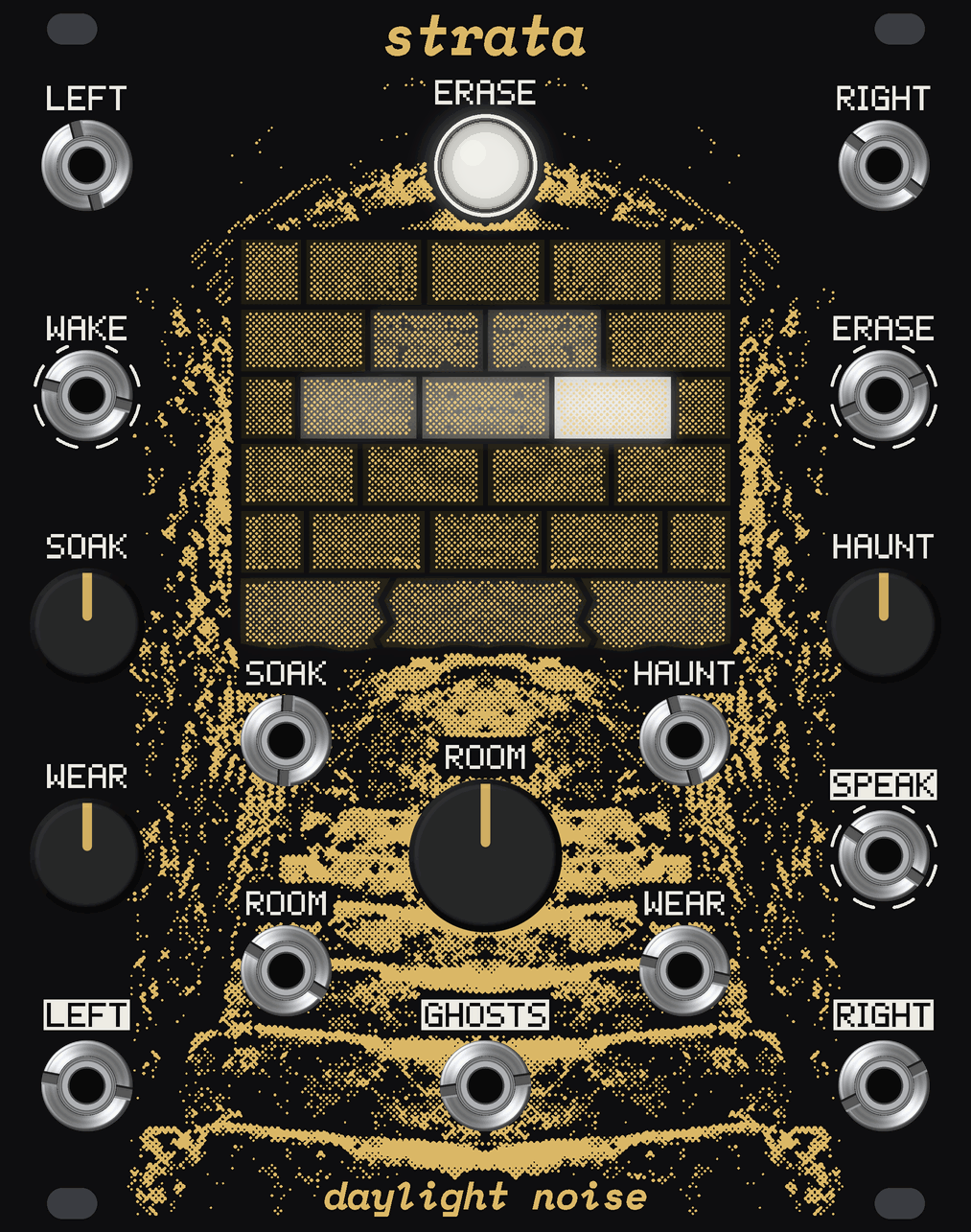
Anything that reaches the SOAK line is written into the stone: the moment itself, from just before it crossed until it falls quiet, three seconds at most. Later, at a time of their own choosing, the walls play one back, darker and further off, into the room.
The wall has layers. The top row is the face, where new moments go. Under it are four strata of what's been erased, newest first, each one three semitones lower and slower than the one above. Under everything is the bedrock, made by the room from nothing but its own noise before you played a note.
One board sits 10 mm behind the panel with everything on its front: the jacks, the knobs, ERASE, the 92 LEDs and the whole circuit, the USB-C in a notch in its left edge. Each block of the wall has its own row of white LEDs in a cell of a black printed baffle, so a block that speaks lights only itself. An RP2350 runs the walls and the room on both its cores; what the walls keep is held in 8 MB of memory beside it.
Drag it or use the arrow keys to turn it; click it to take it apart.