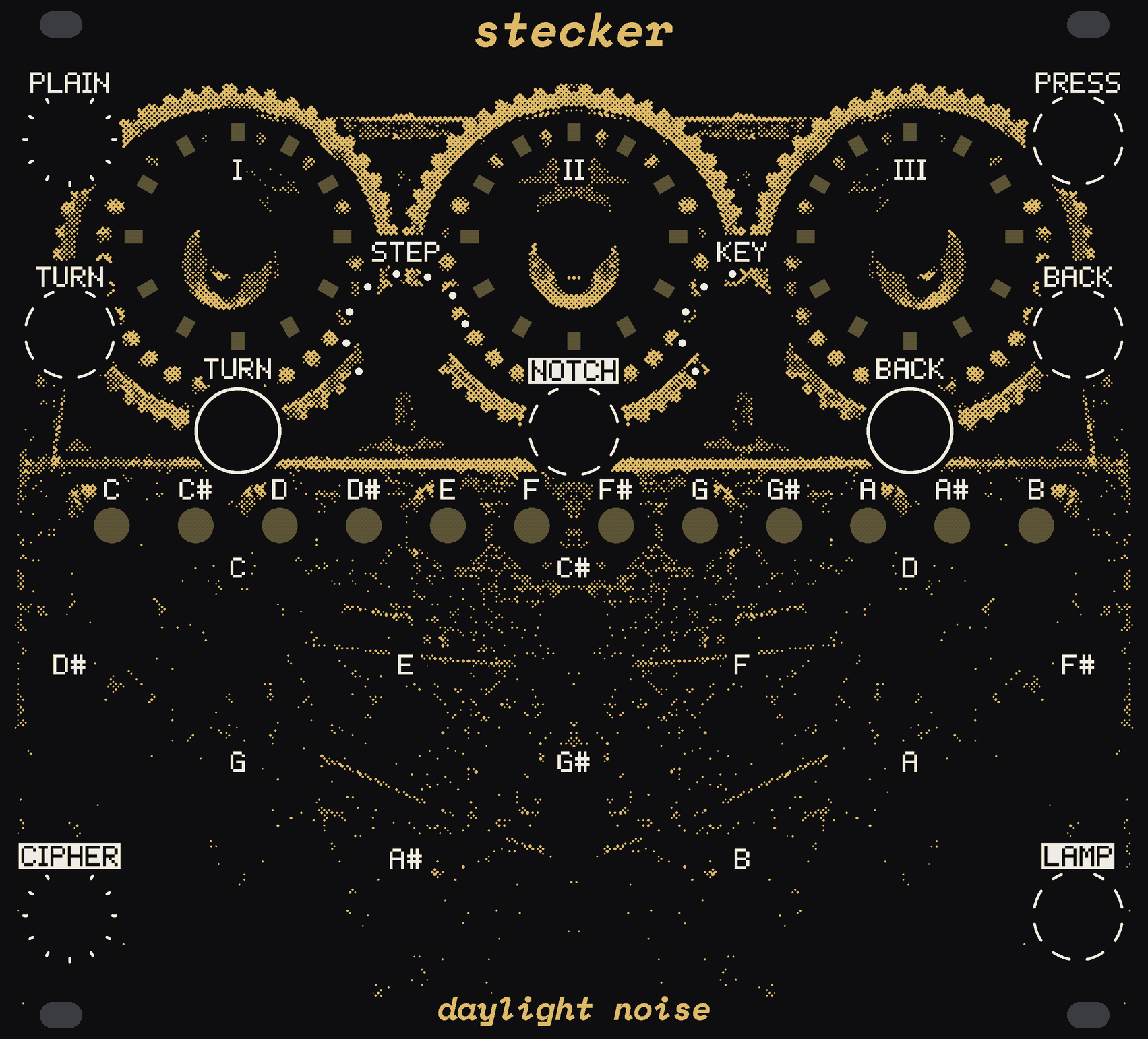
the cables are the key
28 HP
A cipher machine for notes. Each one goes through a plugboard, three rotors and a reflector and comes back as another, never itself, and the rotors step as you play. A cable between two of its twelve jacks swaps two notes; a second one set the same plays your tune back.
Turn a knob: drag it or tap either side of it, roll the wheel over it or use the arrow keys; a double click puts it back. STEP and KEY click from stop to stop the same ways. TURN and BACK are buttons to press. Patch the plugboard: click a jack, then another, and a cable swaps the two; click a cabled jack to pull it out. The patches step on by themselves until you touch anything.
example patches
The cipher, the rotors and the lights here are STECKER's engine, the module's own code, running in your browser; the sequencer, the voices and the drums stand in for a rack.
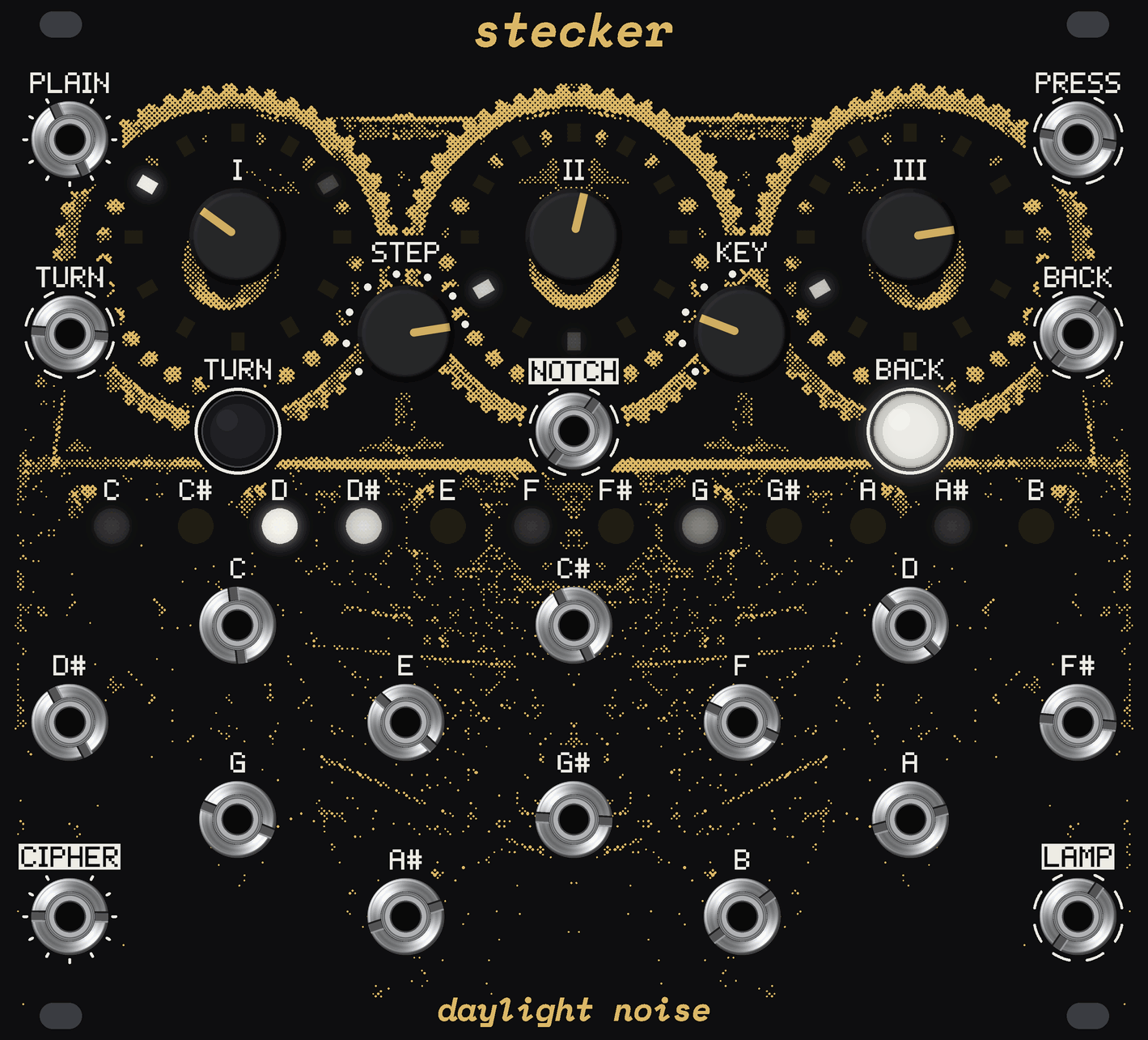
A gate at PRESS is a key pressed: the note at PLAIN goes through the plugboard, rotors I, II and III and the reflector, back through the rotors and the plugboard, and out at CIPHER as another note, never itself. Through a second STECKER set the same, the tune you played comes back.
Each rotor is a scrambled wiring of the notes. The first steps as you play; each time it comes round past the top it turns the second a place, and the second the third, like an odometer. The marks round each knob show where its rotor stands.
Twelve jacks, C to B. A cable between two swaps those notes on the way in and out, and every route through the rotors changes with it. Only pairs count: a jack cabled to two others is left out, and so is anything else patched in.
Every note in is taken to the nearest note of the alphabet, and every note out is one of them, so in a scale the tune stays in key. An alphabet always has an even number of notes, as the reflector pairs them off: that's why no note comes out as itself. A cable to a note outside it waits until KEY lets it in.
One board sits 10 mm behind the panel with everything on its front: the jacks, the knobs, both switches, both buttons, the 48 LEDs and the whole circuit, the USB-C in a notch in its right edge. Each window has its own white LED in a cell of a black printed baffle, so a lit lamp never lights the next note's. An RP2350 runs the cipher four thousand times a second and scans the plugboard a hundred times a second for cables.
Drag it or use the arrow keys to turn it; click it to take it apart.