sprung

kick the tank

20 HP

A spring reverb: three springs of different lengths in an open tank. Every hit you send in runs down the coils and back as a drip of light, smearing as it goes, the way the sound does. Throw one hit in, shake the tank, or kick it and all three crash.

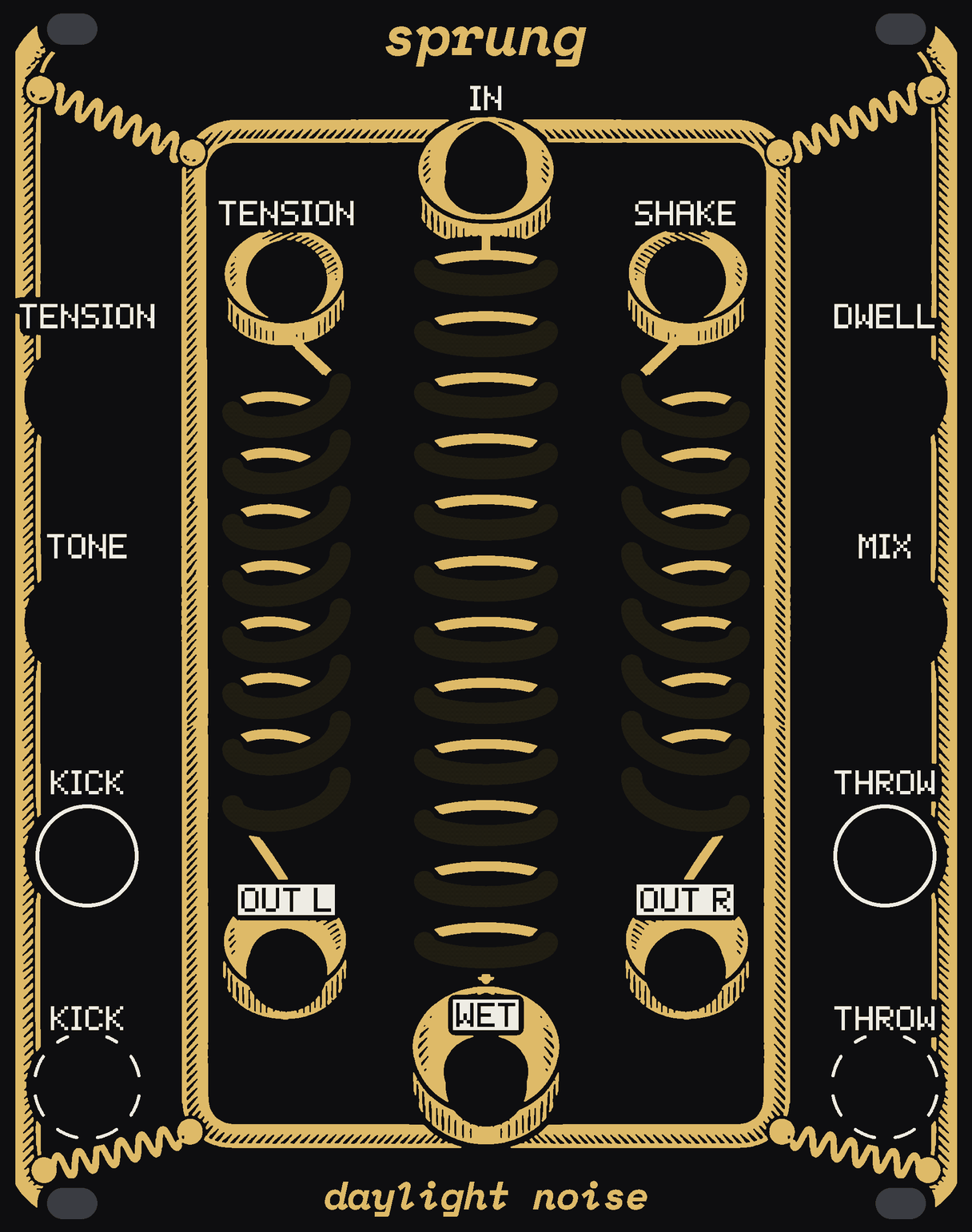
The SPRUNG panel, black and gold: an open spring tank drawn in gold, a rolled rim round the panel and a channel down its middle held by four small springs at the corners. Three coil springs hang in it top to bottom, each between two round transducer cans: the long one down the middle from IN to WET, a shorter one either side. The coils' turns are bare glass, lit from behind. The knobs and buttons run down both edges beside the springs.

Turn a knob: drag it or tap either side of it, roll the wheel over it or use the arrow keys; a double click puts it back. KICK kicks the tank; THROW throws what's playing into the springs while it's held. The patches step on by themselves until you touch anything.

Synthesised here, as the module would make it: three springs, the drip, the kick, round a stand-in rack's dry band.

example patches

SPRUNG here is its engine as designed, in your browser: it hears only what comes into its jacks. The guitar, the dub kit, the sub and the beeps are a stand-in rack, played dry.

One cable

Your sound into IN, OUT L and OUT R to your mixer. It goes into three springs at once, the way an old amp's tank does. A spring doesn't echo a sound back the way it went in: its low end comes back first and its top drags behind, so a snare comes back as a "dwoing", and every time it runs the spring's length and back it smears a little more. That's the drip. The three springs are different lengths, 27, 33 and 39 milliseconds a trip at noon, so their drips fall out of step and fill each other in. The left spring comes out on OUT L, the right on OUT R, the long one on both. Noon on every knob is a classic tank.

TENSION

DWELL, TONE and MIX

KICK

Anyone who's had an amp with springs in it has kicked it. KICK does it on purpose: the tank takes a blow, all three springs crash at once, swing for a moment, and settle as they ring out. A gate into the KICK jack kicks it on every rise, harder the higher the gate, from a nudge at 1.5 volts to a slam at 6. Nothing needs to be playing: a gate pattern into KICK makes the tank a drum.

THROW

THROW is the dub engineer's move. Hold it and everything playing goes into the springs hard; let go and they ring out under the rest. Leave DWELL down and the band stays dry, and throw just one snare, or the last note of a phrase. A gate into the THROW jack holds it while it's high.

SHAKE

SHAKE rattles the tank. A slow CV sways the springs, the left and right stretching opposite ways, so the tail warbles and leans. A quick change jolts them, a little crash in proportion to how fast it moved: a stepped CV makes a jolt on every step. Nothing in it and the tank sits still.

WET

WET is the springs alone, in mono, after TONE and before MIX. Turn MIX fully left and send WET back to a channel of your mixer: the band dry on one fader, the springs on another, the way a studio has them.

Specs

Format

Width
20 HP
Controls
four knobs (TENSION, DWELL, TONE, MIX), two lit buttons (KICK, THROW)
Lights
three coils of light: 28 turns, 56 LEDs
Replaces
a spring reverb module and its tank, a send and return, and a crash you can play
Here
a demo: the parts and the engine as designed, no board yet

Inputs

IN
audio: into the springs, and on to both outs dry
TENSION
CV: added to TENSION, a tenth of its turn a volt
SHAKE
CV: sways the springs; a quick change jolts them
KICK
gate: each rise kicks the tank, harder the higher
THROW
gate: everything goes into the springs hard while it's high

Outputs

OUT L
audio: your sound and the left spring and the long one
OUT R
audio: your sound and the right spring and the long one
WET
audio: the springs alone, mono