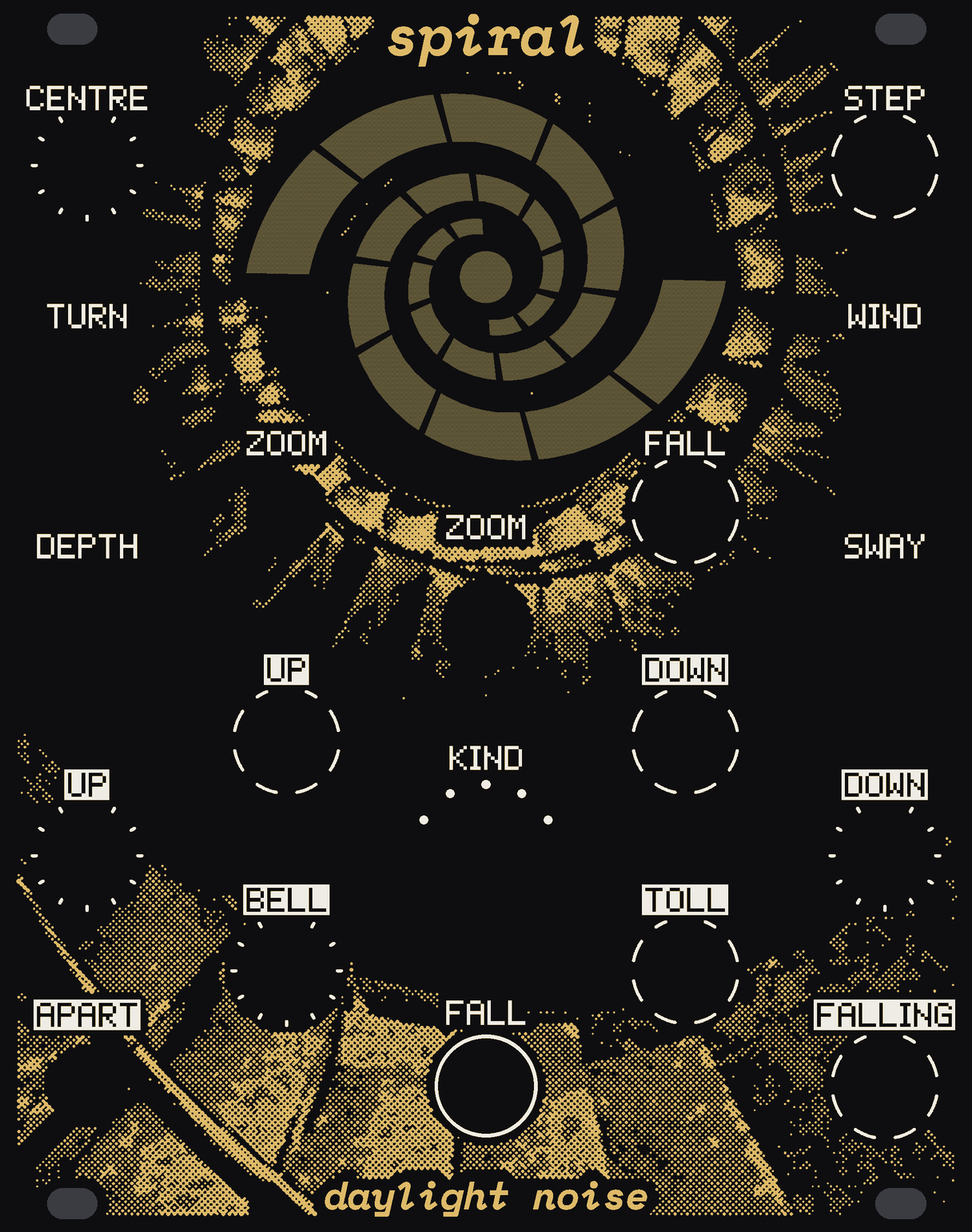
don't look down
20 HP
Hold a note and give it a clock. SPIRAL winds two arpeggios round it in contrary motion, one climbing as the other falls, both home on the centre every turn. ZOOM pulls everything round the note away, or rushes it in; the note never moves.
Turn a knob: drag it or tap either side of it, roll the wheel over it or use the arrow keys; a double click puts it back. KIND clicks from stop to stop the same way; FALL is a button: press it and the spiral falls, hold it and it stays down. The patches step on by themselves until you touch anything.
example patches
The turn, the two lines, the fall and every out and light here are SPIRAL's engine, the module's own code, running in your browser. The groove, the sequencer and the voices are a stand-in rack.
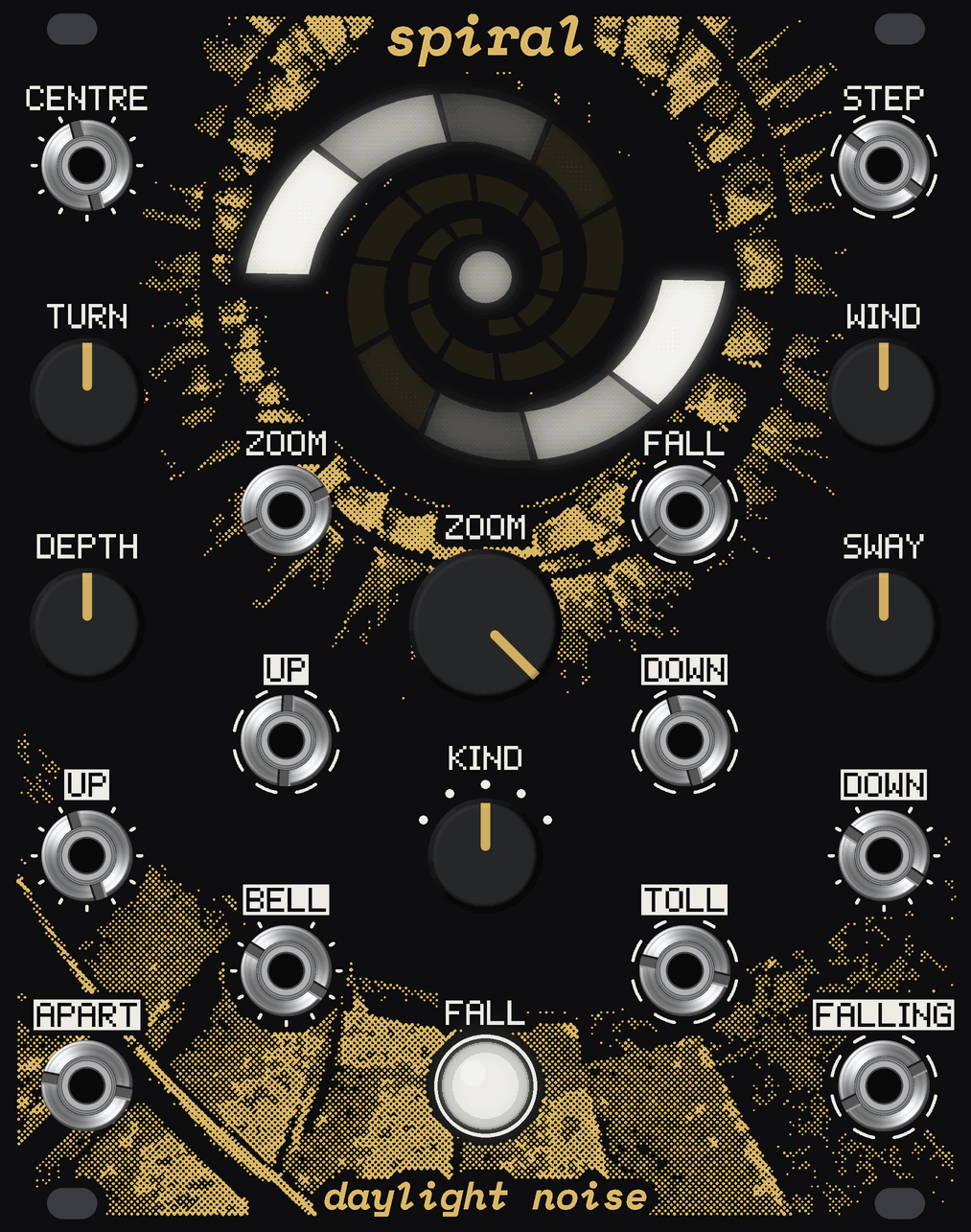
Each turn the two lines leave the centre together, wind out through the chord, UP above and DOWN below, and wind back to meet on it. Under the name, the arm ending on the left lights the notes above the centre, the other those below.
One board sits 10 mm behind the panel with everything on its front: the jacks, the knobs, KIND, FALL, the 46 LEDs and the whole circuit, the USB-C in a notch in its left edge. Each segment of the spiral has its own cell in a black printed baffle, lit by one to three white LEDs along it, so a segment lights evenly and the turn beside it stays dark. An RP2350 winds the two lines three thousand times a second.
Drag it or use the arrow keys to turn it; click it to take it apart.