snarl

it snarls on the beat

20 HP

A hurdy-gurdy: a rosined wheel bows a melody and two drones. Turn the crank and it sings; push it on the beat and the buzzing bridge snarls, so the dance plays its own rhythm.

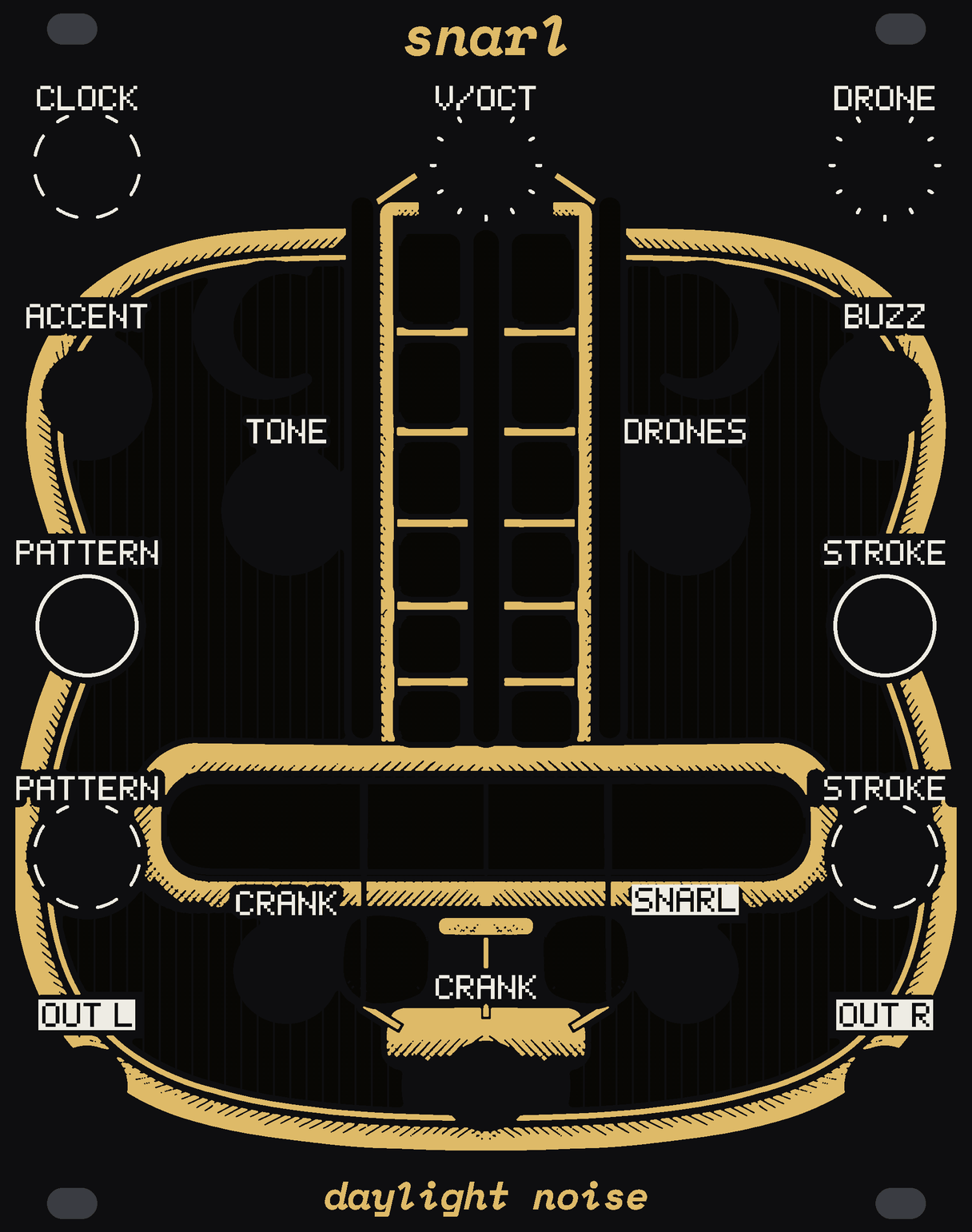
The SNARL panel, black and gold: an ink drawing printed in gold of a hurdy-gurdy seen from above, its guitar-shaped body filling the panel. A long keybox runs down the middle, its twelve keys in two rows either side of the melody string, a drone string outside each wall; across the lower body the wheel's cover, a long slot in it showing the wheel's rim with the three strings crossing it; below, two small buzzing bridges on the drones and the tailpiece, and the big CRANK knob at the foot where the crank comes out. The soundboard, the rim's slot, the strings, the keys and the bridges are bare glass; two C-shaped soundholes in the upper body.

Turn a knob: drag it or tap either side of it, roll the wheel over it or use the arrow keys; a double click puts it back. Turn CRANK up till it snarls; press STROKE to push the crank, PATTERN for the next pattern. The patches step on by themselves until you touch anything.

Synthesised here, as the module would make it: the wheel, the strings, the keys and the buzzing bridges, with a stand-in rack round them.

example patches

Everything SNARL does here is its engine as designed, in your browser: the wheel, the four strings, the keys, the pushes, the two buzzing bridges and the light. The frame drum, the stomp, the pad and the sequencers playing it are a stand-in rack.

Crank it

A hurdy-gurdy is a fiddle played by a wheel. The player turns a crank, a rosined wooden wheel inside the body rubs the strings, and they sing for as long as it turns: no bow to change, no breath to take. One string plays the tune, stopped by keys in a box along the neck, and the others are drones, the same notes held underneath all the time.

CRANK, the big knob, is the crank's handle. Fully left the wheel is stopped. Turn it up and the strings hum, then sing at noon, louder and brighter the faster it goes. On the panel, bands of light run across the wheel's rim as it turns, quicker as you crank. Stop it and the wheel runs down and the strings ring on. The CRANK jack adds to the knob, so an envelope there starts and stops the wheel.

The keys

The snarl

On each drone sits a loose little bridge, the buzzing bridge, held down by a peg. Push the crank suddenly and the wheel drags the drone harder than the peg can hold: the bridge jumps and slaps the soundboard, over and over, at the drone's own pitch. That rattle is the snarl, and a good player pushes on the beat so the instrument plays its own rhythm.

The strings

In a rack

Specs

Format

Width
20 HP
Controls
a big knob (CRANK), four knobs (BUZZ, ACCENT, TONE, DRONES), two lit buttons (PATTERN, STROKE)
Lights
nineteen windows: the wheel's rim, the melody string, two drones, twelve keys, two buzzing bridges and the soundboard, 132 LEDs
Replaces
a lead voice with its envelope and VCA, two drone oscillators, an accent sequencer, a beat-set distortion
Parts
a demo for now: the line's knobs, jacks and buttons, no board yet

Inputs

V/OCT
1 V an octave: the keys; 0 V on C4
DRONE
1 V an octave: the drones' root; 0 V on C
CLOCK
gate: a pulse an eighth note
PATTERN
gate: as the button
STROKE
gate: as the button
CRANK
CV, adds to CRANK: 5 V is the whole turn

Outputs

OUT L
audio: the low drone left, the tune in the middle
OUT R
audio: the high drone right
SNARL
CV, 0 to 8 V: high while it snarls