slime mould

it finds the short way

20 HP

Feed it a few notes and it grows toward them like a slime mould toward food. Its tune wanders busily through everything it reaches, then it prunes, until it plays the shortest way through your notes.

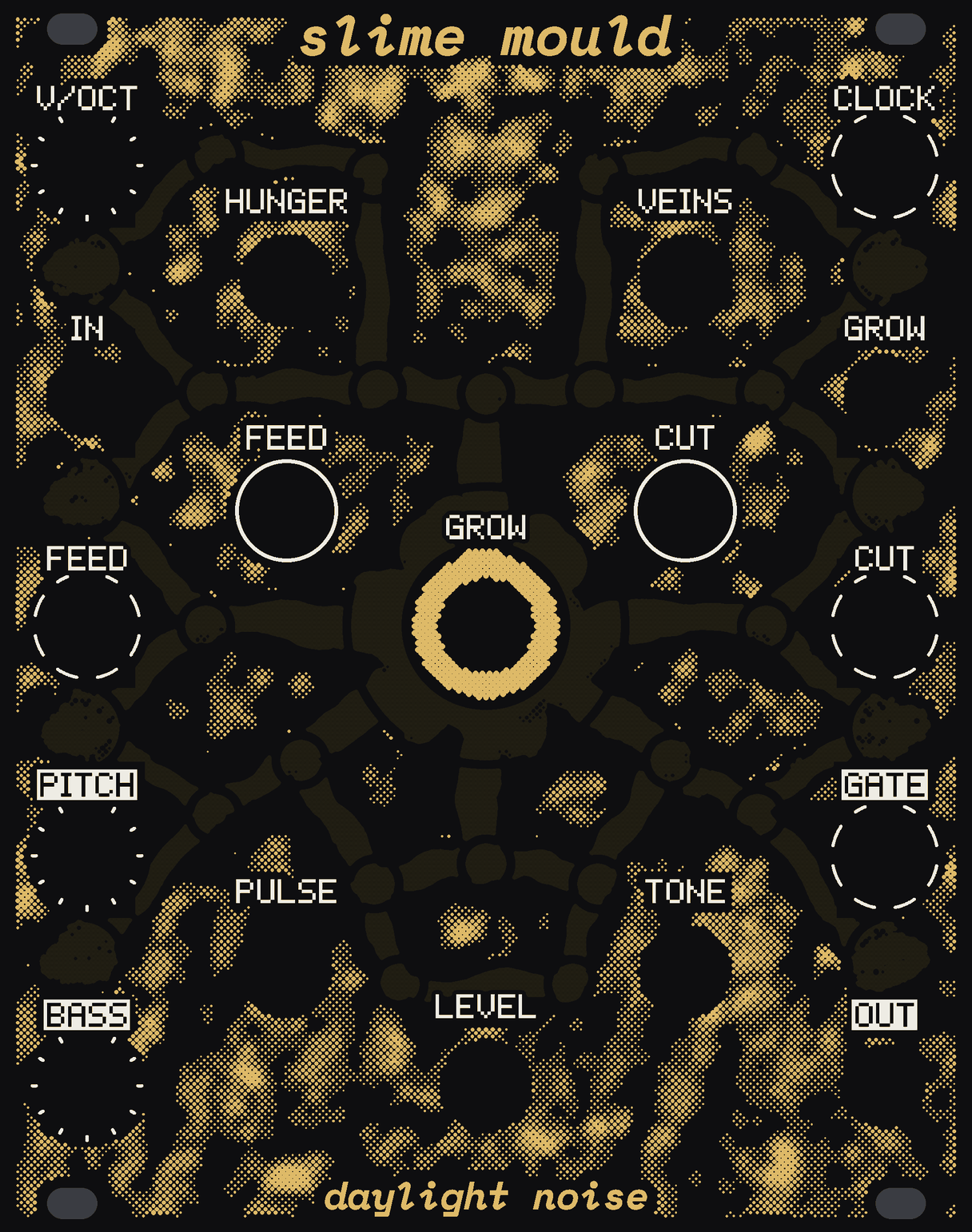
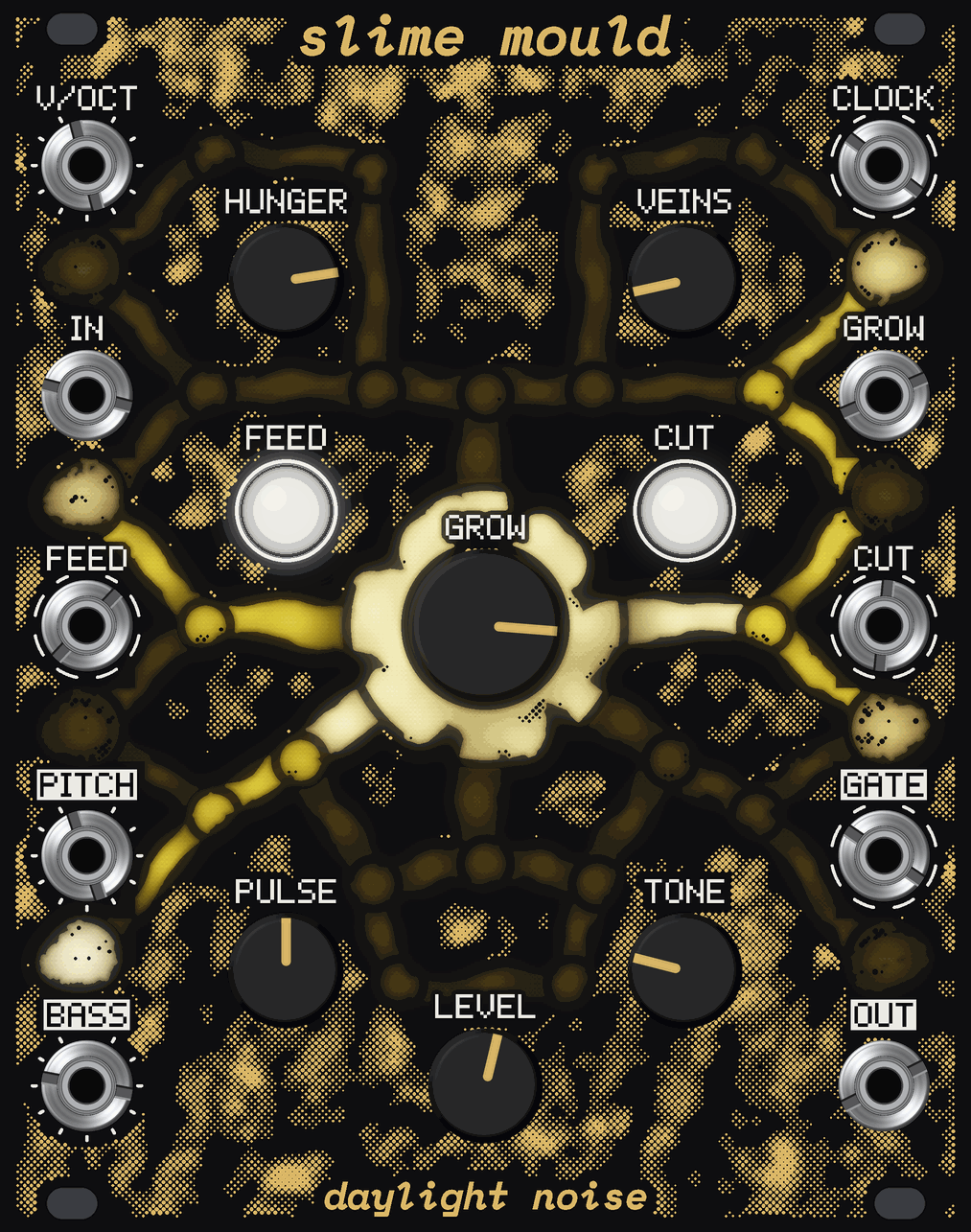
The SLIME MOULD panel, black and gold: a photograph, from straight above, of a bright yellow slime mould spread over the dark, wet bark of a fallen log. A thick, lobed yellow heart sits in the middle, round the big GROW knob, and from it glossy yellow veins fan out between the knobs and jacks, meeting three at a time in small swollen joins, looping over the top knobs, and reaching eight pale oat flakes in the gaps between the jacks, four down each side, each flake partly covered by fine yellow threads. The veins, the heart and the flakes are bare glass for light, cut into cells along the net; the bark's ridges and wet glints are gold dots round them.

Turn a knob: drag it or tap either side of it, roll the wheel over it or use the arrow keys; a double click puts it back. FEED drops a crumb, CUT cuts the net. The patches step on until you touch anything.

Synthesised here: its own struck voice, fed by a stand-in rack.

example patches

Everything SLIME MOULD does here is the module's own engine in your browser; the notes fed into it and the band are a stand-in rack.
Feed it

A slime mould is one yellow cell that spreads veins across a log to reach food, thickens the ones that carry most and lets the rest wither, ending with the shortest net that joins its food. Here your notes are its food.

Each note you feed lands as a crumb, and a pulse runs crumb to crumb through the veins, playing each note it reaches. One cable feeds it: a synth line into IN, a sequencer into V/OCT, or nothing, and press FEED. Take OUT to your mixer; every knob at noon is a good start.

It grows, then it prunes

Always in tune

Cut it, starve it

Its voice

In a rack

Inside

The SLIME MOULD panel lit: a yellow slime mould spread over dark gold bark, its heart glowing under the big GROW knob and its veins running out between the knobs and jacks to glowing oat flakes at the edges.

Drag it or use the arrow keys to turn it; click it to take it apart.

Specs

Format

Width
20 HP
Depth
20.6 mm behind the panel
+12 V
about 141 mA once it has found its way, 266 mA at most (estimated)
−12 V
about 5 mA (estimated)
+5 V
not used
Controls
six knobs (GROW, HUNGER, VEINS, PULSE, TONE, LEVEL), two lit buttons (FEED, CUT)
Light
74 RGB LEDs under the net's 66 windows
Replaces
a sequencer, a quantiser and a voice

Inputs

V/OCT
1 V an octave (0 V is C3)
IN
audio, up to ±10 V
CLOCK
a pulse every sixteenth, high past about 0.9 V
GROW
CV to ±6 V, added to the knob
FEED
gate: a rise feeds it
CUT
gate: a rise cuts the net

Outputs

OUT
audio, its voice, 8 V at most
PITCH
1 V an octave, the tune (0 V is C3)
GATE
5 V on each of the tune's notes
BASS
1 V an octave, the bass, on the bar