slats

let some light in

20 HP

A filter drawn as a window with a venetian blind. Your sound comes through eight slats, one band each: tilt them toward the lows or the highs, draw the blind up band by band, and pull the cord to drop it with a clatter.

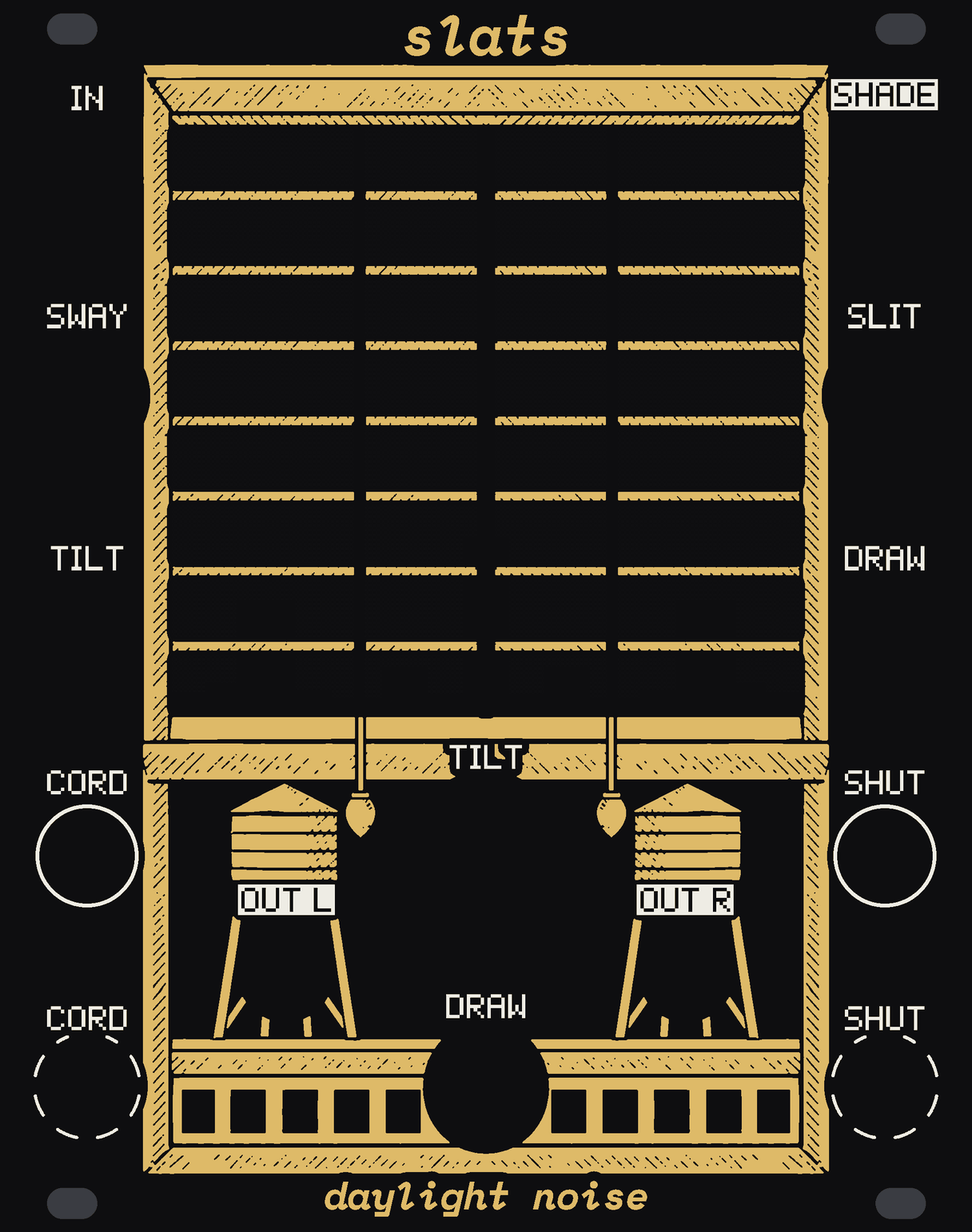
The SLATS panel, black and gold: a tall sash window drawn as a hand-inked illustration, its frame running round the panel inside the jacks. A venetian blind covers the upper half: a hatched head rail under the name, eight thin gold slats, and between them eight long strips of bare circuit board, the window's light; two lift cords and a tilt wand hang down through them in black, and the black tops of a distant city's towers stand against the lowest strips. The blind's bottom rail rests on the meeting rail, which carries TILT's word; below it the lower sash shows a rooftop across the street, two wooden water towers on cross-braced legs and the roof's parapet with a row of dark windows. The big TILT knob sits in the night between the towers, the cords' acorns hanging either side of it; DRAW sits on the parapet; the jacks and buttons run down both edges.

Turn a knob: drag it or tap either side of it, roll the wheel over it or use the arrow keys; a double click puts it back. Press CORD to drop the blind, hold SHUT to snap the slats shut. The patches step on by themselves until you touch anything.

Synthesised here, as the module would make it: the bands, the slats and the blind, round a stand-in rack's band.

example patches

SLATS here is its engine as designed, in your browser: it hears only what comes into its jacks. The horn, the piano, the bass, the drums, the strings, the echo and the beeps are a stand-in rack.

One cable, behind the blinds

Anything into IN, a whole mix if you like, and OUT L and OUT R to your mixer. SLATS cuts your sound into eight bands, from the lowest bass to the hiss at the top, and puts each one behind a slat of a venetian blind. With the slats open the eight add back together exactly: your sound as it was. Close them, raise the blind, let it drop, and you're choosing which parts of the sound get through.

The window shows it: the strip of light between two slats is that band coming through, the lowest at the bottom. A kick glows at the foot of the window, cymbals at the top.

TILT turns the slats

DRAW and CORD

SWAY and SHUT

SLIT and SHADE

Specs

Format

Width
20 HP
Controls
four knobs (TILT, DRAW, SWAY, SLIT), two lit buttons (CORD, SHUT)
Lights
the eight strips between the slats: 64 LEDs
Bands
eight, cut at 92, 185, 370 and 740 Hz and 1.5, 3 and 5.9 kHz; flat when open
Replaces
a filter bank, a tilt filter, and the filter and envelope you'd patch for a sweep and a drop
Here
a demo: the parts and the engine as designed, no board yet

Inputs

IN
audio: your sound, mono, 5 V full scale
TILT
CV, added to TILT: 5 V half a turn
DRAW
CV, added to DRAW: a volt a band
CORD
gate: drops the blind; down while high
SHUT
gate: snaps the slats shut while high

Outputs

OUT L
audio: the light let in, the left side
OUT R
audio: the right side
SHADE
audio: what the slats keep out, mono