slack

tune it down till it rattles

20 HP

A plucked guitar string and a slapped bass an octave under it, built round how slack the strings are. Tight, it's a clean low string, true and ringing. Loosen it and every pick bends sharp and sags flat, buzzing on the frets, over its own swung riff full of rests.

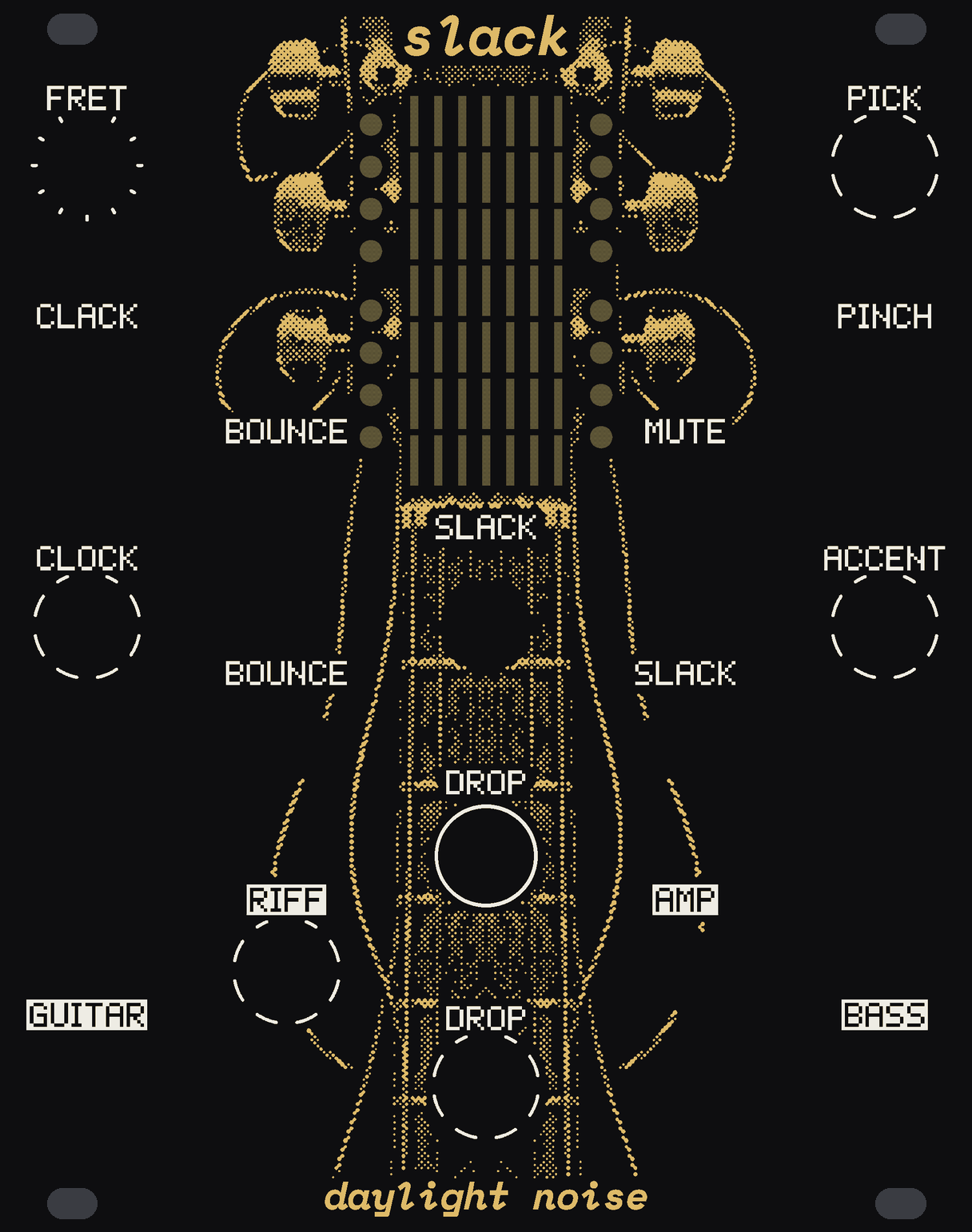
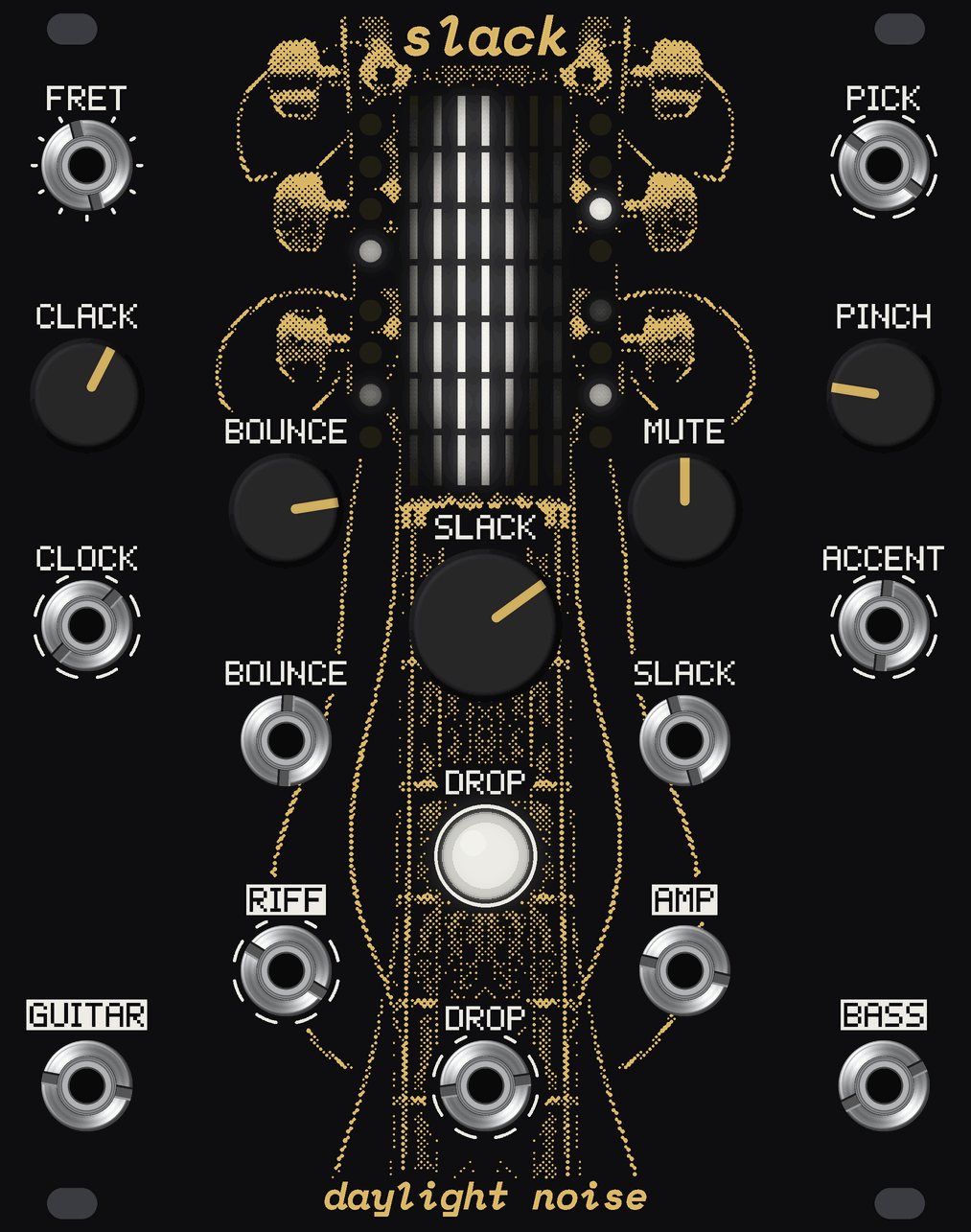
The SLACK panel: black, with a guitar's headstock in gold dots at the top, its tuners either side and its strings let loose off them in loops, hanging slack down the panel, and the neck running down the middle to the foot. Under the name, seven lines of bare circuit board run down the headstock, with eight round steps down either side of them. FRET and PICK at the top corners, CLACK and PINCH below them, BOUNCE and MUTE either side of the lines, CLOCK and ACCENT on the outer columns, SLACK the big knob in the middle with BOUNCE's and SLACK's jacks either side, the DROP button under it, RIFF and AMP out, DROP's jack, and GUITAR and BASS out at the foot. slack at the top, daylight noise at the bottom.

Turn a knob: drag it or tap either side of it, roll the wheel over it or use the arrow keys; a double click puts it back. DROP is a button: hold it and the strings let go. The patches step on by themselves until you touch anything.

What you hear is SLACK's AMP out over a dark drum machine, a clock's sixteenths into CLOCK and a slow chord change into FRET. All made in the page.

example patches

The strings, the riff and the lights are SLACK's engine, the module's own code, running in your browser; the clock, the drums and the other gates stand in for a rack.
The strings

The slap and the squeal

The riff

What comes out

Inside

One board sits 10 mm behind the panel with everything on its front, the USB-C at its right edge. Each of the neck's 49 white LEDs lights its segment through a channel of a black printed baffle running up its line; the walls across a channel stop well short of the panel, so a lit line reads as one string, not seven lamps. Each step of the riff has a well of its own.

The SLACK panel: a guitar's headstock in gold dots, its strings let loose off the tuners, seven lit lines down the neck under the name and the riff's steps either side, its knobs, jacks and DROP on.

Drag it or use the arrow keys to turn it; click it to take it apart.

Specs

Format

Width
20 HP
Depth
20.8 mm behind the panel
+12 V
about 62 mA at rest, 103 mA with the riff at noon, 159 mA on the busiest patch, 208 mA at the most (estimated)
−12 V
about 5 mA (estimated)
+5 V
not used
Controls
a big knob, 4 knobs, a lit button

The strings

Strings
the low string, its fifth and octave, the squeal, the bass an octave under
Lowest note
13 Hz
Riffs
eight, two bars of sixteenths each
Swing
up to 0.3 of a sixteenth

Inputs

FRET
1 V an octave, ±6 V, 0 V the A at 55 Hz
CLOCK
sixteenths, high past 1 V
Gates
PICK, ACCENT, DROP: high past 1 V, low under 0.8 V
CVs
SLACK, BOUNCE: 5 V the whole way, added to their knobs

Outputs

AMP
audio, up to 10 V peak to peak, never past ±5.8 V
GUITAR, BASS
audio, about ±4 V
RIFF
gate, 5 V, half a step (10 ms at the least)