sink or swim

they sink one by one

20 HP

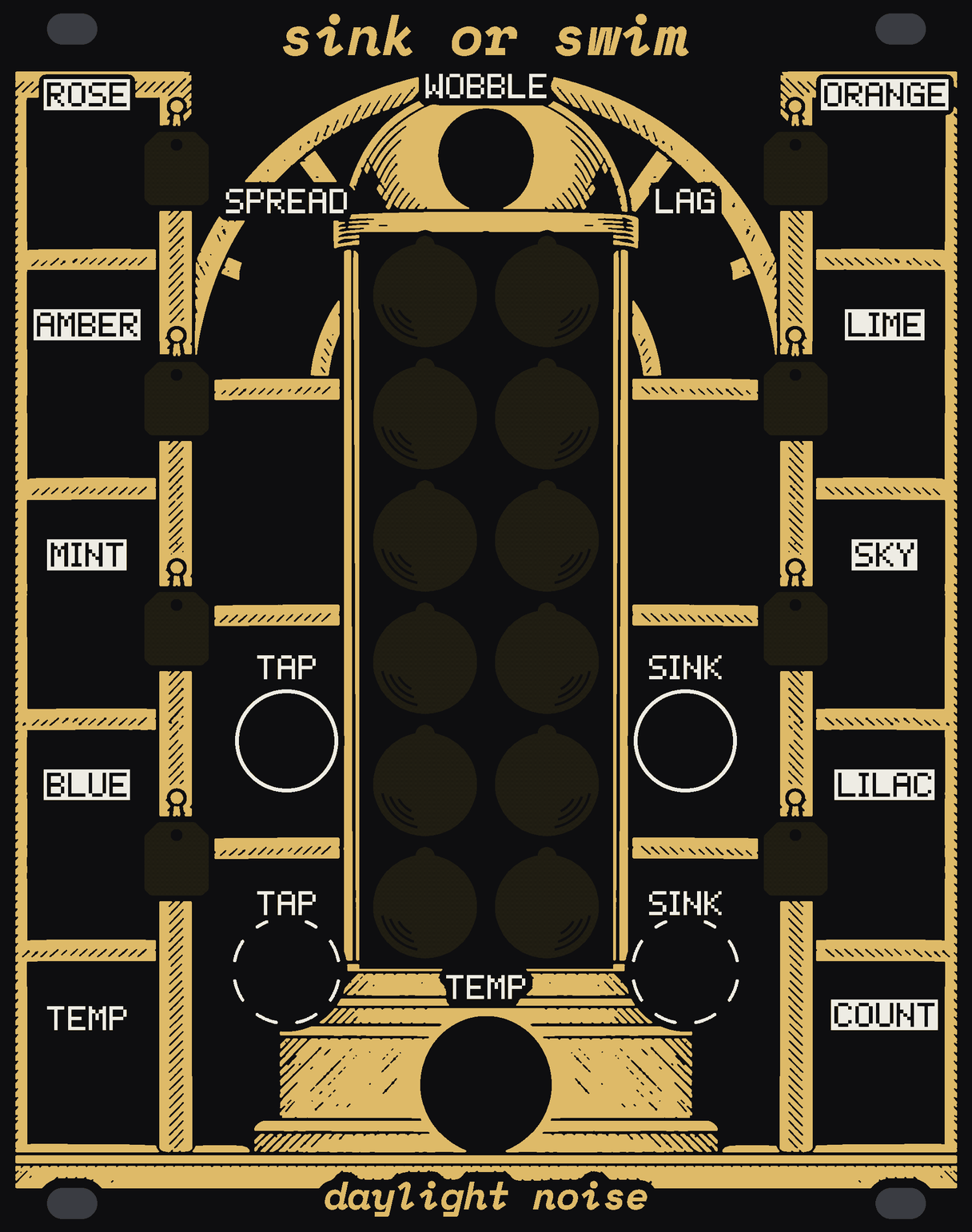
Eight glass bulbs in a column of liquid. Warm it and they sink one by one; cool it and they swim back up. Each bulb is a gate, high while it floats, so one slow voltage brings the parts of your track in one at a time.

The SINK OR SWIM panel, black and gold: a bold hand-inked illustration in solid gold of a tall glass thermometer standing on a broad sill, its brass cap domed round the WOBBLE knob and its stepped brass base round the big TEMP knob, in front of an arched three-light window at night, its mullions and glazing bars hatched in black ink and the fanlight's rays fanning out behind the glass. Inside the glass, two lanes of six round glass places, each a bulb's body and its sealed tip, shaded with a few ink strokes; beside each of the eight gate outs down the edges a tag hangs on a nail on the mullion. Bare glass for light, all of it.

Turn a knob: drag it or tap either side of it, roll the wheel over it or use the arrow keys; a double click puts it back. Press TAP to knock the glass; hold SINK to sink them all. The patches step on until you touch anything.

Synthesised here. SINK OR SWIM makes no sound of its own: its eight gates switch the eight players of a stand-in rack.

example patches

SINK OR SWIM here is its engine as designed, in your browser: it hears only what comes into its jacks. The eight players, the wave, the knocks and the room are a stand-in rack.

Sink or swim

A gate is a voltage that's either on or off: patched into a VCA, it lets a sound through while it's on. SINK OR SWIM has eight, one for each bulb, and each is on while its bulb floats.

Each bulb has its own mark, a temperature. While the liquid is cooler than a bulb's mark, the bulb swims at the top of the glass; once it's warmer, the bulb sinks to the bottom. The marks run from ROSE, the warmest (the last to sink), to LILAC, the coolest (the first). So as the liquid warms the bulbs sink one by one, LILAC first, and as it cools they swim back up, ROSE first. Patch eight parts of a track into eight VCAs, and one voltage into TEMP brings them in and takes them out in order.

The warmth and the marks

Lazy on purpose

Jostle and knock

Hold to sink, and COUNT

In a rack

Specs

Format

Width
20 HP
Controls
a big knob (TEMP), three knobs (WOBBLE, SPREAD, LAG), two lit buttons (TAP, SINK)
Lights
20 windows on 20 RGB LEDs: the glass's twelve places and the eight bulbs' tags
Replaces
an eight-way comparator, a slew, a random source and a gate switcher
Parts
a demo for now: the line's knobs, jacks and buttons, no board yet

Inputs

TEMP
CV, added to TEMP
TAP
gate: each rising edge knocks the glass
SINK
gate: held high, every bulb sinks

Outputs

ROSE
gate, 8 V while the rose bulb floats (the warmest mark)
ORANGE
gate, the orange bulb
AMBER
gate, the amber bulb
LIME
gate, the lime bulb
MINT
gate, the mint bulb
SKY
gate, the sky blue bulb
BLUE
gate, the blue bulb
LILAC
gate, the lilac bulb (the coolest mark)
COUNT
CV, a volt for every bulb afloat, 0 to 8 V