singing arc

it sings in sparks

20 HP

A voice played by lightning. Play it a melody and two coils sing it in sparks, from a thin, quiet buzz to a roar. Low notes strike down, high notes leap up, and a field of bulbs glows with the power left in the air.

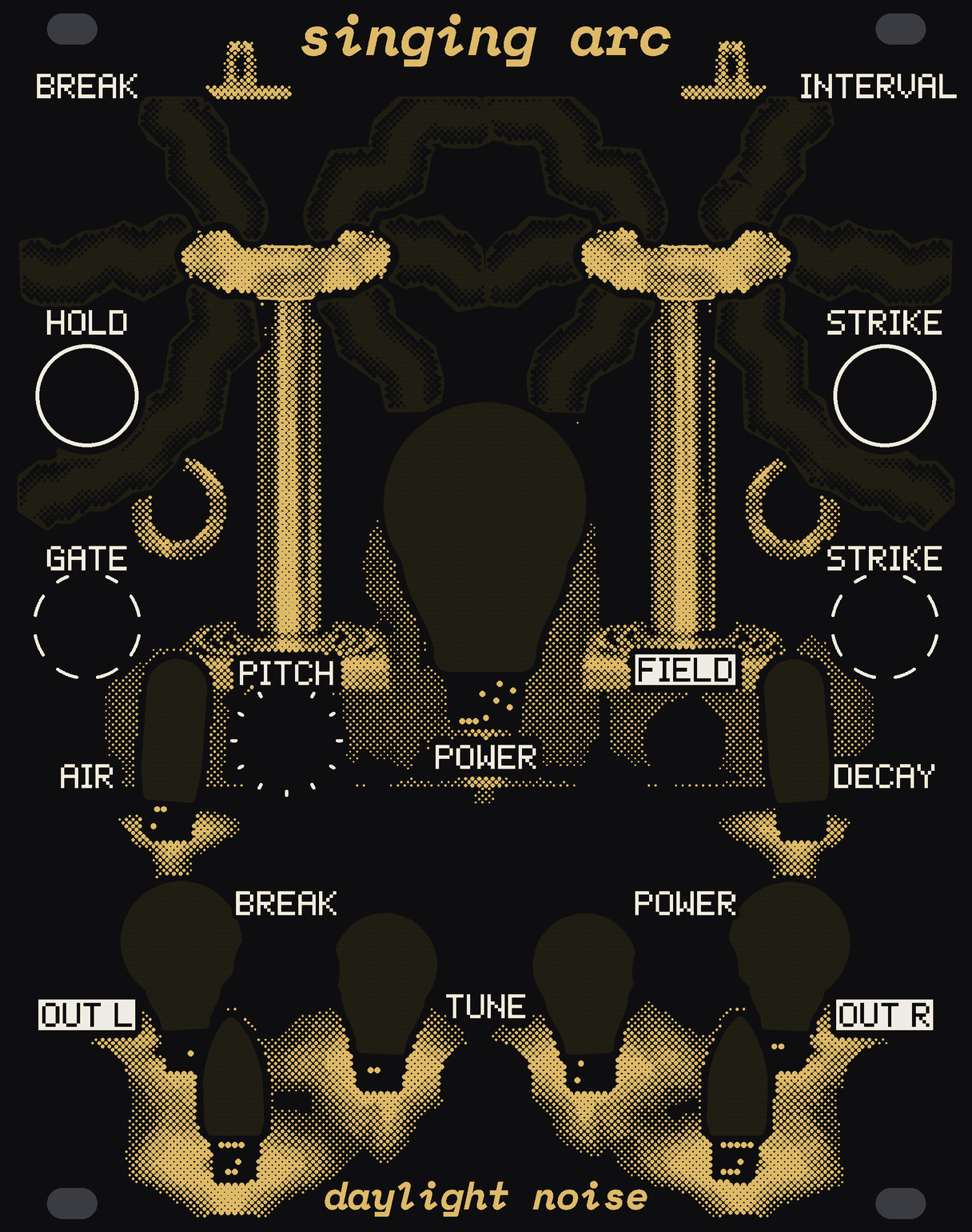
The SINGING ARC panel, black and gold: a photograph of a dark timber workshop, two coils standing on shelves either side of the middle, each a polished gold ring on top of a copper winding. From the rings, bolts of lightning are thrown out to both sides, arch over the top towards each other and strike down into a big clear pear lamp standing between the coils; each bolt is bare glass that lights from inside. Eight glass bulbs of four shapes, tubes, globes, pears and candles, stand on the plank floor below, their glass a window too and their screw caps gold. A shelf with a jar sits high in each top corner and a coil of copper cable hangs beside each coil. POWER, the big knob, sits under the lamp and TUNE under it; BREAK and INTERVAL in the top corners, HOLD and STRIKE buttons, AIR and DECAY, and the jacks down both sides and between the bulbs.

Turn a knob: drag it or tap either side of it, roll the wheel over it or use the arrow keys; a double click puts it back. Press HOLD to hold a note as a drone, STRIKE for a burst at full power. The patches step on by themselves until you touch anything.

Synthesised here, as the module would make it: both coils, their sparks, the strike and the air, with a stand-in rack round them.

example patches

Everything SINGING ARC does here is its engine as designed, in your browser: both coils, their sparks, the strike, the air and the light. The drums, the pad, the sub and the sequencer playing it are a stand-in rack.

It sings in sparks

Patch a sequencer into PITCH and GATE and it plays your notes as lightning. Every note is a train of sparks, one for each cycle of the note: each spark a crack, the whole train a buzzing, singing tone you can hear across a room.

It isn't a pulse wave with noise on top. Every spark comes a little early or late, a little fatter or thinner, and the bigger they get the rougher they are, the way a real arc in the air is. On the panel each coil throws its lightning at the height of the note: low notes strike down, high notes leap up into the corners, and the further you turn POWER, the further out along the bolts the light runs.

The coil

Two coils

Strike, the air and the field

In a rack

Specs

Format

Width
20 HP
Controls
a big knob (POWER), five knobs (TUNE, BREAK, INTERVAL, AIR, DECAY), two lit buttons (HOLD, STRIKE)
Lights
21 windows: each coil's six bolts, eight bulbs and the lamp
Replaces
a buzzy oscillator, a crackle source, a ring modulator, and an envelope and VCA
Parts
a demo for now: the line's knobs, jacks and buttons, no board yet

Inputs

PITCH
1 V an octave, 0 V on C3 with TUNE at noon
GATE
gate: a note while it's high (unpatched: every new note on PITCH is struck)
STRIKE
gate: a rising edge strikes
BREAK
CV, adds to BREAK: 5 V is the whole turn
POWER
CV, adds to POWER: 5 V is the whole turn

Outputs

OUT L
audio: the first coil a little left, the second right, the air
OUT R
audio
FIELD
CV, 0 to 8 V: the energy in the air