shift work

it changes on the line

20 HP

A sequencer that is a factory line. Eight boxes ride a belt past a press, an inspector and a paint gun; each one that reaches the top is played, then goes round again or is packed. The odd notes get thrown off, so the riff keeps changing, and gets better.

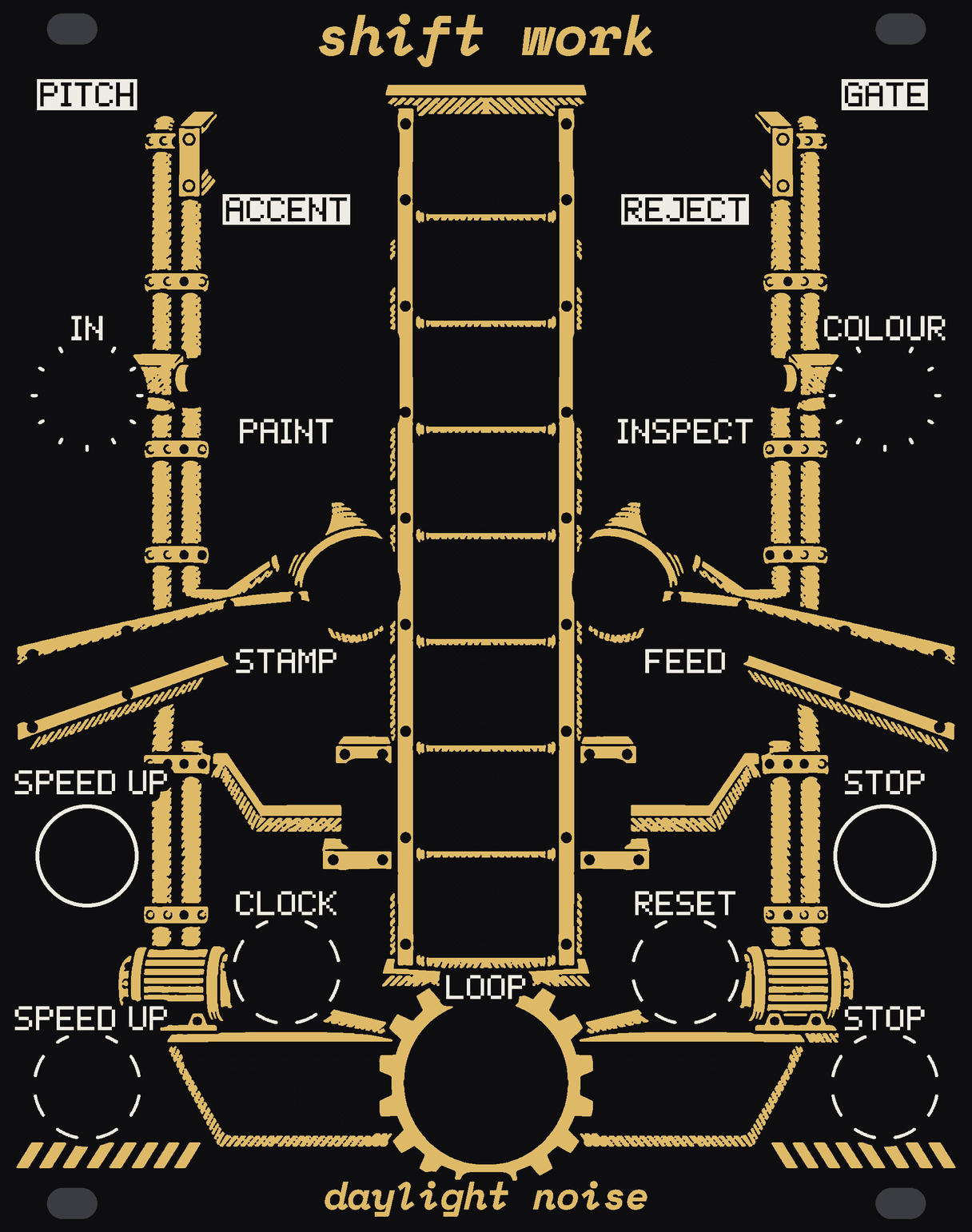
The SHIFT WORK panel, black and gold: a factory line seen from above drawn in bold gold ink, a conveyor belt up the middle with its rollers, side rails and a drum at each end, pipes with bolted flanges up both sides, and the line's machines either side of the belt: the packer's heads at the top, two paint guns, two hooded inspection lamps with reject chutes sloping away to the edges, a stamping press's frame with its pistons, and at the foot a toothed drive wheel with a motor either side and two feed hoppers. The eight boxes on the belt are windows of bare glass with their tape drawn down the middle in black; the stations' lamps, spray, pistons, chutes, heads and hoppers are glass too. LOOP, the big knob, sits in the drive wheel; PAINT, INSPECT, STAMP and FEED beside the belt; SPEED UP and STOP lit buttons over their gate jacks; the outs PITCH, GATE, ACCENT and REJECT at the top.

Turn a knob: drag it or tap either side of it, roll the wheel over it or use the arrow keys; a double click puts it back. Press SPEED UP for a bar at double speed, STOP to stop the line (press again to start it). The patches step on by themselves until you touch anything.

Synthesised here. SHIFT WORK makes no sound: you're hearing a stand-in rack feeding the line its notes and its clock, and the module's outs playing a bass and a reject bin.

example patches

Everything SHIFT WORK does here is its engine as designed, in your browser: the belt, the stations, what comes back round. The bass, the drum machine, the pad and the reject bin's clank are a stand-in rack.

The line

The belt has eight places. Every tick of CLOCK (a sixteenth, say; with nothing in it, eight a second) moves each box up one. A box comes on at the foot with a note from IN, rides up past the stations, and when it reaches the top it's played: PITCH is its note and GATE goes high. So whatever goes into IN comes out seven ticks later, and the eight boxes on the belt are a riff that comes round every half bar.

Then the box at the top either goes back round to the foot, or it's packed and shipped and its place comes round empty, ready for a new one. LOOP, the big knob in the drive wheel, is how many come back. Fully right every box comes back for ever: the riff is locked. At noon about one new note comes in a bar, so the riff mostly stays and slowly changes. Fully left nothing comes back, and the line plays what comes in, worked on the way. With nothing in IN the line takes its own stock, notes of the minor pentatonic.

The stations

Coming back round

The inspector is what makes this more than a looping random sequence. A new note that doesn't fit is thrown off and tried again with another, so with LOOP high the riff settles: the leaps go, the notes that sit together stay. Turn LOOP down for a few bars to let new notes in, and up again to keep the riff you like.

FEED is how full the line runs: each place that comes round empty gets a new box with this chance. Turned down, gaps come round with the boxes, and a gap is a rest. With LOOP high the rests stay where they are, part of the riff.

Speed up and stop

What comes out

In a rack

Specs

Format

Width
20 HP
Controls
a big knob (LOOP), four knobs (PAINT, INSPECT, STAMP, FEED), two lit buttons (SPEED UP, STOP)
Lights
20 windows on 68 RGB LEDs: the eight boxes and the stations
Replaces
a looping random sequencer, an accent sequencer, a transposer, a smoother and a fill button
Parts
a demo for now: the line's knobs, jacks and buttons, no board yet

Inputs

IN
1 V/oct, sampled as a box comes on
COLOUR
1 V/oct: how far the paint moves a note
CLOCK
gate: a step on each rising edge; empty, eight a second
RESET
gate: the round from its first box
SPEED UP
gate: a bar at double speed
STOP
gate: the line stopped while high

Outputs

PITCH
1 V/oct, the box played
GATE
5 V for each box played
ACCENT
5 V with a stamped box
REJECT
5 V when a box is thrown off