set to stun

it can overload

20 HP

A deep, liquid phaser with a dial that gets more dangerous as you turn it. Hold OVERLOAD and the feedback climbs past one: a whine climbs out of your sound and eats it. Twelve counts you can walk back, four you can't, then a crack and a hole in the mix.

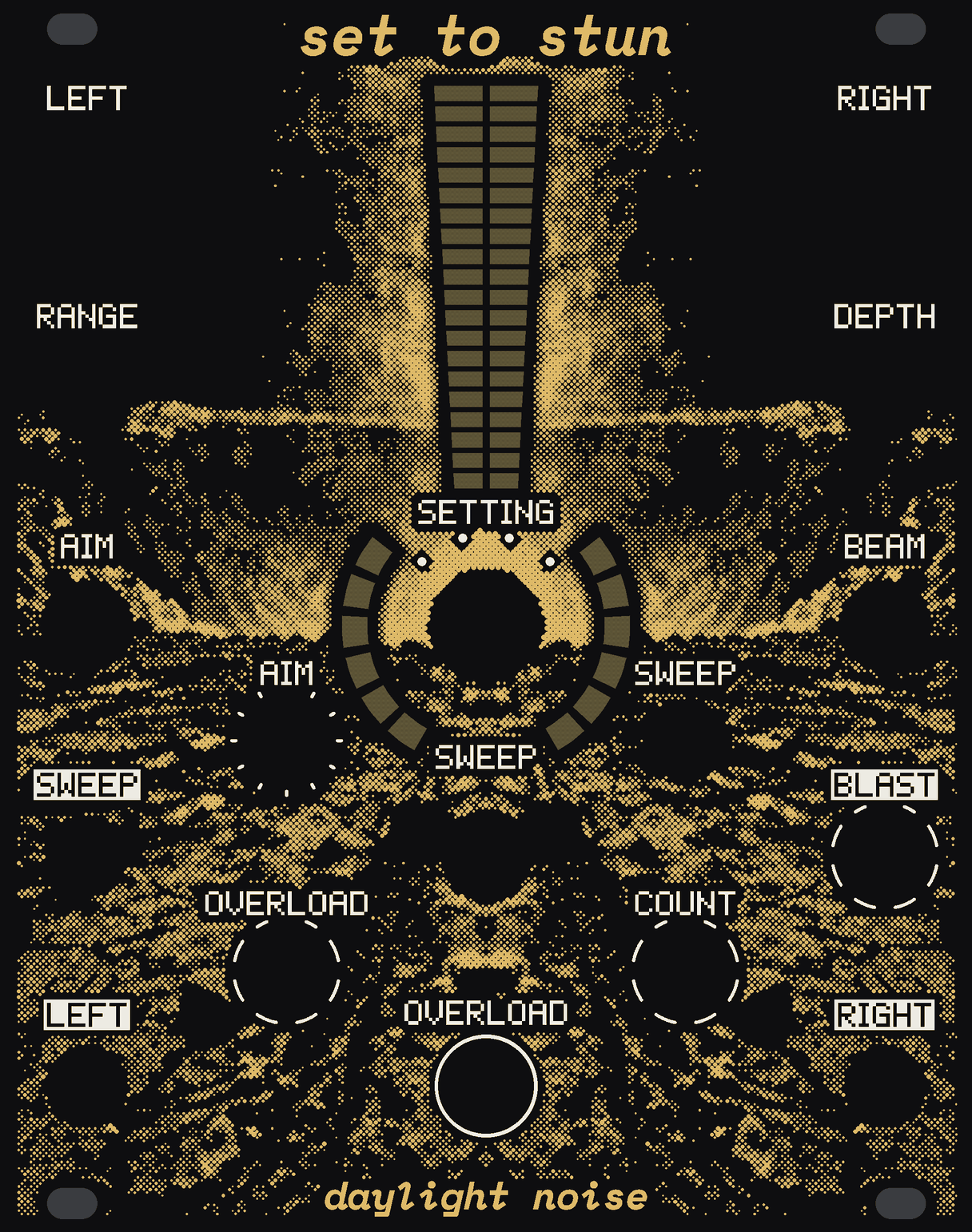
The SET TO STUN panel: black, with a crater in cracked ground in gold dots and a column of dust standing in the air above it. Up the middle, in bare circuit board, a tall beam of forty small cells in two columns, and twelve slats round the SETTING dial, six a side. RANGE, DEPTH, AIM and BEAM knobs, SETTING and SWEEP big knobs down the spine, OVERLOAD a white button at the foot, ten jacks.

Turn a knob: drag it or tap either side of it, roll the wheel over it or use the arrow keys; a double click puts it back. OVERLOAD is a button: hold it, and let go in time. The patches step on by themselves until you touch anything.

Drums, a pad, keys and a bass at 124 BPM, all of it through SET TO STUN. Listen plays the patch from its top.

example patches

The phaser, the charge and the lights are SET TO STUN's engine as designed, running in your browser. The drums, the pad, the keys and the bass are a stand-in rack.

The phaser

Up to twelve stages a side, the two sides a quarter of a sweep apart. At noon, a deep slow phaser you never turn off. A whole mix is the idea.

Overload

Hold it and the feedback climbs past one. A whine climbs, faster and higher, in pips that double as it goes, while your sound goes under. Let go in time and it winds down in a falling purr. Hold on and it goes off: a flash, a crack, then nothing.

The lights

What comes out

Specs

Format

Width
20 HP
Controls
a four-stop switch, a big knob, 4 knobs, a lit button

Inputs

LEFT, RIGHT
audio, ±5 V
AIM
1 V an octave, added to its knob
SWEEP
CV, 1 V doubles the rate
OVERLOAD
gate, high past 1 V
COUNT
clock, rising past 1 V

Outputs

LEFT, RIGHT
audio, ±5 V
SWEEP
CV, −5 to +8 V
BLAST
gate, 5 V