screw

14 HP · slowed, on the clock

Your mix comes out slowed and low, like a screwed tape, but it stays on your clock. SCREW slows whatever comes in the way a tape slows, pitch and time together, down to half speed. Slowed, it falls behind the rack, so after every beat, bar or four bars it cuts back to now, right on the downbeat: the drums drag through the bar and snap back on the one. CHOP repeats the last beat in time. BACK spins it back.

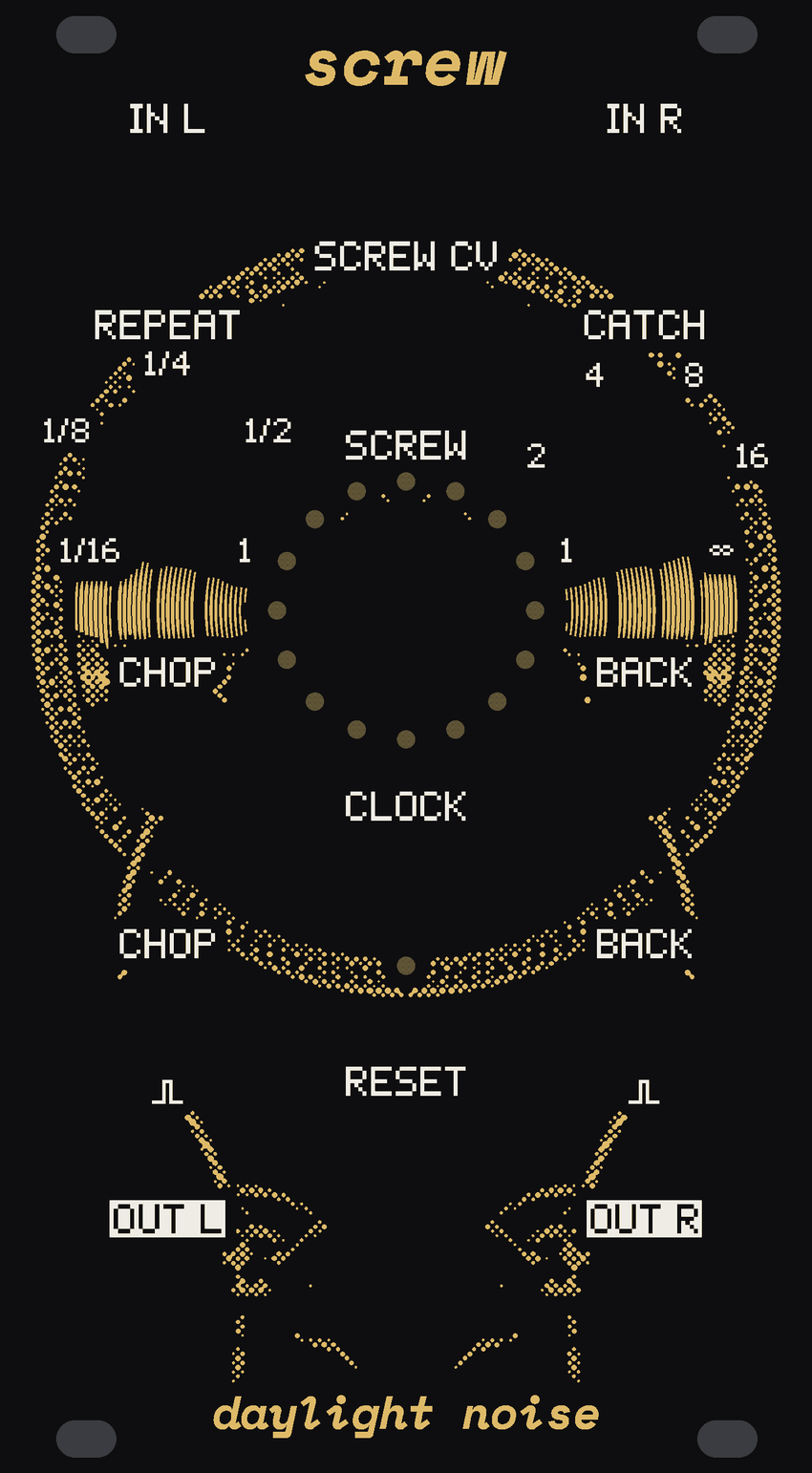
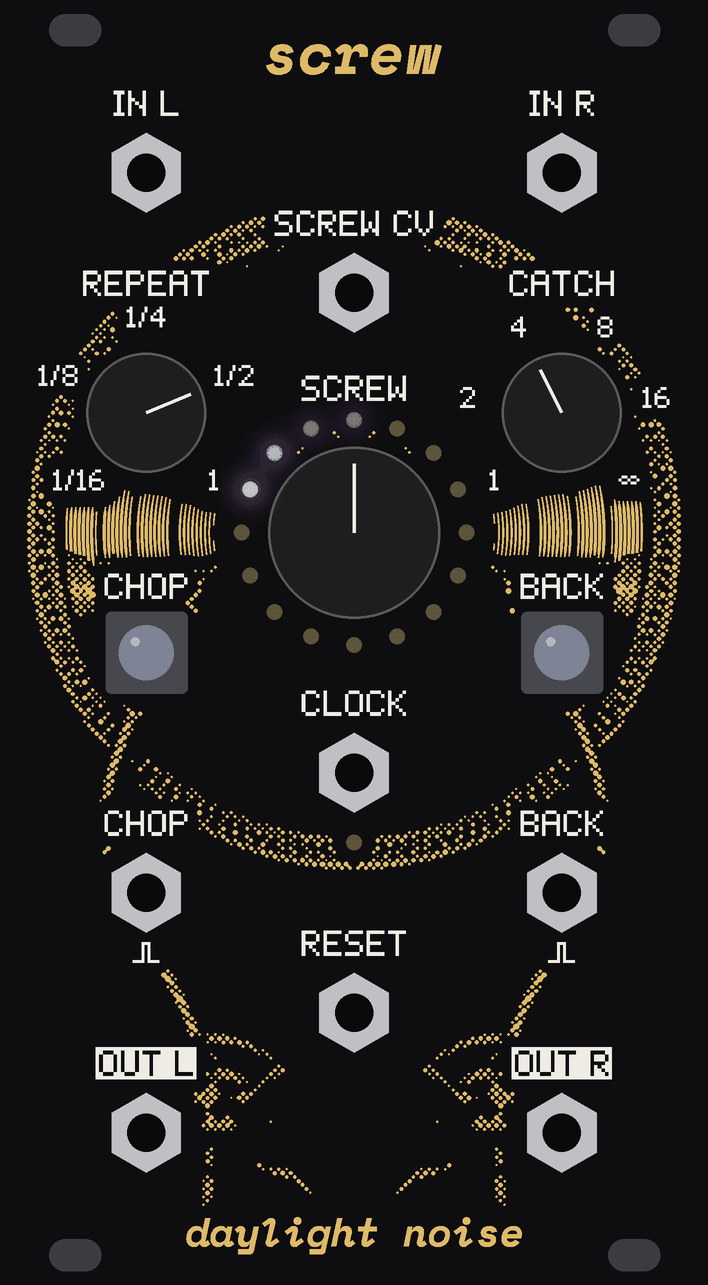
The SCREW panel: a turntable seen from straight above, in gold dots and lines on black, two tonearms set down on one record, the platter's strobe dots round its rim. SCREW, the big knob, sits on the spindle inside a ring of sixteen small round windows. White labels for the knobs REPEAT (printed 1/16 to 1) and CATCH (printed 1 to 16 and infinity), the buttons CHOP and BACK, and the jacks IN L, IN R, SCREW CV, CLOCK, RESET, CHOP, BACK, OUT L and OUT R.

Turn a knob: drag it, roll the wheel over it or use the arrow keys; a double click puts it back.

Everything but the four spoken lines is made in the page as you listen. Headphones help.

example patches

The sound and the lights here are SCREW's own engine: the module's firmware, ported to the page and checked against it sample for sample. The drums, the bass, the pad and the voices are stand-ins for the rest of a rack.
Screw

SCREW is the big knob. Fully anticlockwise the sound passes untouched. Turned, it slows the sound the way a slowing tape does, pitch and time dropping together, down to half speed and an octave lower fully clockwise. Most of its travel is where slowed music lives, between about 1.5 and 9 semitones down; noon is three quarters speed, five semitones.

Inside, IN L and IN R are always being recorded, 44 seconds of tape in 8 MB of memory, and a read head plays them back at the slower speed, smoothly between samples. It can never get ahead of what's been recorded, so it never runs faster than real time.

Catch

Slowed, the sound falls behind the rack: at three quarters speed, a beat behind by the end of a bar. So on each catch SCREW cuts back to now, crossfaded over a few milliseconds, right on the clock's edge, and every window starts on the beat. What you hear in a window is its first part stretched to fill it: at three quarters speed and a bar's window, the bar's first three beats played across four. The last beat is never heard. Those missing tails are the chops.

Chop

CHOP is a button and a gate in. While it's held, SCREW loops the last REPEAT of what it played: the read head jumps back that far every REPEAT, so each repeat lasts exactly REPEAT and stays on the grid. Let go and it goes straight to where it would have been if you'd never touched it, the way a cut goes back to the copy of the record that kept playing.

Back

BACK is a backspin, a button and a gate in, timed the same way. The read head runs backwards, fast at first and slowing to a stop over the rest of the beat (never less than half a beat), the sound falling away as it slows. On the next beat it catches up to now. On the last beat before a drop, it's the spin back and the one.

Playing the speed

SCREW CV is a volt an octave on the tape's speed, added to the knob: −1 V takes it an octave further down, positive volts bring it back toward untouched, and it never goes faster than real time or slower than a quarter. A sequencer in SCREW CV plays the speed as a melody: each catch starts a bar at its own speed, so a voice through it follows the notes.

Patch only a voice into IN, keep the beat straight, and the voice drags against the drums and snaps back on every one. There's no dry and wet and no reverb on the panel: slowed and drenched is a reverb patched after it.

The panel

Fourteen HP, every part on the line's staggered grid and mirrored about the middle. The art is a turntable from straight above in one hard light, gold on black: SCREW on the spindle, the label under the knob, two tonearms set down on the one record, its grooves drawn as gold lines.

Round SCREW are sixteen strobe dots, small windows of bare glass with a violet light behind each. The lit dot is where you are: at the top when nothing's slowed, drifting back a dot for every sixteenth of a bar you fall behind, a faint trail back to the top. On a catch it snaps back to the top. A window under CLOCK blinks the beat, and the caps of CHOP and BACK light blue while they're working.

Inside

The SCREW panel playing, three dots of its ring lit back from the top, its knobs on.

Drag to look around. Lift the panel: the black baffle stays on the board, a cell for each window round SCREW's shaft and one under CLOCK, each with its LED at the foot. One RP2350 does it all, the tape in its 8 MB of memory.

Specs

Format

Width
14 HP
Depth
about 21 mm behind the panel, its power header included
+12 V
about 120 mA with the windows dark, 175 mA at the most (both caps lit, the windows at their cap)
−12 V
about 10 mA
+5 V
not used; 10-pin header
Panel
1.6 mm FR4: ENIG gold through black mask, white labels, seventeen windows of bare glass
Controls
3 knobs (SCREW's big, CATCH and REPEAT in detents), 2 lit buttons

I/O

IN L, IN R
audio, ±5 V with room to ±9; 100 k. IN R normalled to IN L
SCREW CV
1 V an octave on the speed, ±5 V; 100 k
CLOCK, RESET
gates, rising past about 1.1 V; 100 k. Each knows when it's unpatched
CHOP, BACK
gates, the same; they act at once
OUT L, OUT R
±5 V, 1 k; each its own side

Engine

Brain
RP2350, 46.875 kHz, 32-bit float
Converters
PCM1808 in, PCM5102A out, on one I2S clock
Tape
8 MB PSRAM: 44.7 s of stereo, 16 bits, written all the time
Read head
a 16-point windowed sinc between samples, 0.17 ms behind the input
Light
17 RGB LEDs behind the windows, violet, their current capped; the caps' own blue LEDs
Firmware
over USB-C or the debug header, on the back

Nothing's for sale yet.

SCREW is designed and its firmware builds. Nothing has been made, so the numbers here are the design's and the engine's, not measurements, and there's no date.