sawyer

a duet for two saws

20 HP

Two bowed singing saws. Bend it and it sings: every note glides, every long note shakes, and the second saw sings a third under the first, in the key it hears you play. FLAP lets the blades go for a wobbling boom of steel.

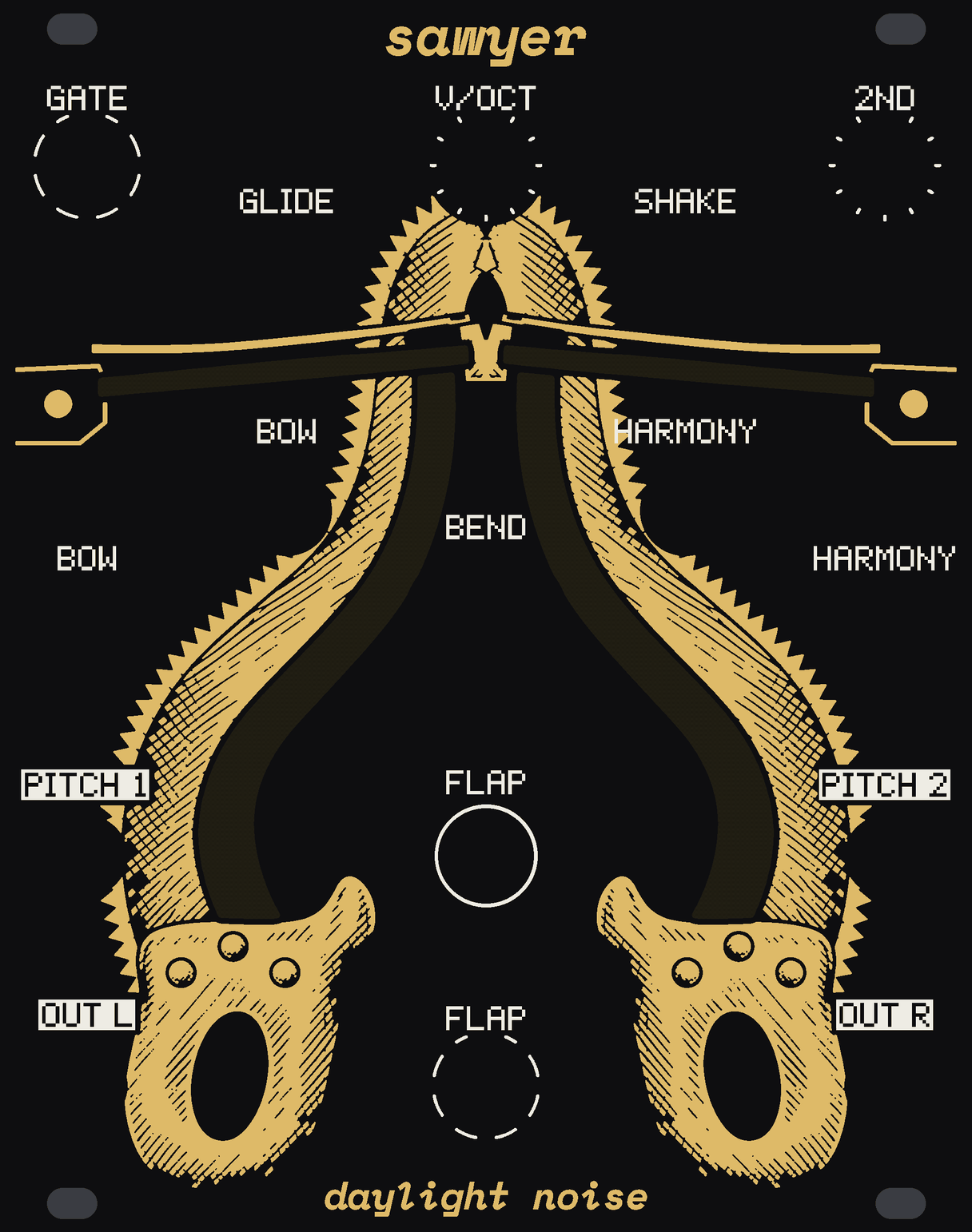
The SAWYER panel, black and gold: an ink drawing printed in gold of two handsaws bent in mirrored S-curves, like the arms of a lyre. Each rises from a wooden handle at the foot, its hand hole and three saw nuts drawn in, swings out at the waist and climbs beside the middle, its teeth along its outer edge, the two tips meeting at the top. A band of bare glass runs along each blade's smooth back, and a bow lies across each blade's upper part, its frog at the panel's edge and its head meeting the other bow's in the middle; the bows' hair is glass too. BEND, the big knob, sits between the blades, FLAP's button and jack below it, V/OCT at the top where the tips meet; four knobs and the jacks down both sides.

Turn a knob: drag it or tap either side of it, roll the wheel over it or use the arrow keys; a double click puts it back. Turn BEND and the saws slide; press FLAP (hold it to keep the blades flapping). The patches step on by themselves until you touch anything.

Synthesised here, as the module would make it: both saws, their bows, the bend, the shake and the flap, with a stand-in rack round them.

example patches

Everything SAWYER does here is its engine as designed, in your browser: both saws, their bows, the bend, the key it hears, the flap and the light. The bass, the brushes, the pump organ and the sequencers playing it are a stand-in rack.

Bend it and it sings

A singing saw is a carpenter's handsaw played with a bow. You bend the blade into an S, draw the bow across its smooth back, and it sings: a pure, eerie tone, like a voice with no words. How hard you bend it is the note. Bend it more and the note goes up.

SAWYER is two of them. Patch a sequencer into V/OCT and GATE and they play your tune. On the panel, the bright spot on each blade is where it's singing: low notes down by the handle, high notes up by the tip. Turn BEND, the big knob, and both blades bend together: the tune moves up or down, and the spots slide with it.

A saw can't jump from one note to the next. The blade has to bend there, so every note slides in, and it sounds like a singer rather than a keyboard.

The player

Two saws

Flap

Shake a saw loose and it booms: a deep, wobbling whoop of steel, like thunder in a sheet of tin. Press FLAP, or send a gate into its jack, and the blades let go and flap. The note they're singing wobbles with them, and on the panel pale violet waves run along both blades. Hold it and they keep flapping; let go and they settle.

In a rack

Specs

Format

Width
20 HP
Controls
a big knob (BEND), four knobs (GLIDE, SHAKE, BOW, HARMONY), a lit button (FLAP)
Lights
four windows: a band along each blade and each bow's hair, 28 LEDs
Replaces
a lead oscillator with its envelope and VCA, a slew and an LFO, a harmoniser with a second voice, a thunder sheet
Parts
a demo for now: the line's knobs, jacks and button, no board yet

Inputs

V/OCT
1 V an octave, both saws; 0 V on C4 with BEND at noon
GATE
gate: the bow (unpatched: it bows all the time)
2ND
1 V an octave: the second saw's own tune
FLAP
gate: as the button
BOW
CV, adds to BOW: 5 V is the whole turn
HARMONY
CV, adds to HARMONY: 5 V is the whole turn

Outputs

OUT L
audio: the first saw a little left, the second right
OUT R
audio
PITCH 1
CV, 1 V an octave: the first saw's pitch as it sings
PITCH 2
CV, 1 V an octave: the second saw's