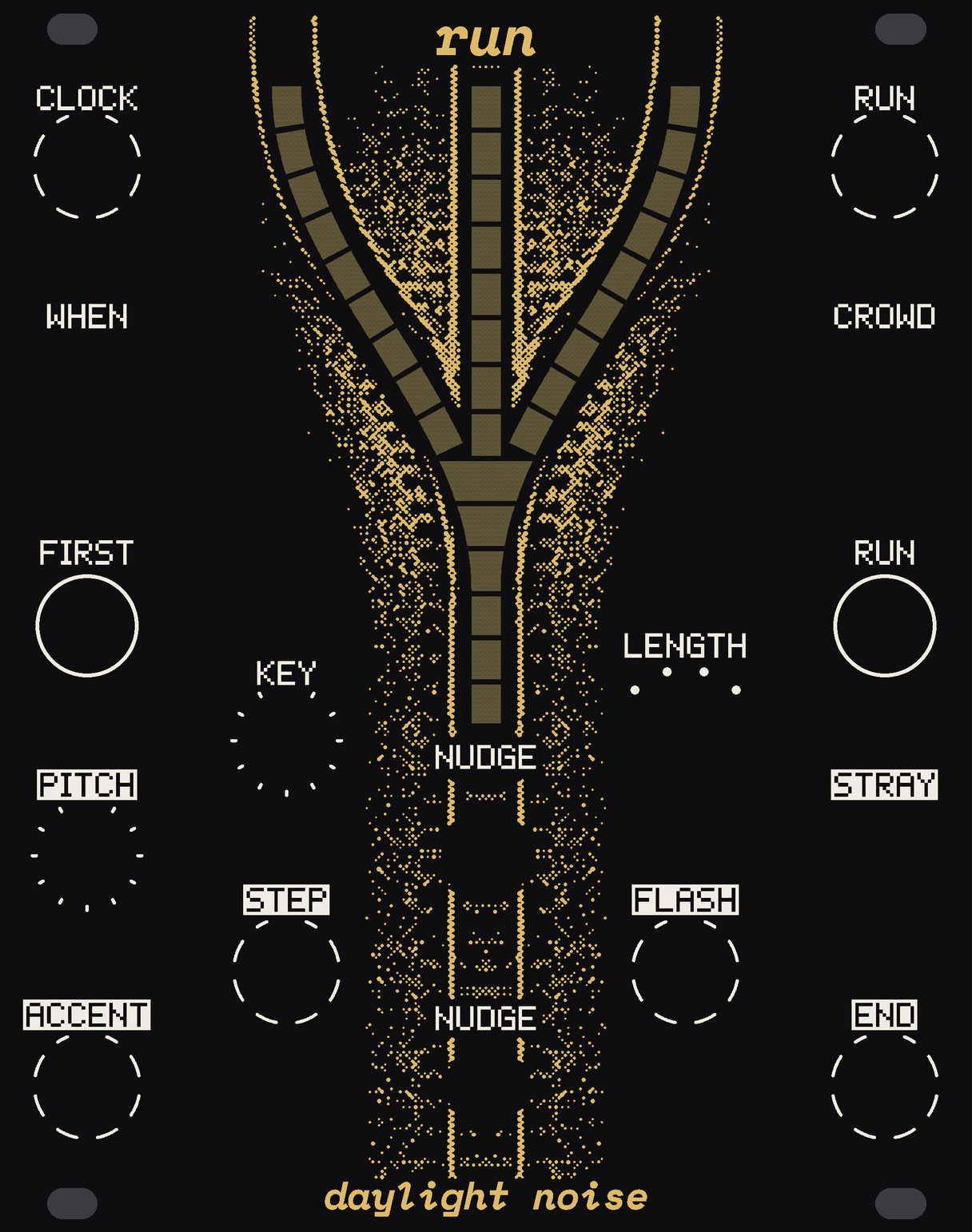
it ends somewhere else
20 HP
A run of notes on your clock, the same every time round. Bump it and the difference doubles every step: the run plays on as the first one did, then parts from it and ends somewhere new.
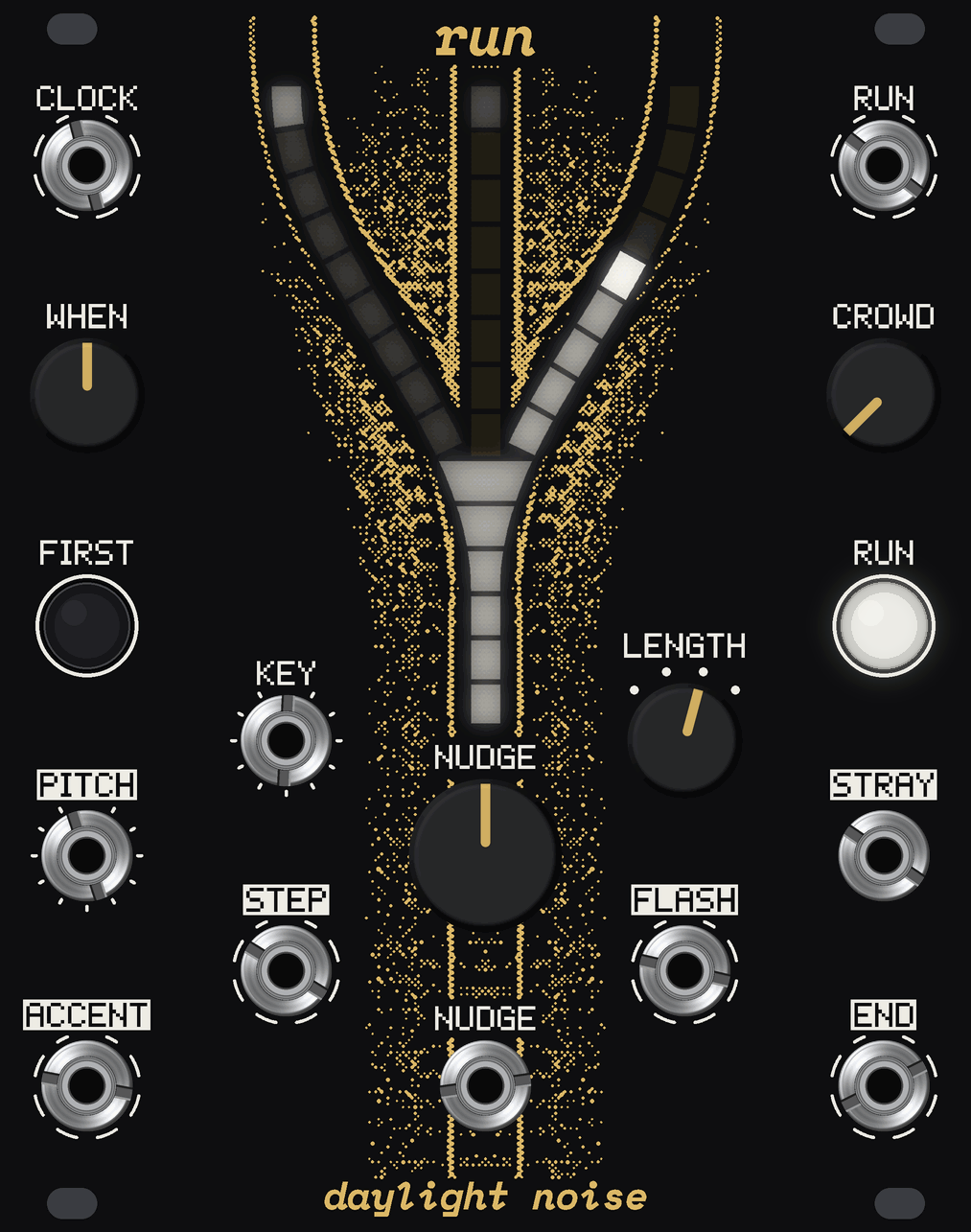
Turn a knob: drag it or tap either side of it, roll the wheel over it or use the arrow keys; a double click puts it back. LENGTH clicks from stop to stop the same way; RUN and FIRST are buttons: hold FIRST a second for a new first run. The patches step on by themselves until you touch anything.
example patches
Everything RUN does here is its engine as designed, running in your browser. The groove and the lead are a stand-in rack.
Four small chaotic maps, started from one seed, make the run a step at a time: each step a note or a rest, tied or accented, its interval up or down a scale. Started from the same place, they make the same run every time.
A bump too small to change a note doubles every step until it does, and from there the run goes its own way. Each run gets a bump of its own, so runs two, three and four end three different ways, every time.
The run climbs the trunk through its opening, crosses the points from the bump to where it parts, and takes a track: straight on if it never parts, out to the side the last run didn't take if it does. The last run's way stays faintly lit.
One board sits 10 mm behind the panel with everything on its front: the jacks, the knobs, LENGTH's switch, the buttons, the 67 LEDs and the whole circuit, the USB-C in a notch in its left edge. Each cell of the run has its own cell in a black printed baffle, lit by its own white LEDs, so the run lights cell by cell up its track. An RP2350 plays the run 4,096 times a second, its four maps in 64-bit floating point.
Drag it or use the arrow keys to turn it; click it to take it apart.