roost

pecking order

20 HP

A mixer for six parts where you don't set levels: you set who's on top. Patch them in at anything from a whisper to 10 V and it seats each one a step under the hen above her, then holds her there like a fader would. One that pokes up 6 dB past the rung above is pecked straight back down.

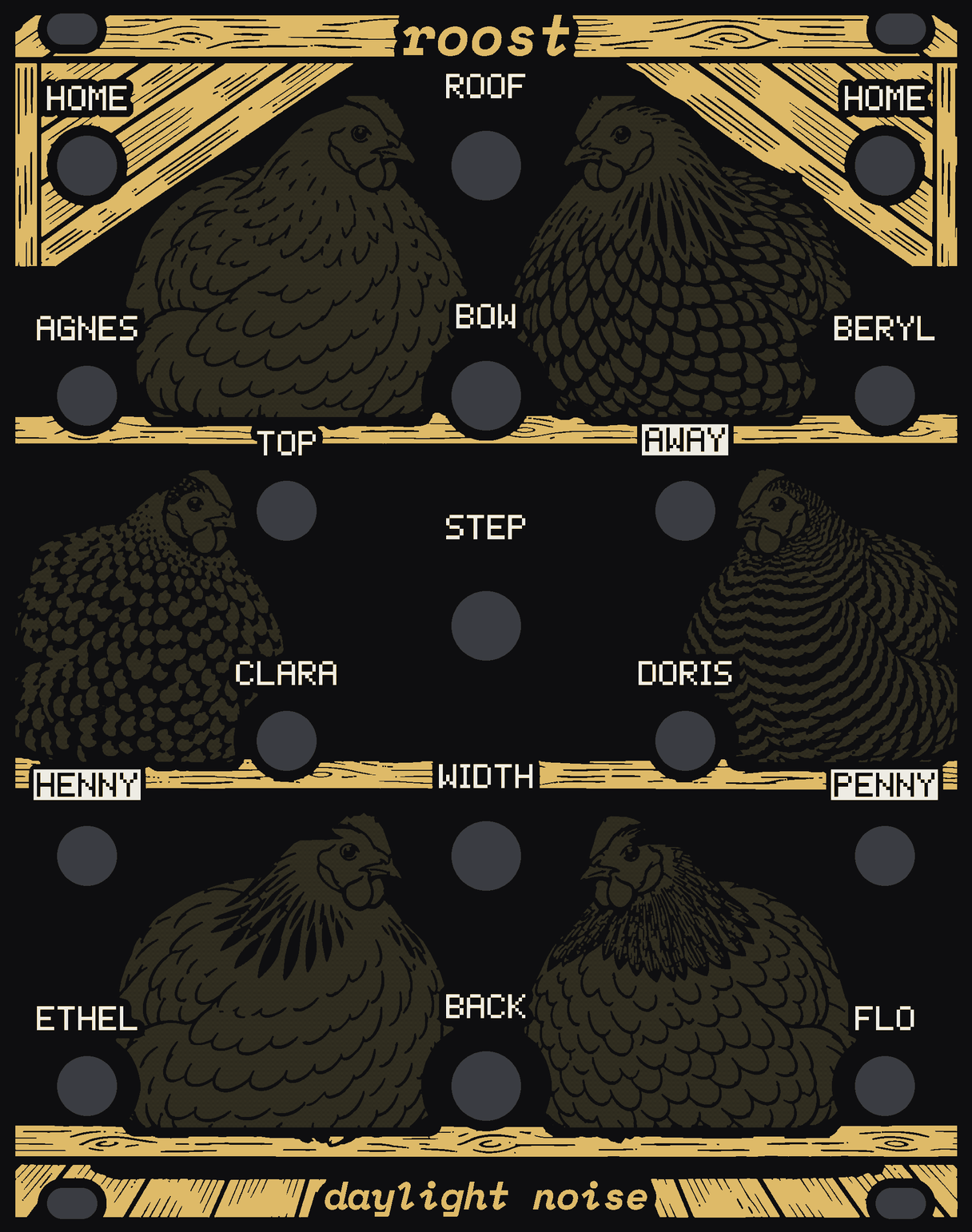
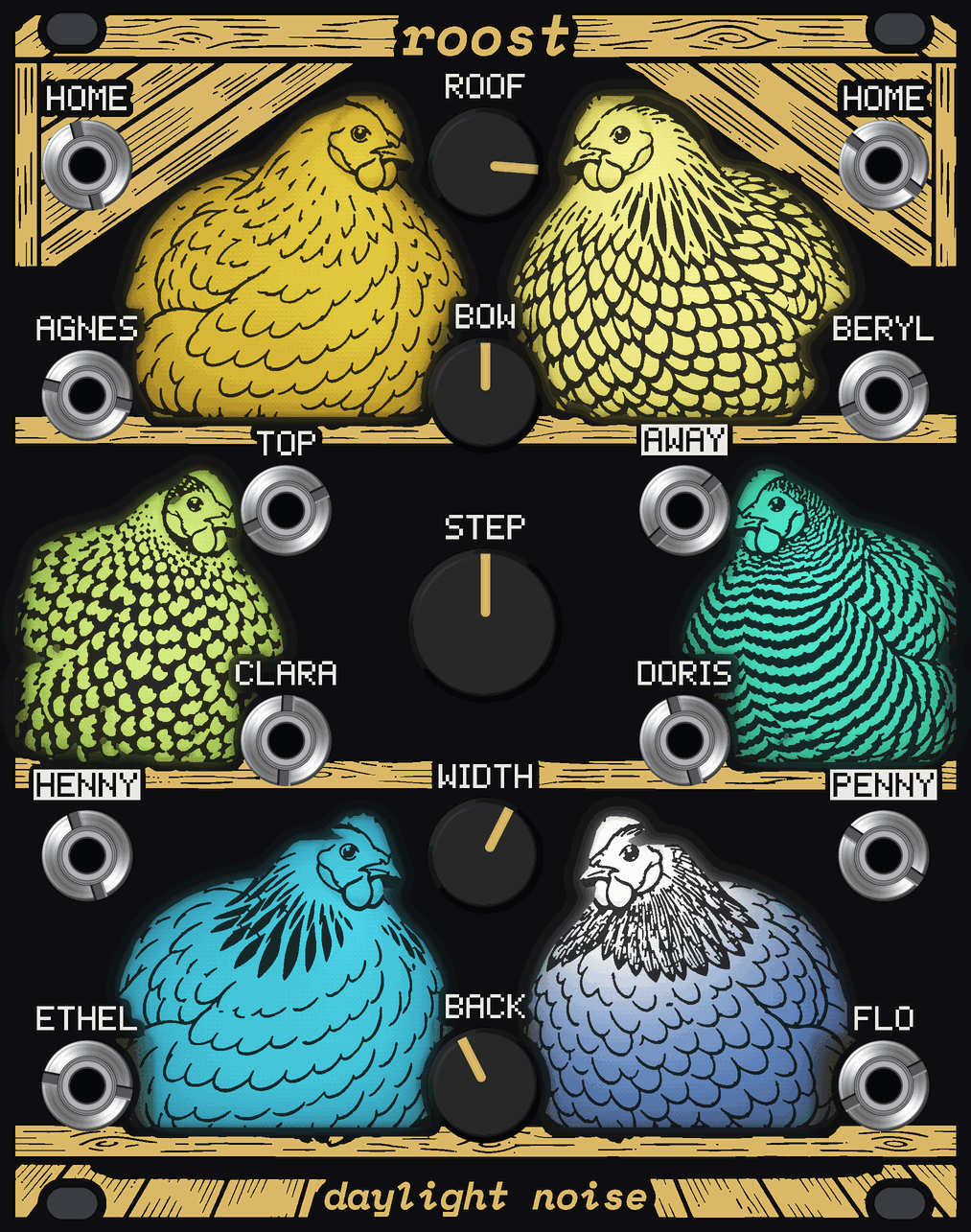
The ROOST panel: black, and six hens of six breeds on stepped perches, fluffed up and turned to you, two to a tier: AGNES and BERYL up under the roof, CLARA and DORIS out at the sides, ETHEL and FLO low inside, each one a pale window with her hand-inked drawing in it, her feathers in black lines: soft scallops, bold lacing, speckles, bars, a streaked ruff. The roof's timbers up beside the name, the perches and the floor's boards either side of the brand in solid gold with black ink grain, all running out to the sides. A jack by each hen, named for her, TOP and AWAY on the upper perch, HENNY and PENNY on the lower; five knobs up the middle, BOW between ROOF and STEP.

Turn a knob: drag it or tap either side of it, roll the wheel over it or use the arrow keys; a double click puts it back. Tap a hen, anywhere on her, and she goes to the top; she glows amber while she leads. Hold one to mute her. The patches step on by themselves until you touch anything.

A funk band at 106 BPM, scratch guitar, popped bass, a snare full of ghost notes and swung hats under a sung line: six parts from a 0.15 V voice to a 9 V kick, and a spring reverb from AWAY back into HOME. Listen plays the patch from its top.

example patches

Everything ROOST does here is its engine, running in your browser; the module runs the same engine. The band is a stand-in rack, patched in at deliberately wild levels.
The order

Six hens on a roost, a part in each, every jack named for its hen. AGNES starts on the top rung and FLO the bottom, in the jacks' order. Whatever's in the top hen leads, and every hen under her is seated a step quieter than the one above.

Finding her place

The yard

The roof

What comes out

Inside

The ROOST panel lit: six hens of six breeds on stepped perches, two to a tier, glowing through their inked drawings, each in the colour of her rung, amber on top to blue at the bottom; one dimmed with her head flaring white where she's just been pecked; the roof above them in gold; its knobs and its jacks.

Drag it or use the arrow keys to turn it; click it to take it apart.

Specs

Format

Width
20 HP
Depth
20.8 mm behind the panel, plus the power cable's plug
+12 V
about 71 mA dark, 157 mA with every hen in her place, 188 mA with a hen pecked, 286 mA at the most, held at the light's cap (estimated)
−12 V
about 3 mA (estimated)
+5 V
not used
Controls
a big knob, 4 knobs, and the six hens: tap one to put her on top, hold one to mute her

I/O

AGNES to FLO
the hens: audio, ±10 V, read to ±12 V; unpatched, silent
HOME
the return, left and right: audio, the same
TOP
CV, 1 V a rung down your order from the hen you tapped, read to ±12 V
HENNY, PENNY
the mix, left and right: audio, never over 5 V
AWAY
the send: audio, to ±10 V

Engine

Brain
RP2350 at 46,875 Hz, 32-bit float
The mix
digital: each hen from 5 Hz, flat to 15 kHz, 1 dB down at 18 kHz (estimated)
In to out
about 4 ms, 1.5 of it the roof looking ahead
The order
every hen's place, seat and peck 1,465 times a second
Light
102 RGB LEDs behind the hens, each hen in the colour of her rung, 180 frames a second
Touch
each hen's photograph is her button, under the panel's black finish: one hen touched and let go within 0.6 s, or by 3 s to mute
Power cycle
your order, mutes and calibration kept; every hen finds her level again