roll

a ball that picks up your sound

20 HP

Every hit it rolls over sticks to it and comes round as it turns. The more it picks up, the heavier it gets: slower, lower, harder to turn. Small, it can only take quiet things; anything too big for it knocks pieces off.

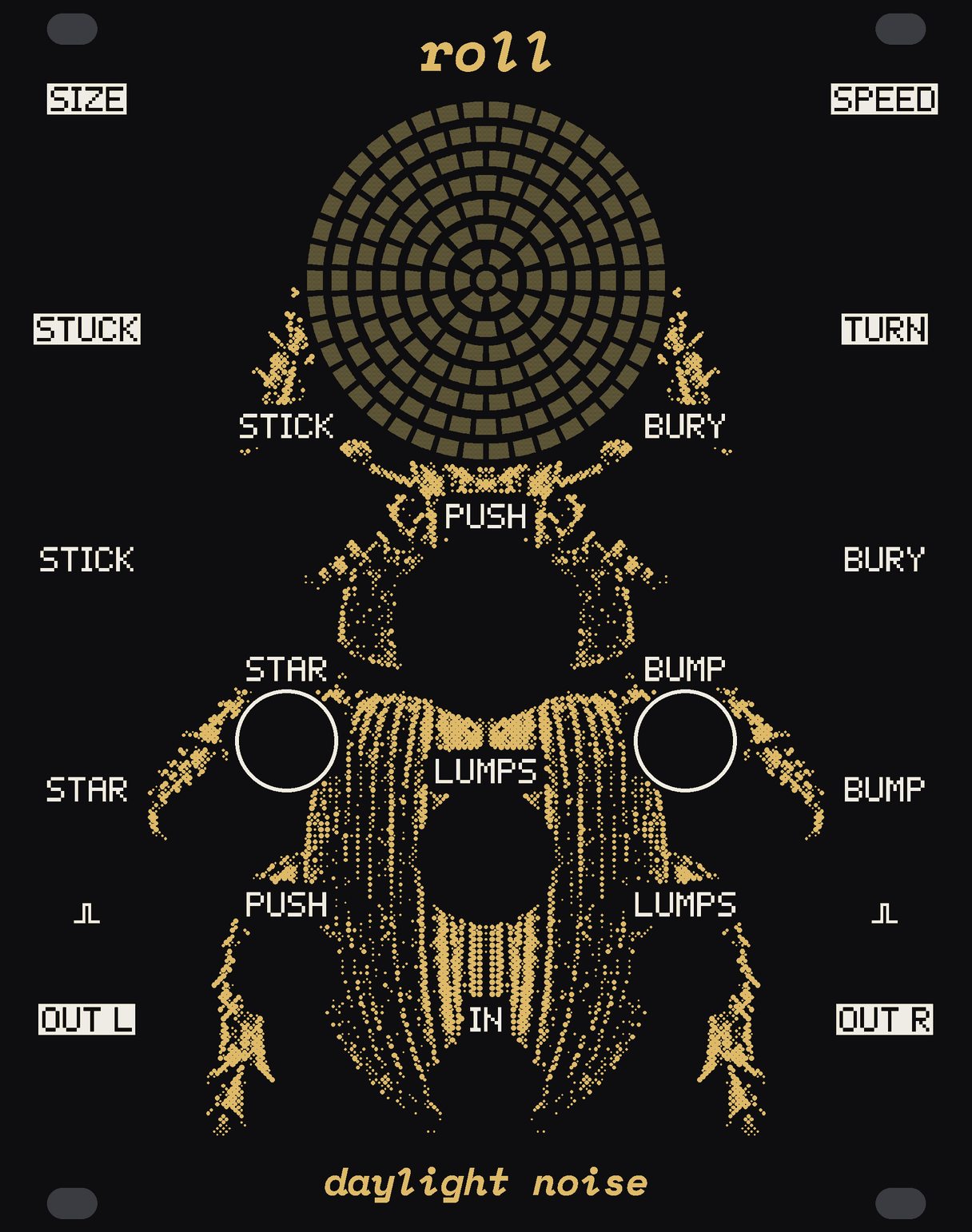
The ROLL panel: black, with a beetle in gold dots seen from above, its forelegs reaching up round a ball of 169 small lights of bare circuit board in rings under the name, its spiked head under the ball, its ridged back down the middle to IN, three legs a side. STICK and BURY at the foot of the ball, the big PUSH knob on the beetle's shield, the STAR and BUMP buttons either side of it, LUMPS on its back. Down the left edge SIZE, STUCK, STICK's and STAR's ins and OUT L; down the right SPEED, TURN, BURY's and BUMP's ins and OUT R; PUSH's and LUMPS's ins under the buttons. roll at the top, daylight noise at the bottom.

Turn a knob: drag it, roll the wheel over it or use the arrow keys; a double click puts it back. STAR and BUMP are buttons to press. The patches step on by themselves until you touch anything.

What you hear is the ball, with the song it's rolling over under it. The drums, the bass, the lead and the pad are made in the page as you listen.

example patches

The ball, what sticks and what knocks it, its weight and every out here are ROLL's engine as it's designed, running in your browser. The song is a stand-in for the rest of a rack.

Pushing it

The ball is a loop. What it picks up is stuck round its outside, and as it turns each piece comes round past you: quiet behind it, swinging past on the left, loud and centred in front, off to the right. PUSH is a force, not a speed. The heavier the ball, the slower the same push turns it, the lower it plays, and the longer it takes to get going and to stop.

What sticks

Every hit it rolls over meets its reach, a level that rises as the ball grows. Under it, the hit sticks: a piece of it, from just before the hit to its tail, where the ball touches the ground. Over it, nothing sticks: the hit knocks the newest pieces off, each dropping an octave as it falls, and the lighter ball lurches forward. So it finds its size against the music. Quiet parts grow it, a break lets it grow, a loud part chips at it, and a big drop after a quiet one bashes it apart.

Shedding it

What comes out