refrain

every note in its place

20 HP

A whole song, verse and chorus, written for you, lit up and strummed: one cable from STRUM to your mixer and you hear it, with no other module. Its bass and chords come out as voltages too, and it pulls anything you patch in onto notes that fit.

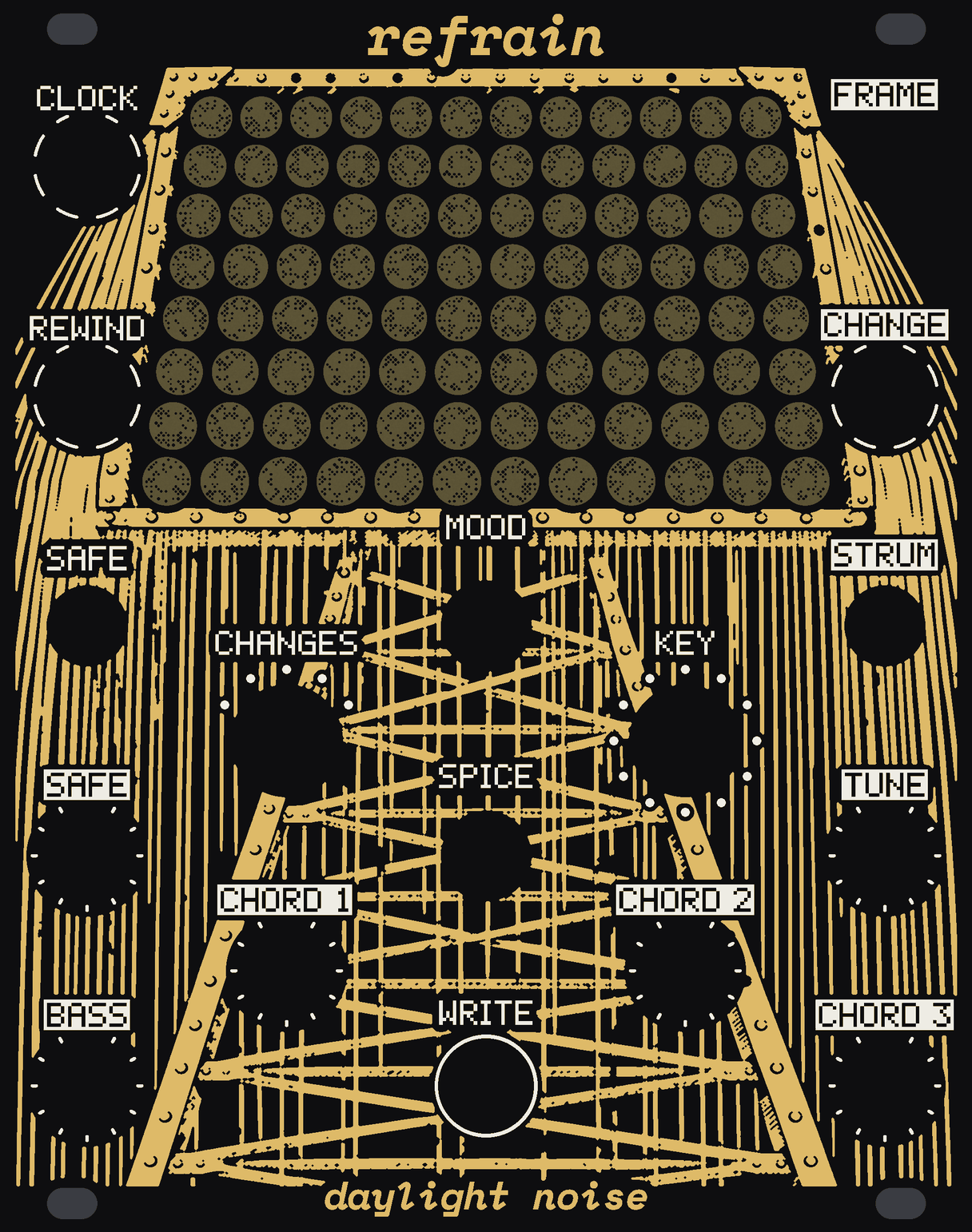
The REFRAIN panel, a hand-inked drawing in black and gold: across the top a ballpark's bank of floodlights in a riveted steel frame that narrows toward the top, twelve round lamps across and eight rows down, each lamp's reflector printed in fine dots. Under it, in solid gold with black ink between, a curtain of sparks pouring off the bank down the whole panel, the lattice light tower behind it, its X bracing bold. Jacks down both sides, the knobs and switches between, a round white button at the foot.

Turn a knob: drag it or tap either side of it, roll the wheel over it or use the arrow keys; a double click puts it back. CHANGES and KEY are switches: they click from stop to stop the same ways, and KEY turns on round. WRITE is a button: press it, tap it twice to go back a song, hold it to stay on the part playing, or keep holding for two seconds to keep the whole song going round. The patches step on by themselves until you touch anything.

STRUM alone: REFRAIN on its own 96 BPM, a harp strumming the song it writes (Beeps at 100, the bossa nova at 132, Heavy at 168). Listen plays the patch from the top.

example patches

Everything REFRAIN does here is its engine as designed, running in your browser: the chords, their writing, the pulling onto notes and STRUM's strings. The bands round it are a stand-in rack.
Why beeps sound like beeps

Patch a random voltage into an oscillator over a drone and you get beeps and boops: each note lands wherever the voltage happened to, nothing changes underneath, and the bass never moves. A track has four things the beeps don't.

The floodlights

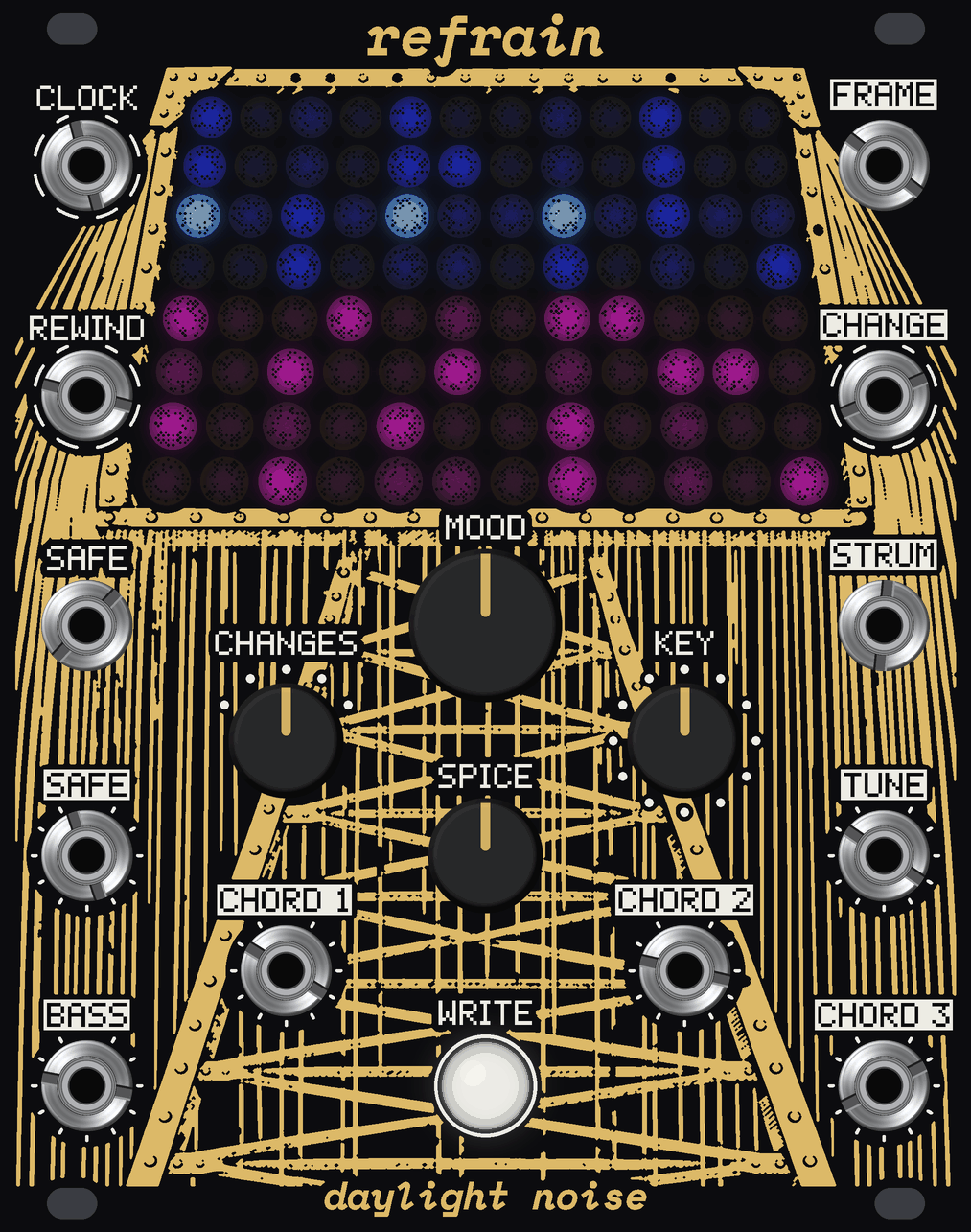
The window is a ballpark's bank of floodlights, and the song is written on it: the twelve notes of an octave across, C at the left, and the song's eight chords down, the verse's four on top, the chorus's under them. Each row's lit lamps are that chord's notes, the row playing blazes, the key's other safe notes glow faintly, and a note a lane plays flares its lamp. (A song's refrain is the part that keeps coming back: here, the chorus on the bottom four rows.)

One cable, or three

What comes out

Inside

The REFRAIN panel, the third row of the bank playing, a beep landing on the chord.

Drag it or use the arrow keys to turn it; click it to take it apart.

Specs

Format

Width
20 HP
Depth
20.6 mm behind the panel
+12 V
about 170 mA at its busiest, 185 mA at most (estimated)
−12 V
about 7 mA (estimated)
+5 V
not used
Controls
a big knob, a knob, a five-stop switch, a twelve-detent knob for the key, a lit button
Light
96 RGB LEDs, one a lamp
Parts
418 on one side by machine; the jacks, knobs, switch, encoder, button and header by hand

Inputs

CLOCK, REWIND
gates, high past about 0.9 V: a pulse every sixteenth, the bar's one
SAFE
any voltage, read from −6 to +6 V

Outputs

STRUM
audio, up to 10 V peak to peak, dry, AC-coupled
Voices
BASS, CHORD 1, CHORD 2, CHORD 3: V/OCT, 0 V = C3, calibrated at two points each
SAFE, TUNE
V/OCT, 0 V = C3
CHANGE
trigger, 5 V, 10 ms
FRAME
0 to 5 V, a ramp a chord