red light

red light, green light

20 HP

Four VCAs that play red light, green light with your rack. While the light is green they pass, and each channel climbs towards the line by how much it plays. When it turns red they shut on a stop-time break, and anything still sounding is out. The ones who make it across play through every red.

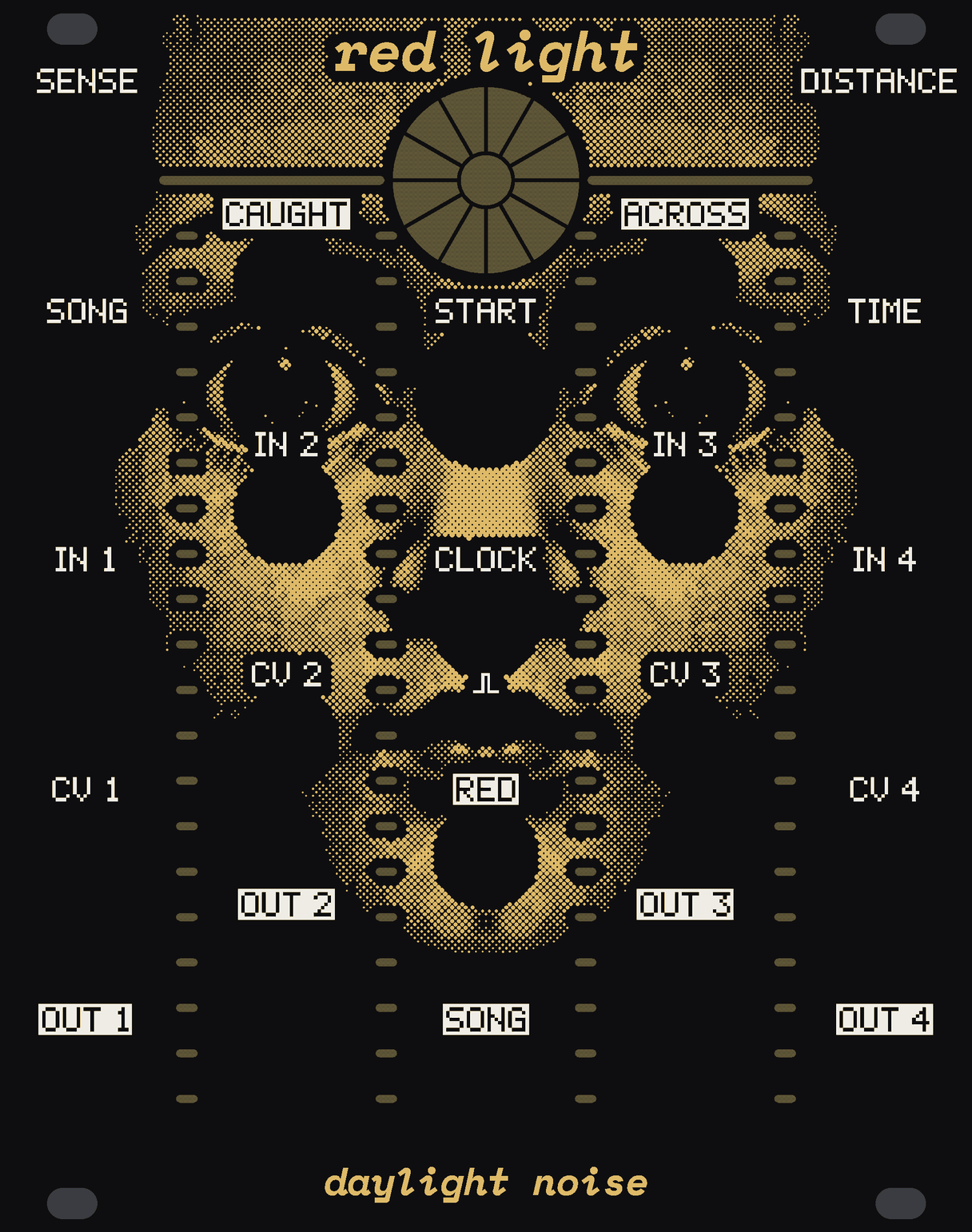
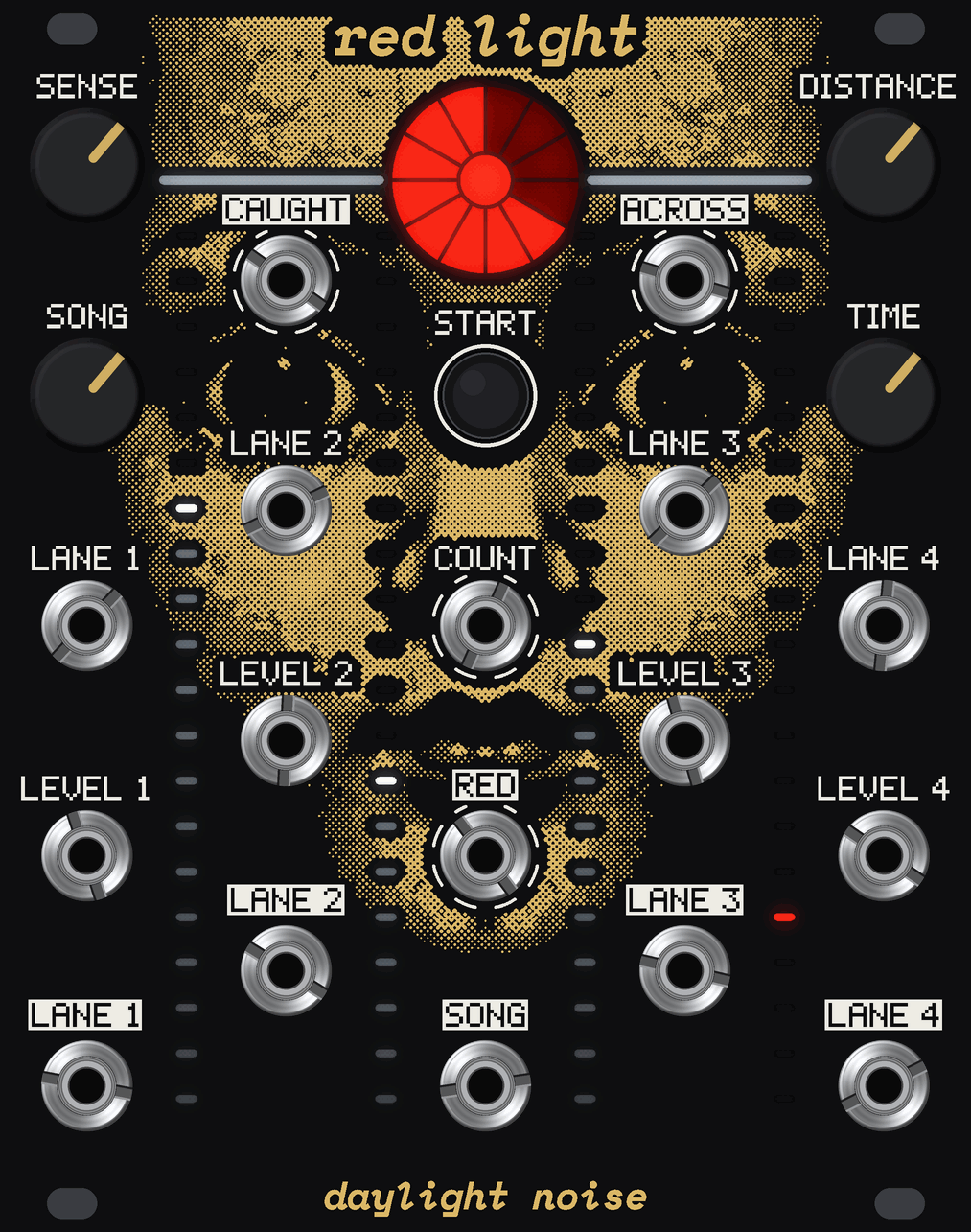
The RED LIGHT panel: black, with an old porcelain face in gold dots, its eyes looking out halfway up. Under the name a round light of bare circuit board cut into twelve wedges round a hub, a line through it across the top, and four lanes of small bars running up the panel to the line. The knobs SENSE and DISTANCE in the top corners, SONG and TIME under them; START under the light; CAUGHT and ACROSS under the line; each channel's three jacks down its own column, LANE (in), LEVEL and LANE (out, in a white block); COUNT, RED and SONG down the middle; COUNT, RED, CAUGHT and ACROSS ringed with dashes. red light at the top, daylight noise at the bottom.

Turn a knob: drag it or tap either side of it, roll the wheel over it or use the arrow keys; a double click puts it back. START: click or tap it, or press Space or Enter on it. The patches step on by themselves until you turn a knob or press START.

The light, the lanes and the four VCAs are RED LIGHT's own. The drums, bass, lead and pad it plays with are made in the page as you listen.

example patches

Everything RED LIGHT does here is the module's own engine, running in your browser: the same sums as its firmware. The drums, the bass, the lead and the pad are a stand-in for the rest of a rack.
Green and red

While the light is green a little tune plays and the four channels pass. When the tune ends the light turns red, on the beat: every VCA shuts at once, so the music stops, and RED goes high to stop whichever sequencers you've patched it to. Half a beat later the light has turned. Then green again.

Still

Once the light has turned, anything still sounding is out: a part nobody stopped, a note held over, an echo or a long tail. A part that stopped clean stays in. Out, a channel's VCA stays shut and its lane goes dark until the round is over.

The line

Each channel has a lane of lights up the panel. While the light is green it climbs by how much it plays, so a busy, loud part gets there first. At the line it's across, and from then on it plays straight through every red.

The round

The light's twelve wedges are the time: they go out one by one as the round runs down, and the tune speeds up as they go, so the breaks come closer together. When the time is up, everyone who isn't across is out. A bar's rest, and a new round with everyone back.

Four VCAs

Inside

The RED LIGHT panel on red: the light's wedges lit red, a lane caught, its knobs, jacks and START on.

Drag it or use the arrow keys to turn it; click it to take it apart.

Specs

Format

Width
20 HP
Depth
20.8 mm behind the panel
+12 V
about 60 mA dark, 150 mA in play, 225 mA with its lights at their cap (estimated)
−12 V
about 5 mA (estimated)
+5 V
not used
Controls
4 knobs, a button

I/O

Lanes in
LANE 1 to 4: audio or CV, ±10 V, read to ±12 V
Levels
LEVEL 1 to 4: 0 to 8 V is nothing to unity, in a straight line; open when unpatched
COUNT
the clock: a gate a beat, up past 1.5 V, down under 0.8 V; 120 BPM unpatched
Lanes out
LANE 1 to 4: each through its VCA, to ±10.24 V; a free one adds into the next
RED
a 5 V gate while the light is red
Triggers
CAUGHT, ACROSS: 5 V for 10 ms
SONG
the tune, 2.4 V at a note's peak

Engine

Brain
RP2350 at 62.5 kHz, 32-bit float
The VCAs
digital, DC-coupled: DC to 16 kHz, about 73 dB of signal to noise for a 10 V swing (estimated)
In to out
0.8 ms
The game
a thousand times a second, on the samples' own clock
Light
102 colour LEDs, 200 frames a second
Power cycle
a new round on its first beat; only the calibration is kept