rain

a cable is a dam

20 HP

Rain runs down the panel through its jacks, and a cable is a dam. The water pools behind it and every drop that lands rings a note, higher as the pool fills, until it breaks and floods down.

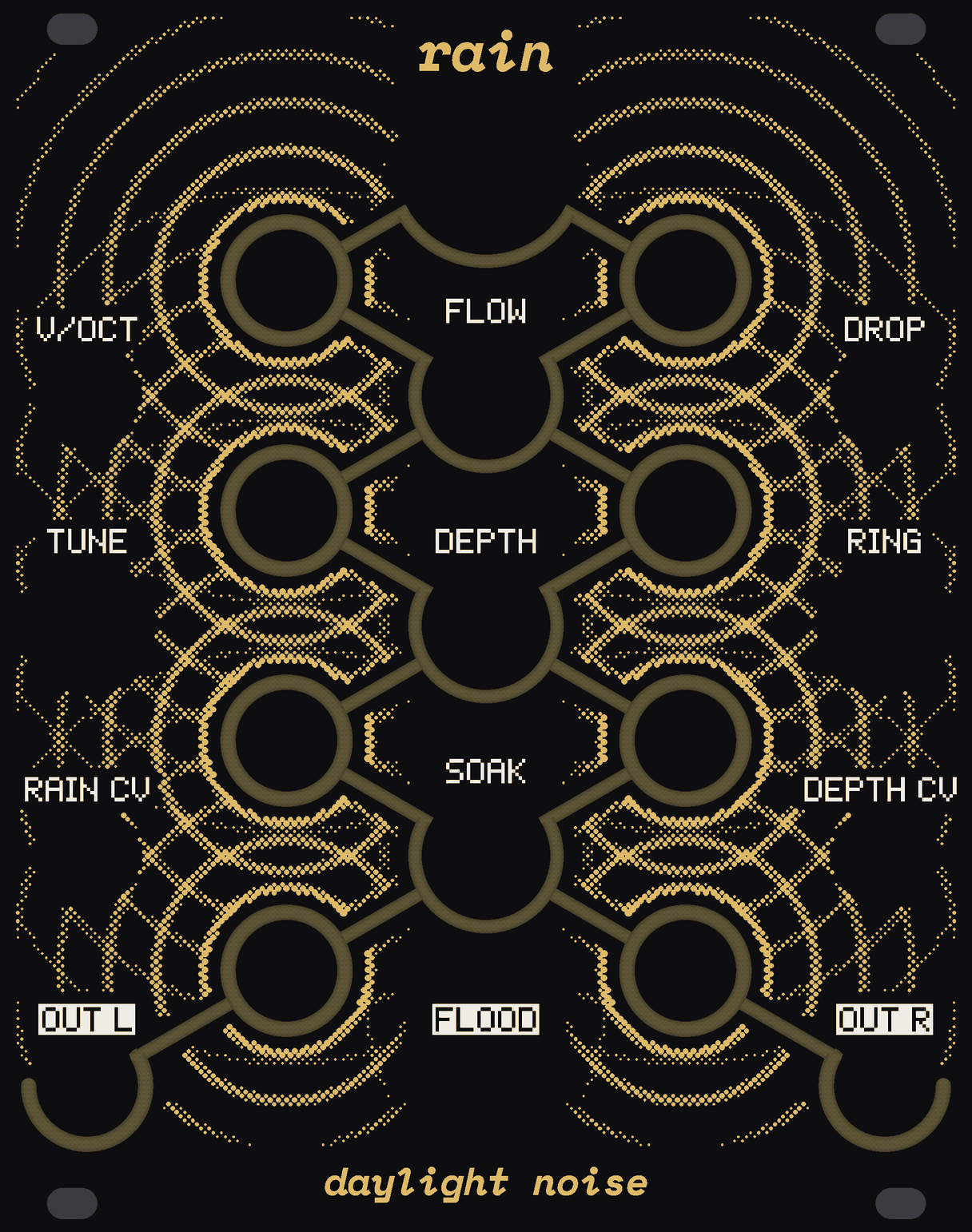
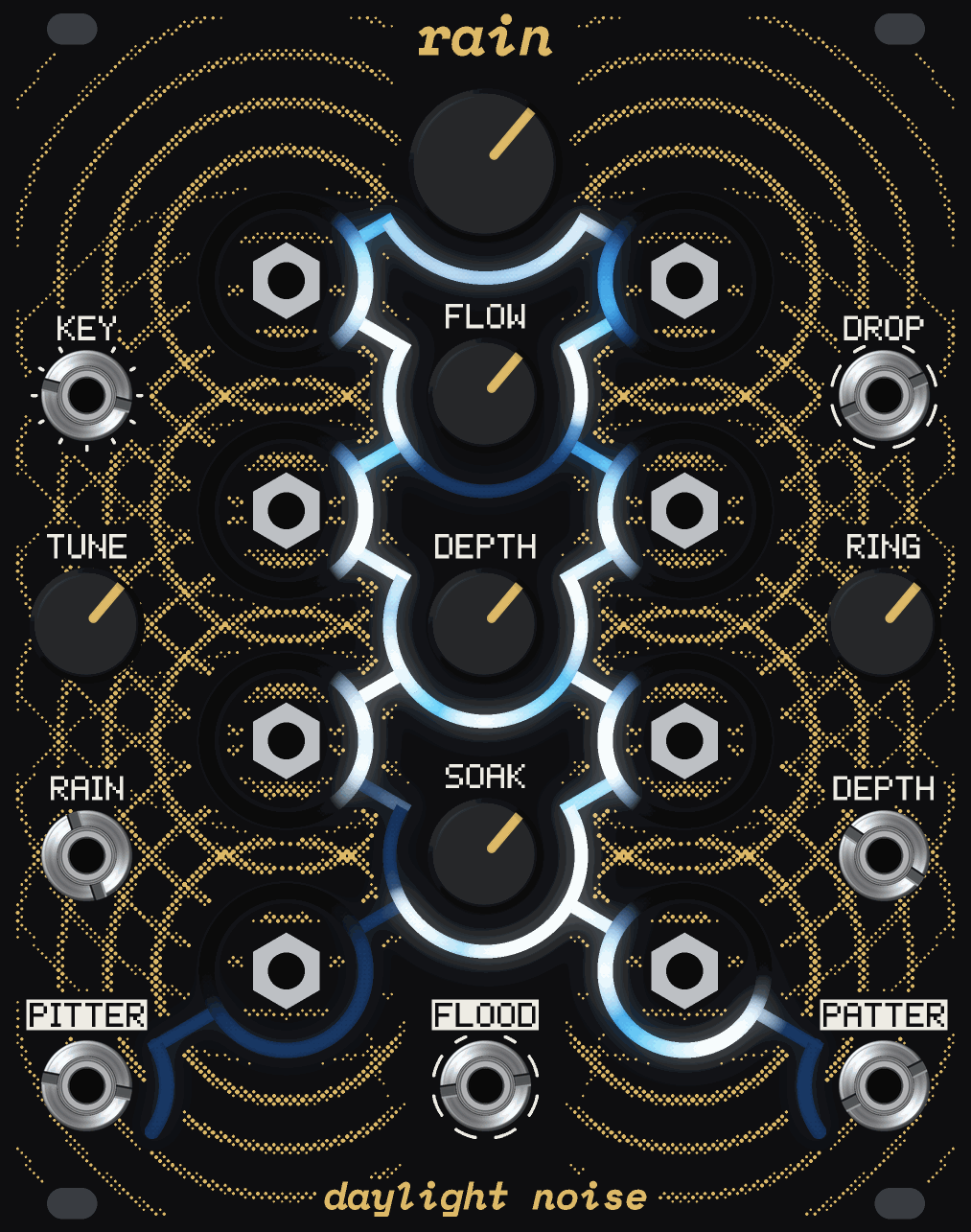
The RAIN panel: black, with rings of solid gold lines spreading out from eight jacks down the middle, thinning as they go and crossing where they meet, on into the middle column, where they thin away round the knobs. A braid of bare circuit board runs down the middle three columns: an arc under the big knob at the top, a horseshoe round each of three knobs down the middle, a ring round each of the eight jacks either side of them, hooks round the two outputs in the bottom corners, and straight channels joining them. White labels: SURFACE and LIQUID on the knobs in the top corners; FLOW, DEPTH and SOAK on the knobs down the middle and FLOOD at the foot; KEY, TUNE, RAIN and PITTER down the left; DROP, RING, DEPTH and PATTER down the right; a ring of white dashes round DROP and FLOOD, twelve white ticks round KEY. rain at the top, daylight noise at the bottom.

Turn a knob: drag it or tap either side of it, roll the wheel over it or use the arrow keys; a double click puts it back. Dam the water: click a jack in the water to plug a cable into it, and click it again to pull the cable out.

The notes, the ticks and the rush of each flood are RAIN's own. The beat, the bass and the pad round it are made in the page as you listen. Each patch starts with dry channels.

example patches

The water, the dams, the notes and the light here are RAIN's own engine, the module's firmware line for line, running in your browser: where each drop goes, when a pool breaks, what it rings, what every LED shows. Everything round it is a stand-in for the rest of a rack.
The rain and the water

Rain falls from the cloud under the big knob, and some lands here and there on the water. Each drop runs down the lit channels, round the stones and through the jacks either side of them, and out at the bottom corners. At a stone it goes left or right at random. A drop ticks as it lands, and rings the lowest note of each open jack it runs through, softly.

The dams

Plug a cable into one of the eight jacks in the water and it's a dam. The water stops there and pools, filling the ring round the jack from the bottom, then backing up the channel above it. Everything else goes round the other side. Plug both jacks on a row and there's nowhere left to go: it all backs up towards the stone. Pull the cable and the pool runs away.

Every dam is an output too. The cable that dams the water carries its pool's level to wherever its other end goes: a filter, a VCA, a quantiser. So RAIN is also eight slow random voltages for the rest of a rack, each climbing and breaking in its own time, and they're there whether or not you listen to RAIN itself.

The break

When a pool holds DEPTH drops the dam breaks: the whole pool floods down at once, a white rush, into the next dam below that has a cable in. That can fill it and break it too, and its flood the next: a chain. The cables are still in, so each dam starts filling again.

Soak

In a light rain a pool can soak away before it ever breaks.

The notes

Every drop that lands in a pool rings a note, and the fuller the pool the higher it rings, like a bottle filling: a pool climbs a minor pentatonic scale, two octaves from empty to full, and a flood runs back down it over the rush of the water. Higher dams ring higher, the left ones on the left and the right ones on the right. Each note is struck glass, bright as it's hit and rounder as it rings, until SURFACE says otherwise.

Surface and liquid

The two knobs in the top corners change what the rain is and what it lands on. With both at noon it's water falling on glass: RAIN as it always was. Each knob has nine settings and turns smoothly from one into the next, so there's always something in between.

Inside

The RAIN panel in a torrent: the water lit white and blue down the middle three columns, running through every channel, round the knobs and through the jacks, with its knobs on.

Drag it or use the arrow keys to turn it; click it to take it apart.

Specs

Format

Width
20 HP
Depth
about 21 mm behind the panel, to the top of the power header (estimated)
+12 V
about 135 mA with the water dark, about 255 mA at the LEDs' cap (estimated)
−12 V
about 10 mA (estimated)
+5 V
not used; 10-pin header
Controls
8 knobs

I/O

KEY
V/OCT in: the key, 1 V an octave, −2 to +8 V
DROP
gate or trigger, rising over about 1 V
RAIN, DEPTH
±5 V, half of the knob's travel
PITTER, PATTER
the outs, left and right: audio, under 5 V peak
The dams
eight, 0 to 8 V each: its pool's level, 16 bits; a cable in is a dam
FLOOD
5 V, 8 ms, at every break

Engine

Brain
RP2350, 46.875 kHz, 32-bit float
Voice
16 voices, five partials each: nine surfaces from moss to a bell, nine liquids from lava to mercury
Water
stepped every millisecond; a drop placed to an eighth of one
Light
263 RGB LEDs behind the water, 62.5 frames a second, their current capped
Firmware
over USB-C, on the back