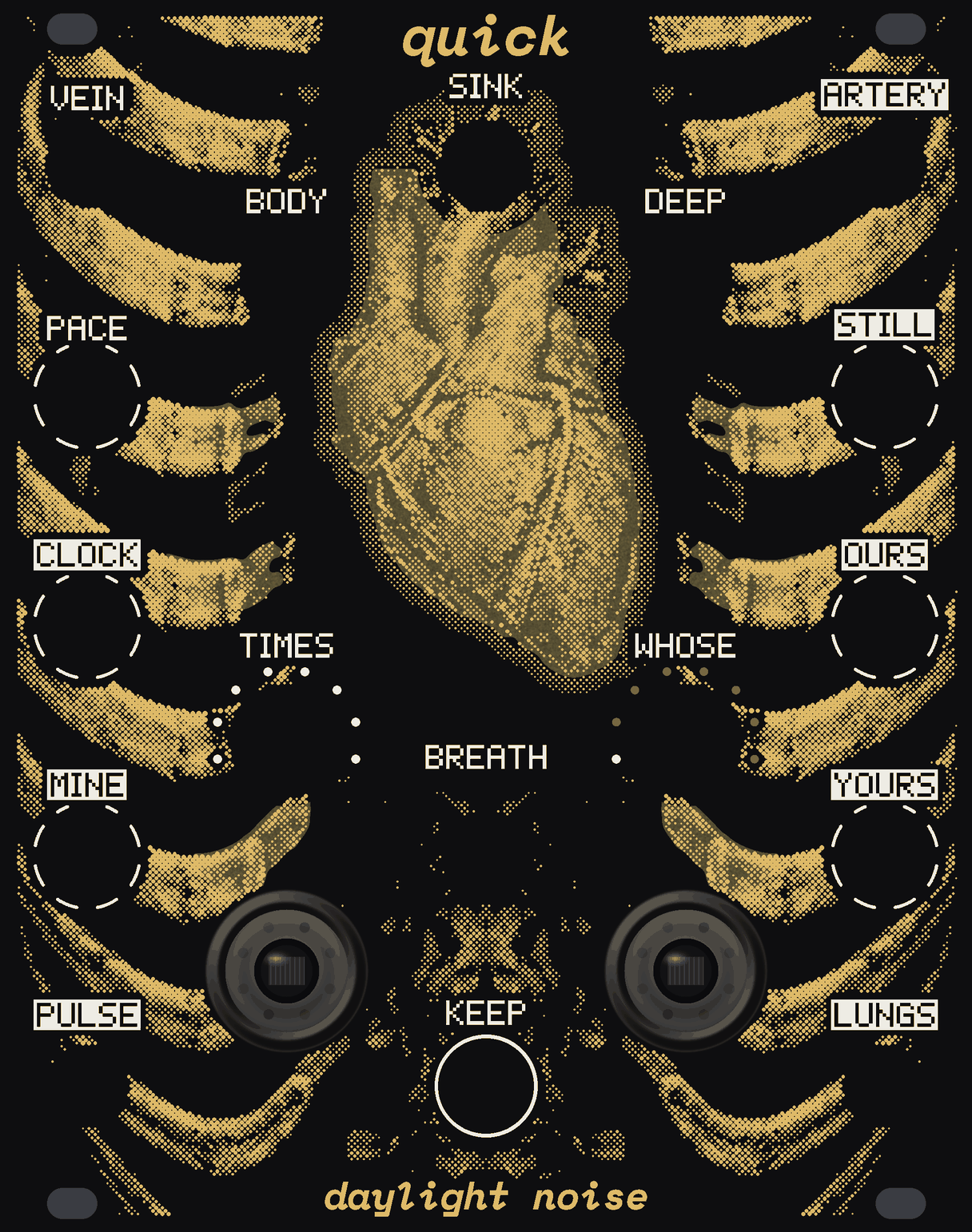
it keeps time with you
20 HP
Put a finger on the pad. Red light goes through it and you can see your own fingertip glow, and that light reads your pulse. Now your rack runs on your blood. Let go and it goes on without you, weaker and further apart, until it stops. Or keep it, and it'll run on your heart when you're not there.
Turn a knob: drag it or tap either side of it, roll the wheel over it or use the arrow keys; a double click puts it back. Give it a pulse: find the one in your wrist or your neck and tap it on a pad, and from the fourth tap the rack is running on you. Or press and hold a pad and a stand-in heart starts. Let go and it sinks. Tab to a pad: Space is your finger. The patches step on by themselves until you touch something.
example patches
The page can't feel your finger, so it asks you for your pulse, or it holds a stand-in: a model of one heart, seeded, with a person's wander. On the module it's your blood, read through your skin by light. Everything else here is its engine as designed, running in your browser. The band is a stand-in rack. Nothing you tap leaves this page, and what you keep goes when you close it.
Two round pads, a side each. A ring of red light under a fingertip, and a photodiode in the middle reading what comes back through your skin. It's the same light you can see glowing in your finger: there's no electrical contact with you at all.
The pulse in a finger comes about a fifth of a second after your heart, too late to play on. So the module doesn't react. For a few beats it can only answer, and then it has you: it works out when your next beat is due from the last few, and it's there as it lands, corrected a little each time. A heart that moves on the pad is coasted over until the reading comes back. Two people, one on each pad, get a heart each.
A resting heart speeds up as you breathe in and slows as you breathe out. That's the instrument: the most human swing a rack has had. Nervous on stage, the set speeds up by itself. Run up the stairs and it's techno.
Take your finger off and it keeps your heart going without you, from what it remembers. It slows, weakens, and stops.
It keeps people. A minute of a heart, every interval as it came, for good, and the rack can run on it: your partner's, your child's, someone who's gone. Their breath is in it too. It comes back note for note, and being stored it's more exact than you are: it never has to guess.