quaver

turn it, it sings

20 HP

A voice you play by hand. Turn the big dial and the note under its pointer lights on a keyboard bent round it. Hold SPEAK and it sings, sliding from note to note. Play a phrase once and KEEP loops it for you.

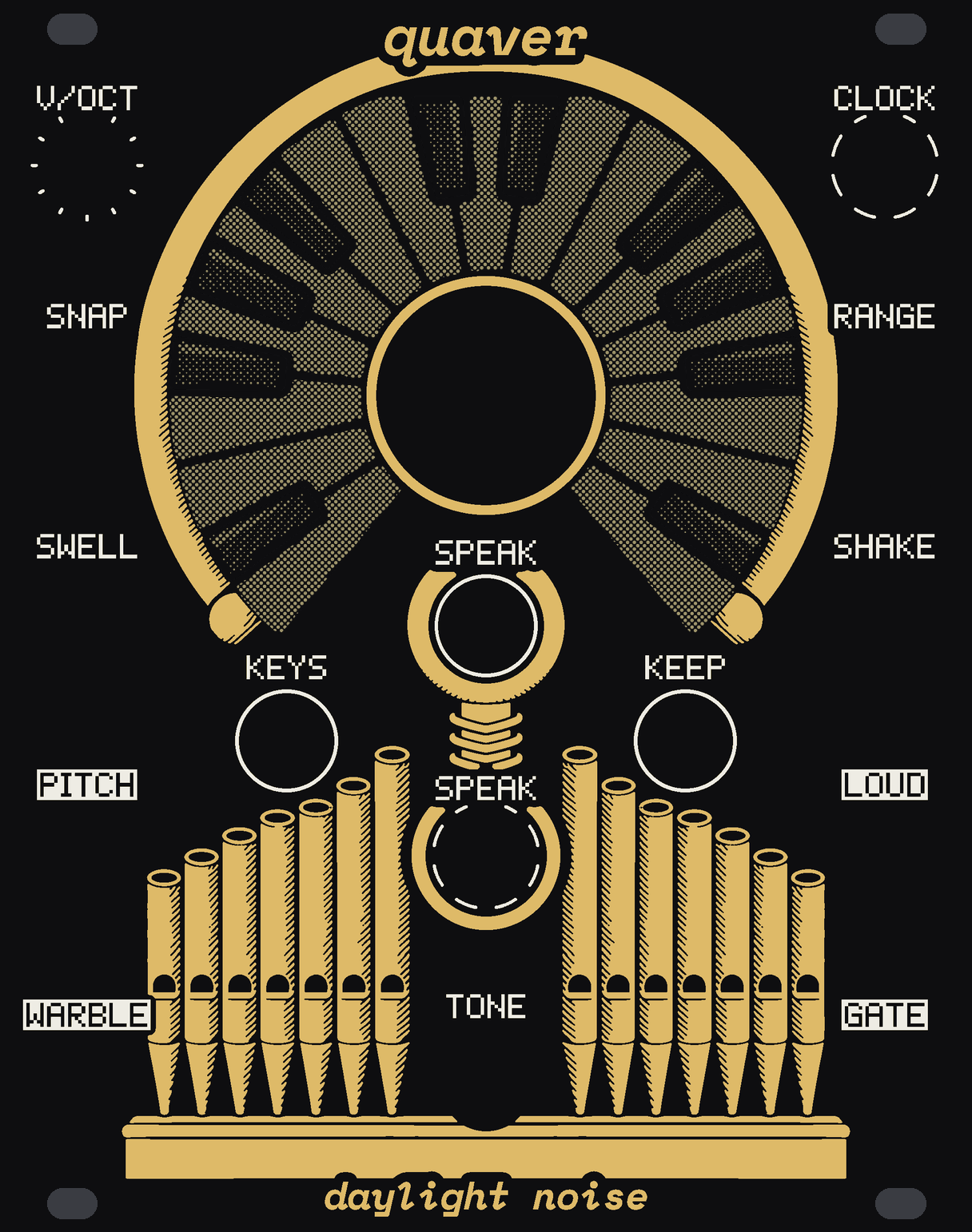
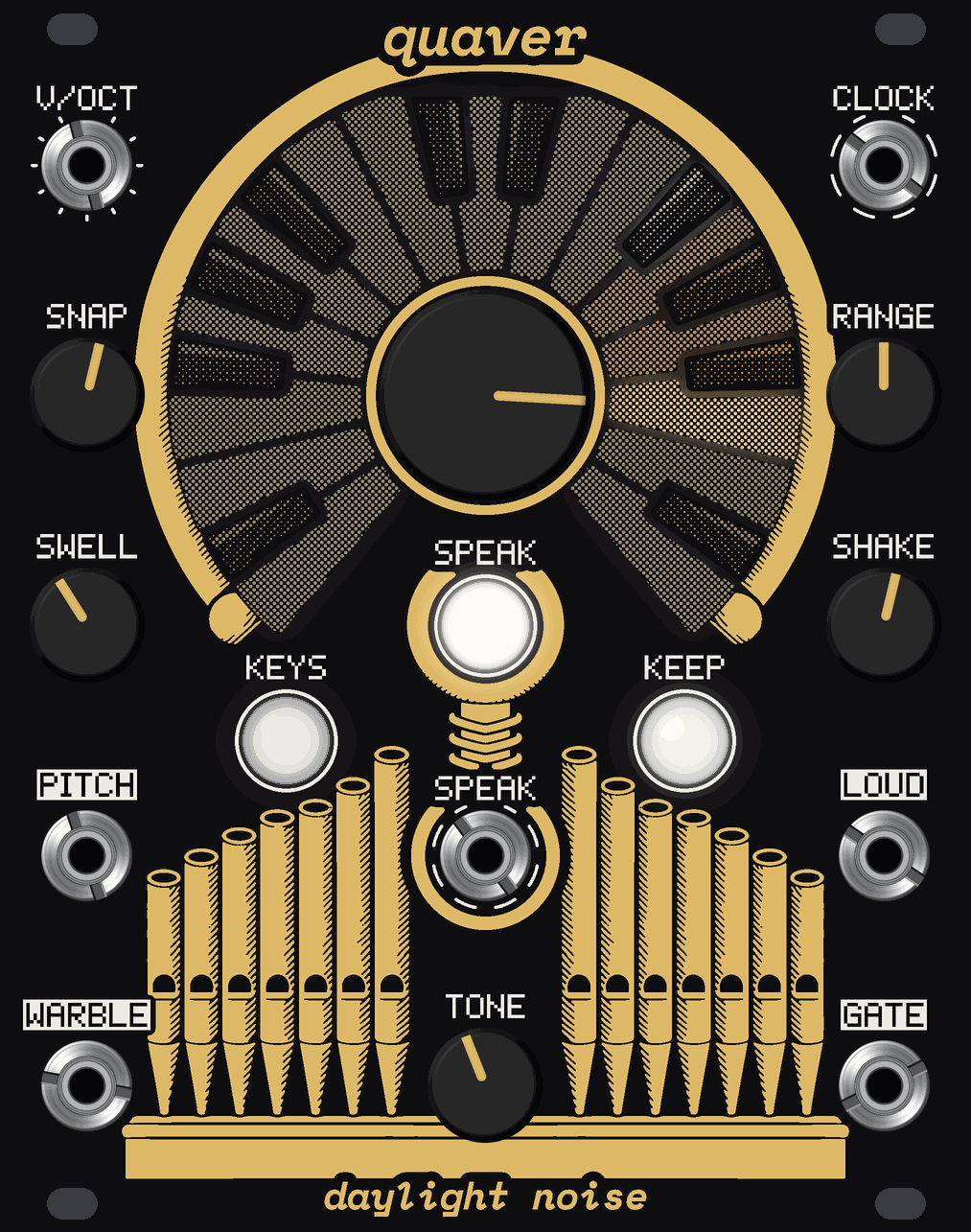
The QUAVER panel, black and gold: an organ console drawn from straight above, hand-inked in flat solid gold and bold black ink. Its keyboard, two octaves of plain white keys with the black keys lined in ink between them, is bent into a horseshoe round the big TURN knob near the top in a plain brass ring, a heavy brass rail round its back running unbroken behind SNAP and RANGE and ending in a round knob each side. Under the keyboard a sprung brass lever runs down the middle to the SPEAK button and its jack, and two ranks of round tin organ pipes, open at the top with a mouth low on each and tallest in the middle, stand in a solid brass windchest that runs straight across behind TONE. The keys are bare glass that lights from behind. SNAP, SWELL, RANGE and SHAKE sit down the sides, KEYS and KEEP either side of the lever, the jacks in the corners.

Turn a knob: drag it or tap either side of it, roll the wheel over it or use the arrow keys; a double click puts it back. Play TURN: grab the knob or any key and turn, and hold SPEAK or the space bar to sing. The patch's hand lets go while you play.

The module's own engine, in your browser, with a stand-in rack round it.

example patches

Everything QUAVER does here is the module's own engine, in your browser. The hand on TURN and SPEAK in each patch is a scripted player; the band, the beeps and the big synth are a stand-in rack.
Turn it and it sings

TURN is the pitch. Its pointer sweeps an arc of 25 keys, two octaves bent round the dial, and the key it points at burns. Between keys the note glides.

SPEAK is the lever: hold it and the voice swells in, let go and it dies away. One hand plays the note, the other sings it, so it swoops and leans as a keyboard can't. The top key is the root, a D until V/OCT moves it.

Landing on the keys

The voice

It keeps what your hands did

Press KEEP and play; press again and the phrase loops exactly as you played it, its ghost walking the arc in cool blue. Turn TURN and the phrase moves with you; hold SPEAK and you sing over it. Hold KEEP a second to clear it. With a clock in CLOCK the loop is whole beats.

In a rack

What it can't do

Inside

The QUAVER panel playing: the keyboard bent round TURN, the key it points at burning amber, the kept phrase's key cool blue.

Drag it or use the arrow keys to turn it; click it to take it apart.

Specs

Format

Width
20 HP
Depth
20.6 mm behind the panel
+12 V
about 80 mA dark, 100 mA playing (estimated)
−12 V
about 5 mA (estimated)
+5 V
not used
Controls
a big knob (TURN), five knobs (SNAP, RANGE, SWELL, SHAKE, TONE), three lit buttons (SPEAK, KEYS, KEEP)
Light
70 RGB LEDs under the 25 keys
Replaces
a lead oscillator with its envelope and VCA, a quantiser, a slew, a vibrato, a CV recorder and a hand controller

Inputs

V/OCT
1 V an octave (0 V: the top key is D4), within 3 cents once calibrated
CLOCK
pulses: KEEP's beat
SPEAK
gate: sings while it's high

Outputs

WARBLE
audio: the voice, 10 V peak to peak at most
PITCH
1 V an octave, D4 at 0 V, −3.5 to +5.4 V, within 3 cents once calibrated
LOUD
0 to 8 V: the swell
GATE
10 V while it speaks

Engine

Brain
RP2350 at 150 MHz, 46.875 kHz: this page's engine, to the last bit
Memory
the kept phrase and KEYS's set, through power-off
Updates
over USB, the module out of the case