pooka

20 HP · voice

A voice that takes the shape of an ancient instrument. Pick a carnyx, a conch, a banshee, a lyre or a crwth, by hand or by CV, and the module becomes it: a physical model you play with V/OCT, GATE and BREATH, drawn in 3D on its own screen and reshaped by four knobs.

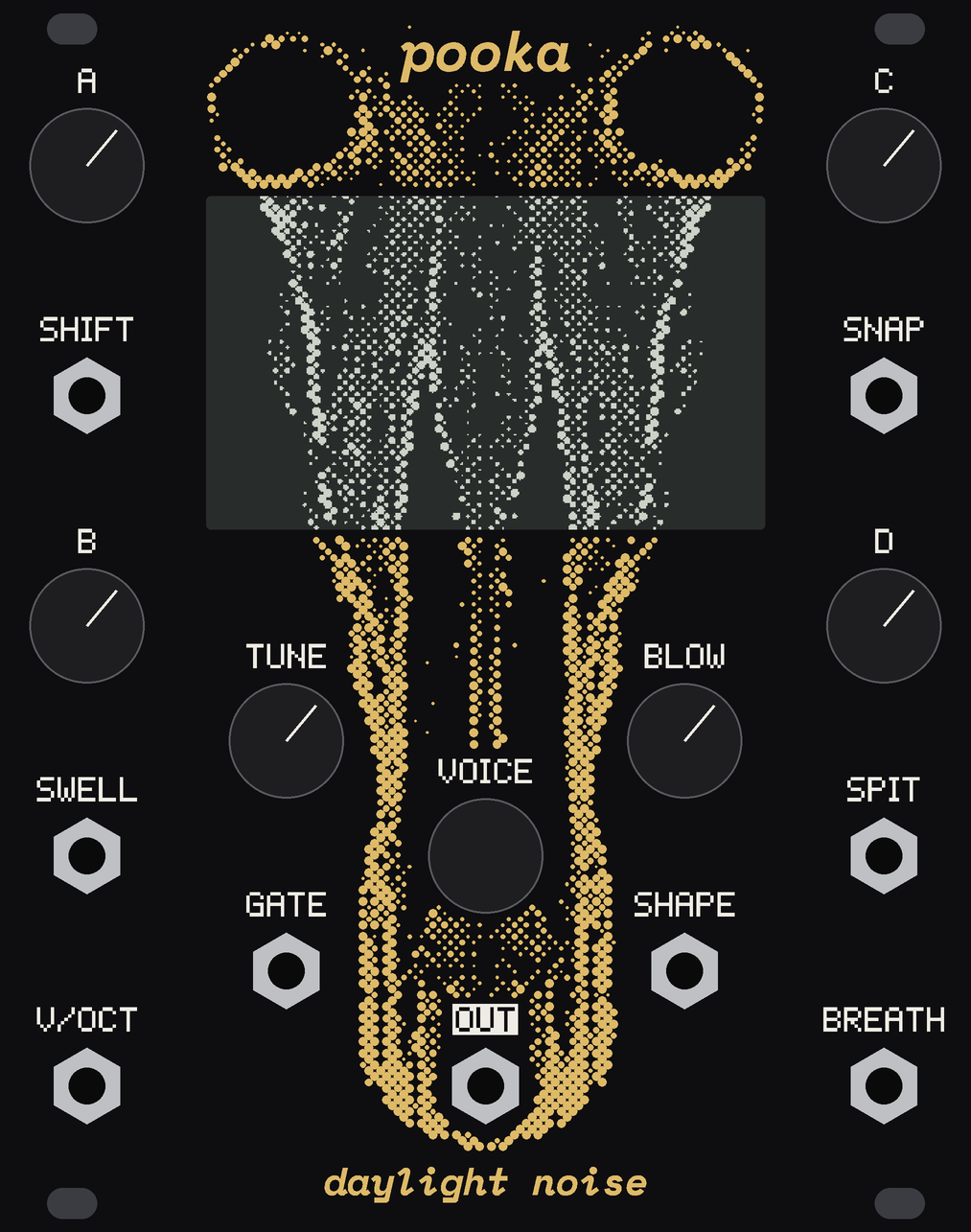
The Pooka front panel: black, with a horse's skull in gold halftone dots that runs on across the dark screen, its eye sockets either side of the name at the top and its teeth round the OUT jack at the bottom; six knobs, an encoder and nine jacks, each one mirrored by its twin across the middle.

The screen as the firmware's desktop simulator draws it: each voice in turn, without sound.

The voices

Five so far, all in one firmware; VOICE or SHAPE picks one. Each is a physical model of its instrument, not a sample, computed 48,000 times a second: lips that open once a period at exactly the V/OCT pitch and drive a bore, vocal folds that drive five formant resonators, or strings as delay loops, a bowed one correcting its own pitch by ear.

Every voice has the same four knobs, A to D, each changing one part of the instrument, in sound and on the screen. Play one to hear a riff while they turn one after another, then all four together.

Horns and a voice

CARNYX

An Iron Age war horn: a bronze trumpet held upright, taller than its player, with a boar's head for a bell. The one found at Deskford in Scotland had a moving wooden tongue.

  • LENGTH: the bore's length. Whole harmonics ring clean; the settings between them growl.
  • HEAD: from a boar (small, bright, nasal) to, past the middle, a dragon (big, dark, hollow).
  • JAW: muffled with the jaw closed, blaring wide open.
  • TONGUE: the flapping tongue, from a flutter to a rattle.

Each note starts with a bark.

CONCH

A seashell blown through a hole at its spire: one of the oldest horns there is, made all round the world for thousands of years.

  • WHORLS: how many turns the shell has, and so the bore's length.
  • FLARE: a wider lip is brighter and louder.
  • HAND: a hand pushed into the opening muffles the note and flattens it by up to a semitone.
  • CRACK: a cracked shell, a rough, unstable buzz.

BANSHEE

The bean sí of Irish legend, whose keening warns of a death: a voice that runs from a sung note to a scream.

  • VOWEL: oo, oh, ah, eh, ee.
  • STRAIN: sung, then yelped, then screamed: pressed folds, rasp, and the voice splitting an octave down.
  • CRUSH: drive, then the grit of an old sound chip, its sample rate locked to the pitch so the grit stays in tune.
  • WASH: reverb, then echoes timed from GATE, fed back through a saturator.

Each gate scoops up into its note, and a held note grows a vibrato.

The bard's strings

LYRE

Six plucked strings on a soundbox with arms of horn. A burnt lyre bridge from a cave on Skye, about 2,300 years old, is the oldest piece of a stringed instrument found in western Europe.

  • STRINGS: gut (warm and short) to bronze wire (bright, long and shimmering, ringing in sympathy).
  • BODY: a small box is tight and nasal, a big one deep and resonant.
  • PLUCK: a fingertip at the middle (round, hollow) to a nail by the bridge (bright, twangy).
  • BRAY: bray pins: strings played hard buzz against them, then clear as the notes fade.

Notes ring on across the six strings, which resonate with each other.
CRWTH

The Welsh bowed lyre, with two drone strings beside the fingerboard, played until around 1800. Its round soundholes become the beast's eyes.

  • BOW: bowed by the fingerboard (soft, round) or toward the bridge (edgy, nasal).
  • BODY: a small box is thin, a big one dark and woody.
  • DRONES: the melody alone, then drones on the home key and its fifth.
  • ROSIN: from a smooth bow to a gritty, raucous one.

Each gate turns the bow round for a new stroke.

The screen

A 2.7-inch Sharp memory LCD, run dark. The skull on the panel runs on across it, dot for dot, so it's never cut. In front of it stands the voice you've picked, in 3D, lit from below like the skull and rebuilt from the knobs about 20 times a second. Touch a knob and the camera flies to the part it changes: the jaw, the bell, the bow. The names round the edge sit beside the knobs they belong to.

The panel

The púca (say POO-kuh) is the shapeshifter of Irish folklore, most often a black horse with burning eyes. Its nearest kin is the Mari Lwyd, the horse's skull that Welsh wassailers carry from door to door at midwinter, and that skull fills the panel: its sockets either side of the name, its face running on across the screen, its incisors round OUT, in 1,411 dots of bare gold. Every part has its twin across the middle, knob for knob and jack for jack.

Inside

The Pooka front panel, with its knobs and jacks.

Drag to look around. Lift the panel to see the screen on its header; turn it round for the RP2350 on the back.

Specs

Format

Standard
Eurorack, 3U
Width
20 HP (101.3 × 128.5 mm)
Panel
FR4, black mask, bare gold (ENIG) art, white labels
Screen
2.7″ Sharp memory LCD, 400 × 240, run dark, about 20 frames a second
Controls
6 knobs (A to D, TUNE, BLOW); VOICE, an encoder that pushes
Power
About 90 mA on +12 V, 10 mA on −12 V

I/O

Pitch in
V/OCT, −2 to +8 V
Gate in
GATE, over 1.4 V
CV in
BREATH, 0 to 8 V; SHAPE, 0 to 5 V; SHIFT, SWELL, SNAP, SPIT, ±5 V
Audio out
OUT, ±5 V
USB
USB-C, for firmware

Engine

Brain
RP2350 at 153.6 MHz: one core makes the sound, the other draws the screen
Audio
48 kHz into a PCM5102A DAC
Voices
5 so far; a new one is new firmware
Pitch
0.7 cents worst error, 65 Hz to 1 kHz. Horns within 0.2 cents from 41 to 523 Hz, strings from 65 Hz to 1 kHz.
Firmware
One, with every voice: drag a .uf2 file onto the module

Nothing's for sale yet.

The boards are drawn in KiCad and the firmware builds, but no Pooka has been built yet. Every sound and every screen on this page comes from the firmware running in its desktop simulator.