the room, upside down
20 HP
A real lens looks out of the panel and throws what it sees onto a small round glass: a real image, no pixels, in the room's own colours. Behind the same lens a sensor reads the same picture, and one line of it is your wave. A blank wall is a sine. Everyone who walks past is in the sound.
Your camera is off until you press that. Nothing's recorded or sent, and it stays on this page.
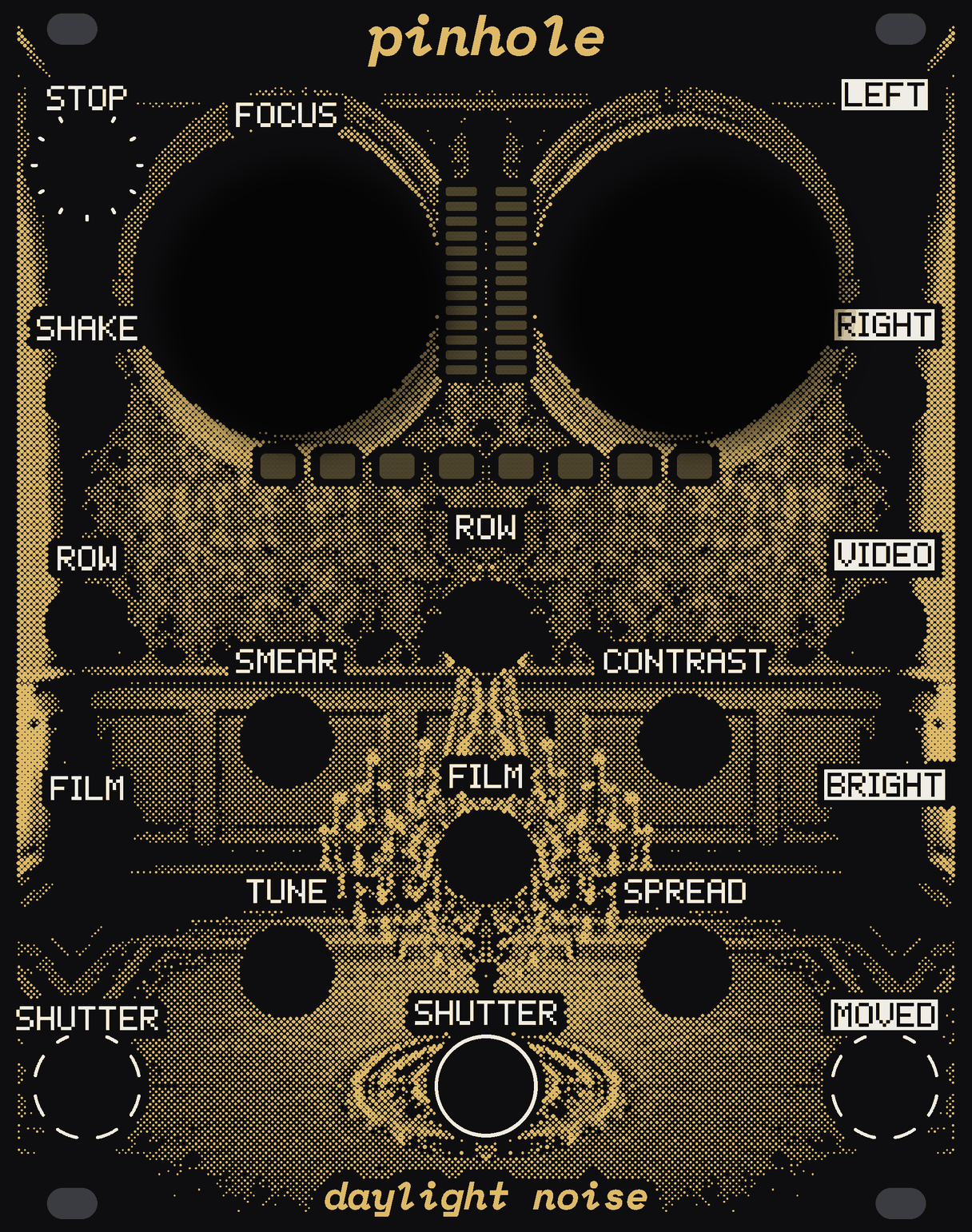
Hold your hand up to it: drag on the glass. Cover the lens: hold it. Focus: turn the ring round the lens as you would a knob. SHUTTER: press it to hold a picture and keep it. Turn a knob: drag it or tap either side of it, roll the wheel over it or use the arrow keys; a double click puts a knob back. The patches step on by themselves until you touch something.
example patches
The real one has a real lens and a real image on real glass, as bright as the room and no brighter. A browser has neither, so here a photograph of a small room stands in, with a lamp, someone walking through and a model of the sensor's grain, or your own webcam if you ask. The line across the glass is the page's: the module marks it on the ruler beside the glass. The engine that turns a line into a wave, the exposure, the roll and everything else the module does with the picture are as designed, running in your browser. The tune and the drums are stand-ins.
It's the oldest optical trick there is. Light from the room comes in through a lens, turns twice behind the panel and lands on a small dark glass: a real picture, no pixels, soft and dim and in colour. It's upside down, and it moves the way you move. It's there with the power off. It's only ever as bright as the room: in a lit room you'll want to lean in, and at a dark show what you'll see on it is the lit stage, not the crowd. Behind the same lens a small grey sensor reads the same picture, sixty times a second.
Nothing is kept but what SHUTTER keeps, eight small grey pictures, and it has no network: nothing it sees leaves the module except through its jacks.
The brightness along one line of the picture is one cycle of an oscillator. The line's faded to nothing at both ends, so it closes into a loop, and that means anything flat is a sine: a blank wall, a dark room, a white sheet. Everything else in the room is a dent in that sine. A person against a bright window is a pulse wave as wide as they are, and when they move, it sweeps. You hear yourself.